Posted on
Apr 1, 2026
AI Documentation for Emergency Medicine (ER)
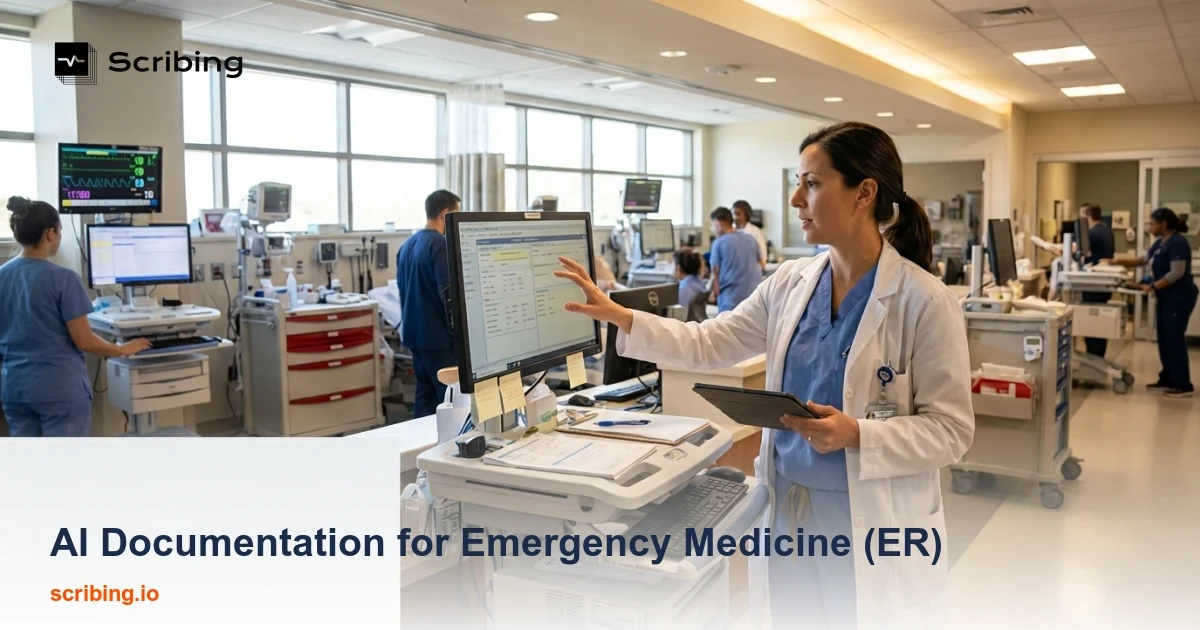
AI Documentation for Emergency Medicine: Revolutionizing the ER Workflow
The emergency department is one of the most demanding environments in healthcare. Between life-threatening traumas, complex medical presentations, and an endless stream of patients, ER physicians face immense pressure to deliver exceptional care while maintaining thorough documentation. Now, artificial intelligence is stepping in to help—and the results are transforming emergency medicine.
The Documentation Burden in Emergency Medicine
Emergency physicians spend an estimated 43% of their time on documentation and administrative tasks. In a specialty where every second counts, this documentation burden isn't just frustrating—it can impact patient care. AI-powered documentation tools are emerging as a critical solution, helping physicians capture accurate, compliant records without sacrificing precious time at the bedside.
Understanding ED Visit Coding: 99283, 99284, and 99285
Accurate coding is essential for appropriate reimbursement and compliance. Emergency department visits are categorized by complexity and resource utilization:
99283 - Moderate Severity ED Visit
This code represents patients with problems of moderate severity requiring expanded evaluation. Examples include simple lacerations, urinary tract infections, or mild asthma exacerbations. Documentation must support the medical decision-making complexity and time spent.
99284 - High Severity ED Visit
Reserved for patients presenting with high-severity problems requiring urgent evaluation. Think chest pain requiring cardiac workup, significant abdominal pain, or moderate injuries. The documentation must clearly reflect the physician's clinical reasoning and the resources utilized.
99285 - High Severity ED Visit with Immediate Threat
This highest-level code applies when patients present with conditions posing an immediate, significant threat to life or physiologic function. Major trauma, acute MI, stroke, and severe sepsis fall into this category. Comprehensive documentation is absolutely critical.
Critical Care Time and Medical Decision-Making (MDM)
The Importance of Critical Care Documentation
When patients require critical care services, proper documentation of critical care time becomes paramount. According to CMS guidelines, critical care involves direct delivery of medical care for a critically ill or injured patient where there is an acute impairment of one or more vital organ systems with a high probability of imminent or life-threatening deterioration.
Key documentation requirements include:
Total time spent in critical care activities
Specific interventions performed
The patient's critical condition and why they required this level of care
Time must exclude separately billable procedures
Medical Decision-Making in the ED
The 2021 E/M guidelines shifted focus to either total time OR medical decision-making as the basis for code selection. For emergency medicine, MDM typically drives code selection and encompasses:
Number and complexity of problems addressed
Amount and complexity of data reviewed and analyzed
Risk of complications, morbidity, or mortality
AI documentation tools excel at capturing the nuanced clinical reasoning that supports appropriate MDM levels, automatically identifying elements that physicians might overlook in their manual documentation.
How AI Transforms ER Documentation
Real-Time Capture and Ambient Listening
Modern AI documentation solutions use ambient listening technology to capture physician-patient interactions in real time. This means the clinical narrative is recorded naturally, preserving important details that might otherwise be lost in the chaos of a busy ED.
Intelligent Code Suggestion
AI systems can analyze documentation and suggest appropriate E/M codes based on documented elements. This helps ensure:
Proper capture of 99283, 99284, or 99285 level visits
Accurate critical care time documentation
Complete MDM element capture
Compliance Safeguards
Built-in compliance checks help identify documentation gaps before claims are submitted, reducing audit risk and ensuring medical necessity is clearly established.
The Future of Emergency Medicine Documentation
As AI technology continues to evolve, we can expect even more sophisticated tools that:
Predict documentation needs based on chief complaint
Auto-generate procedure notes
Integrate seamlessly with existing EHR systems
Provide real-time coding feedback
Conclusion
AI documentation represents a fundamental shift in how emergency medicine handles the administrative burden of medical records. By automating capture of critical elements—from proper E/M code support for 99283-99285 visits to accurate critical care time tracking and comprehensive MDM documentation—these tools allow emergency physicians to focus on what matters most: saving lives.
The emergency department will always be high-pressure, but AI documentation ensures that paperwork no longer has to be part of that pressure.
Interested in learning how AI documentation can transform your emergency department workflow? The future of ER documentation is here—and it's intelligent.


