Posted on
Aug 1, 2026
AI Documentation for Geriatric Care
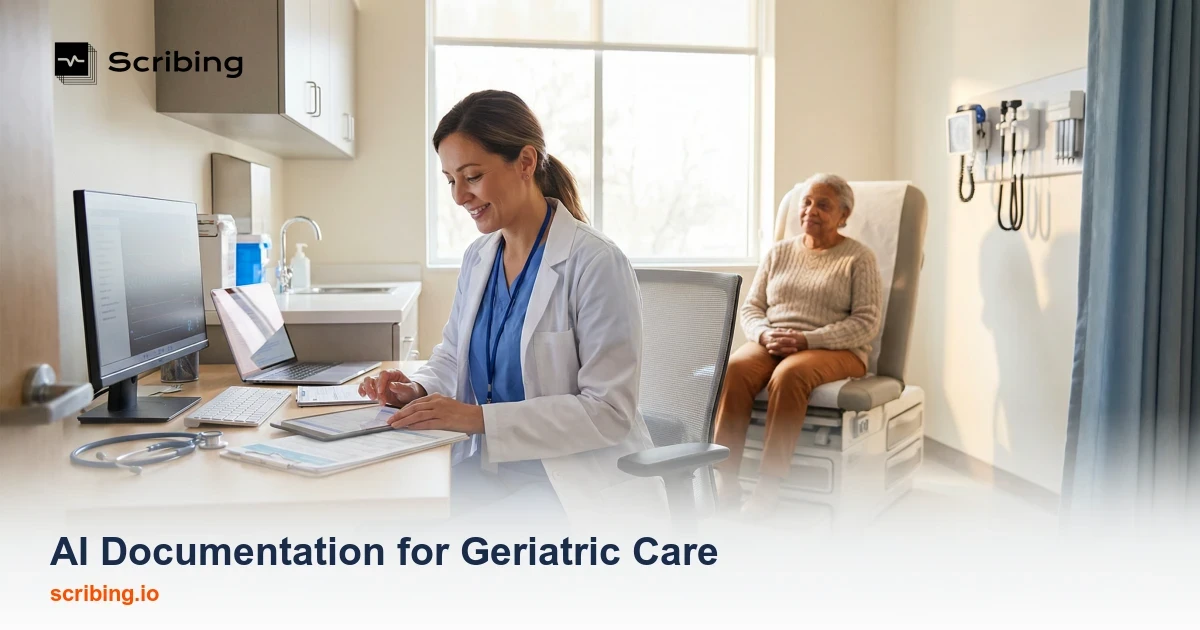
AI Documentation for Geriatric Care: Navigating Cognitive Assessments, Frailty Scores, and Critical Consent Requirements
As our population ages, geriatric care has become one of the most complex and documentation-intensive areas of medicine. From cognitive assessments to advance care planning conversations, geriatricians and primary care physicians must balance comprehensive patient care with meticulous documentation requirements. Artificial intelligence is emerging as a powerful ally in this challenging landscape.
The Growing Complexity of Geriatric Documentation
Caring for elderly patients involves layers of clinical, legal, and ethical considerations that demand precise documentation. Unlike routine visits, geriatric encounters often require:
Detailed cognitive evaluations
Frailty assessments that influence treatment decisions
Sensitive conversations about end-of-life preferences
Coordination with family members and caregivers
Compliance with specific billing codes and legal requirements
The administrative burden can be overwhelming, often pulling clinicians away from what matters most—their patients.
Understanding Key Billing Codes in Geriatric Care
CPT 99483: Cognitive Impairment Assessment and Care Planning
This critical code covers the comprehensive assessment and care planning services for patients with cognitive impairment. To properly bill 99483, documentation must include:
Cognition-focused evaluation including medical history and current cognitive status
Functional assessment covering activities of daily living (ADLs) and instrumental activities
Use of standardized instruments for staging dementia severity
Medication reconciliation with review of high-risk medications
Evaluation for neuropsychiatric symptoms and safety concerns
Identification of caregiver needs and knowledge gaps
Development of a care plan with specific interventions
This service requires approximately 50 minutes of face-to-face time and generates substantial documentation requirements that AI can help streamline.
CPT 99497: Advance Care Planning (ACP)
Advance care planning conversations are essential for geriatric patients but often go undocumented or inadequately captured. CPT 99497 covers the first 30 minutes of ACP and requires documentation of:
Voluntary nature of the discussion
Explanation of advance directives
Discussion of patient's values, goals, and preferences
Review of prognosis when appropriate
Documentation of who was present during the conversation
Cognitive Assessments and Legal Requirements
Proper documentation of cognitive assessments carries significant legal weight. These evaluations can determine:
Decision-making capacity for medical and legal matters
Driving fitness evaluations
Guardianship and conservatorship proceedings
Eligibility for certain care levels and services
AI documentation tools must capture not just the scores but the clinical context—the patient's baseline function, any acute factors affecting performance, and the clinician's interpretation of results. Legal defensibility depends on this comprehensive approach.
Common Cognitive Assessment Tools Requiring Documentation
Mini-Mental State Examination (MMSE)
Montreal Cognitive Assessment (MoCA)
Saint Louis University Mental Status (SLUMS)
Clock Drawing Test
Mini-Cog
Each tool has specific scoring criteria and normative data that should be referenced in documentation.
Frailty Scores: Why Precision Matters
Frailty assessments have moved from academic exercises to clinical necessities. These scores now influence:
Surgical candidacy decisions
Chemotherapy protocols
Hospitalization versus outpatient management
Prognostication and care planning
Documentation must capture the specific frailty instrument used, individual component scores, and clinical implications. Common tools include:
Clinical Frailty Scale (CFS)
Fried Frailty Phenotype
FRAIL Scale
Edmonton Frail Scale
AI systems can prompt clinicians to complete all components and flag inconsistencies between documented frailty levels and proposed treatment plans.
How AI Enhances Geriatric Documentation
Automated Assessment Integration
Modern AI documentation platforms can:
Auto-populate standardized assessment scores from integrated cognitive testing
Calculate frailty indices from documented clinical findings
Flag missing required elements for complete billing code capture
Generate longitudinal comparisons showing cognitive trajectory
Natural Language Processing for Complex Conversations
Advance care planning discussions are nuanced and deeply personal. AI tools equipped with natural language processing can:
Capture the essence of goals-of-care conversations
Identify key phrases indicating patient preferences
Document family dynamics and surrogate decision-makers
Ensure required elements for 99497 billing are present
Time Savings and Accuracy
Studies suggest that AI documentation can reduce physician documentation time by 30-50% while improving completeness. In geriatrics, where visits often run long and complex, this efficiency translates directly to:
More face-to-face time with patients and families
Reduced after-hours documentation ("pajama time")
Decreased physician burnout
Improved billing capture for services rendered
Best Practices for AI-Assisted Geriatric Documentation
1. Verify Consent Documentation
AI systems should prompt verification that appropriate consent was obtained, particularly for:
Cognitive testing (patient awareness of testing purpose)
Advance care planning discussions
Information sharing with family members
2. Maintain the Human Element
While AI captures clinical data efficiently, the documentation should still reflect:
The physician's clinical judgment and reasoning
Patient and family preferences expressed in their own words
The therapeutic relationship and trust-building efforts
3. Regular Audit and Quality Review
Implement periodic reviews of AI-generated documentation to ensure:
Legal requirements are consistently met
Billing codes are appropriately supported
Clinical nuances are accurately captured
4. Train Staff on AI Capabilities and Limitations
Ensure all team members understand:
What the AI can and cannot document
When manual override or addition is necessary
How to review and approve AI-generated notes
The Future of AI in Geriatric Care Documentation
Emerging technologies promise even more sophisticated support:
Predictive analytics identifying patients at risk for cognitive decline
Voice-activated documentation allowing hands-free note generation during examinations
Automated caregiver communication summaries
Real-time coding suggestions during encounters
Conclusion
AI documentation represents a significant opportunity to improve geriatric care while meeting complex legal and billing requirements. By properly documenting cognitive assessments (99483), advance care planning conversations (99497), and frailty evaluations, clinicians can ensure both optimal patient care and practice sustainability.
The key is implementing AI as a tool that enhances—rather than replaces—the deeply human work of caring for our elderly patients. When documentation flows seamlessly, physicians can return their focus to where it belongs: on the patient in front of them, their family, and the meaningful conversations that define quality geriatric care.
This blog post is intended for informational purposes only and does not constitute legal or billing advice. Healthcare providers should consult with their compliance teams and legal counsel regarding specific documentation and billing requirements.


