Posted on
Jan 10, 2026
AI Scribing for Hospitalists
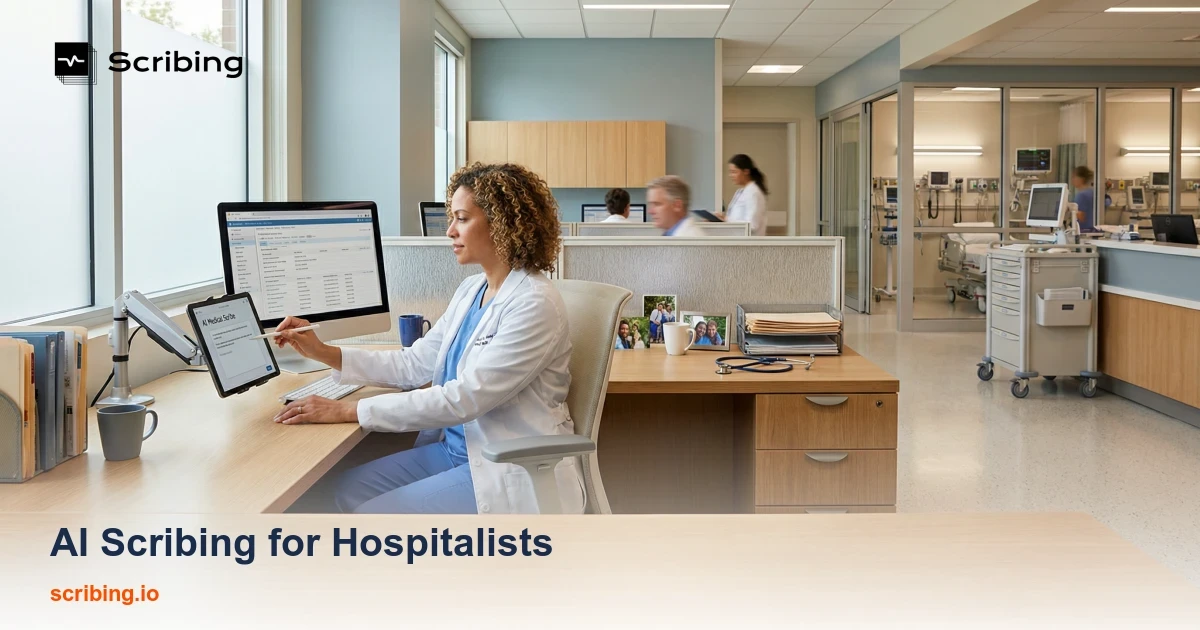
AI Scribing for Hospitalists: Transforming Inpatient Documentation
As a hospitalist, you know the reality all too well: hours spent documenting admission H&Ps and discharge summaries, often long after your shift should have ended. With patient loads that can exceed 15-20 patients daily, the documentation burden has become one of the most challenging aspects of hospital medicine. AI scribing technology is now offering hospitalists a path back to what matters most—patient care.
The Documentation Challenge in Hospital Medicine
Hospitalists face a unique documentation landscape. Unlike outpatient settings with brief follow-up visits, inpatient medicine demands comprehensive documentation at critical junctures: the initial admission and the discharge. These documents aren't just billing requirements—they're legal necessities that ensure continuity of care, satisfy regulatory requirements, and protect both patients and physicians.
The Admission History and Physical (H&P) must be completed within 24 hours of admission per CMS requirements and Joint Commission standards. Meanwhile, Discharge Summaries serve as the critical handoff document that follows patients back to their primary care providers and specialists.
Understanding the Billing Framework
AI scribing for hospitalists primarily supports documentation for two key code families:
Initial Hospital Care (99221-99223)
These codes capture the complexity of your admission work:
99221: Low complexity admission
99222: Moderate complexity admission
99223: High complexity admission
Proper documentation must support the medical decision-making complexity you're billing for. AI scribes can help ensure that your thought process, differential diagnosis, and treatment rationale are captured completely—not abbreviated due to time pressure.
Discharge Day Management (99238-99239)
99238: Discharge day management, 30 minutes or less
99239: Discharge day management, more than 30 minutes
Discharge documentation requires summarizing the hospital course, reconciling medications, coordinating follow-up care, and communicating critical information. AI scribing can help structure these complex summaries efficiently.
How AI Scribing Works for Hospitalists
Modern AI scribing solutions for hospital medicine work by:
Ambient listening during patient encounters, capturing the natural conversation
Intelligent structuring of information into appropriate H&P or discharge summary formats
Integration with EHR templates specific to your hospital's requirements
Real-time or near-real-time draft generation for physician review and approval
The technology understands medical terminology, recognizes the difference between admission and discharge contexts, and can distinguish between information from the patient versus family members or nursing staff.
Consent Considerations for Inpatient AI Scribing
Patient consent for AI-assisted documentation in the hospital setting requires thoughtful implementation. Most facilities adopt one of these approaches:
Verbal consent with documentation: The physician informs the patient that an AI assistant will help with documentation, and consent is noted in the record
Integration into general admission consent: Some hospitals include AI scribing disclosure in their standard admission paperwork
Posted signage with opt-out option: Patients are informed of the technology with the ability to decline
Given the vulnerability of hospitalized patients and the sensitive nature of inpatient conversations, clear communication about how the technology works—and how their information is protected—builds trust and satisfies ethical obligations.
The Legal Documentation Imperative
Both Admission H&Ps and Discharge Summaries carry significant legal weight:
Admission H&P Requirements:
Must document medical necessity for inpatient admission
Establishes baseline status for comparison
Required within 24 hours (or 30 days prior with 24-hour update)
Serves as foundation for the entire hospital stay
Discharge Summary Requirements:
Must be completed within 30 days (though best practice is within 24-48 hours)
Required elements include reason for hospitalization, significant findings, procedures performed, discharge condition, discharge medications, and follow-up instructions
Critical for care transitions and reducing readmissions
AI scribing helps ensure these legal requirements are met consistently, with complete documentation that captures the full scope of clinical decision-making.
Benefits Specific to Hospital Medicine
Time Recovery
Hospitalists report saving 1-2 hours per shift with AI scribing—time that can be redirected to patient care, teaching, or simply going home on time.
Improved Documentation Quality
When you're not rushing to document between admissions, the quality improves. AI scribes capture details that might otherwise be forgotten or abbreviated.
Better Work-Life Balance
Hospital medicine already demands irregular hours. Reducing after-shift documentation can significantly impact burnout and career sustainability.
Enhanced Discharge Planning
More complete documentation supports better care transitions, potentially reducing readmission rates and improving patient outcomes.
Implementation Considerations
When evaluating AI scribing for your hospitalist practice, consider:
Workflow integration: Does it work with your rounding style? Can it handle bedside documentation?
EHR compatibility: Seamless integration with your hospital's system is essential
Template flexibility: Can it accommodate your facility's specific documentation requirements?
HIPAA compliance: Ensure the solution meets all security and privacy requirements for protected health information
Physician oversight: The final document must always be reviewed and authenticated by the physician
The Future of Hospitalist Documentation
AI scribing represents more than a time-saving tool—it's a fundamental shift in how hospitalists can practice. By handling the mechanical aspects of documentation, these technologies free physicians to focus on clinical reasoning, patient communication, and the complex decision-making that defines hospital medicine.
As the technology continues to evolve, we can expect even deeper integration with clinical decision support, predictive analytics, and care coordination tools. For hospitalists drowning in documentation, AI scribing offers a lifeline back to the practice of medicine they trained for.
Ready to explore how AI scribing can transform your hospitalist practice? The documentation burden doesn't have to define your career. Modern solutions exist that can help you reclaim your time while maintaining—and even improving—the quality of your clinical documentation.


