Posted on
Feb 11, 2026
AI Scribing for Physical Therapists (PT)
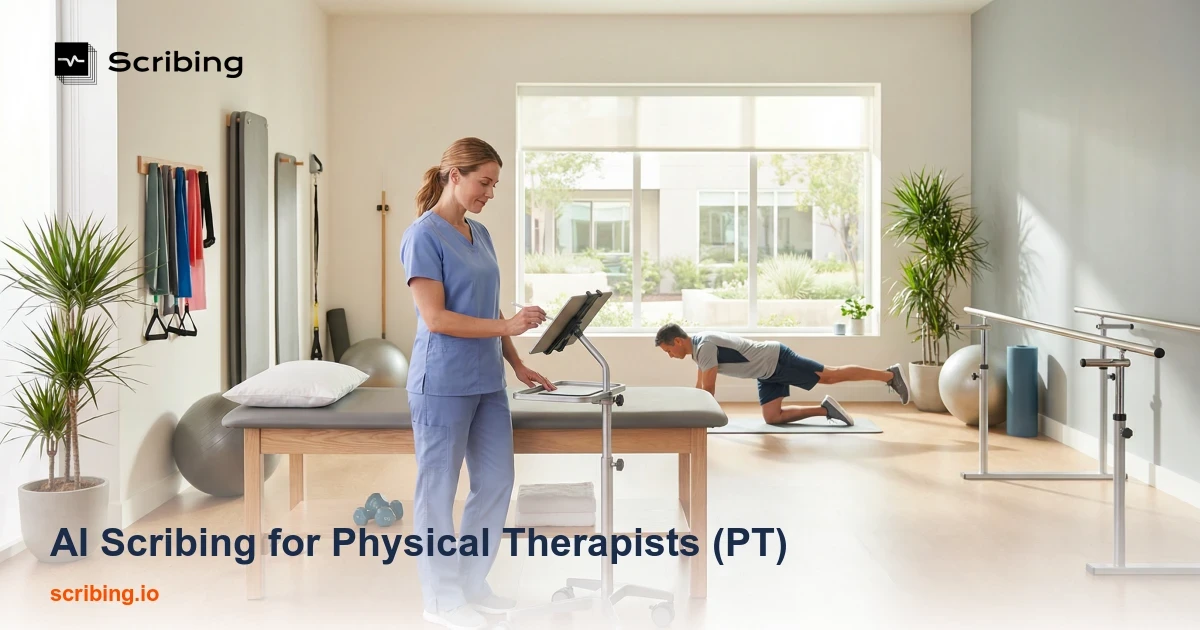
AI Scribing for Physical Therapists: Revolutionizing Documentation While You Focus on Patient Care
As a physical therapist, you entered the profession to help patients recover, regain mobility, and improve their quality of life—not to spend hours hunched over a computer typing notes. Yet documentation demands continue to grow, eating into valuable treatment time and contributing to burnout across the profession.
Enter AI scribing technology: a game-changing solution that's transforming how PTs handle their documentation burden while maintaining compliance and improving note quality.
The Documentation Challenge in Physical Therapy
Physical therapists face unique documentation requirements that set them apart from other healthcare providers. Between functional progress notes, daily treatment notes, and the need to justify medical necessity for every intervention, the paperwork can feel endless.
The reality? Many PTs report spending 1-2 hours daily on documentation alone—time that could be spent with patients or, frankly, with their families after work.
Understanding Your Documentation Requirements
Functional Progress Notes
Functional progress notes are the backbone of PT documentation. These notes must clearly demonstrate:
The patient's current functional status
Measurable progress toward established goals
Objective data supporting continued treatment
Clinical reasoning for the treatment plan
Payers scrutinize these notes carefully. Without clear documentation of functional improvement, claims get denied, and patients lose access to necessary care.
Daily Treatment Notes
Every session requires documentation that captures what was done, how the patient responded, and why the interventions were appropriate. These notes must be thorough yet efficient—a challenging balance when you're seeing patients back-to-back.
Documenting Common CPT Codes with AI Assistance
AI scribing tools excel at capturing the specific elements required for frequently billed PT services. Let's look at three of the most common codes:
97110 - Therapeutic Exercise (TherEx)
When documenting therapeutic exercise, your notes must include:
Specific exercises performed
Sets, reps, resistance levels, or duration
Body regions targeted
Patient performance and tolerance
How exercises relate to functional goals
An AI scribe can listen to your verbal cues during treatment—"Let's do 3 sets of 10 bridges with the yellow band"—and automatically populate these details into structured note formats.
97140 - Manual Therapy
Manual therapy documentation requires particular attention to:
Specific techniques applied (soft tissue mobilization, joint mobilization, manual traction, etc.)
Body structures treated
Grade of mobilization when applicable
Patient response to intervention
Time spent in skilled, hands-on treatment
AI scribing captures your real-time descriptions of techniques, ensuring nothing gets lost between the treatment table and the computer screen.
97112 - Neuromuscular Re-education
For neuromuscular re-education, documentation should reflect:
Movement patterns addressed
Balance and coordination activities
Proprioceptive training components
Functional task practice
Objective measures of performance
How AI Scribing Works in a PT Setting
Modern AI scribing solutions for physical therapy typically operate through:
Ambient listening during patient encounters
Real-time transcription of verbal documentation
Intelligent structuring of notes into compliant formats
Integration with your existing EMR system
The best solutions understand PT-specific terminology, recognize when you're describing different interventions, and automatically organize information under appropriate headings.
Benefits Beyond Time Savings
Improved Note Quality
When you're not rushing to remember details hours later, your notes become more accurate and comprehensive. AI captures specifics in the moment—exact measurements, patient quotes, and clinical observations that might otherwise be forgotten.
Better Compliance
AI scribing tools can be programmed to prompt for required elements, ensuring your notes meet payer requirements and reduce denial rates.
Enhanced Patient Interaction
Without a laptop creating a barrier between you and your patient, you can maintain eye contact, demonstrate exercises more effectively, and build stronger therapeutic relationships.
Reduced Burnout
Documentation burden is a leading contributor to PT burnout. Reclaiming even 30-60 minutes daily can dramatically improve work-life balance and job satisfaction.
Choosing the Right AI Scribing Solution
When evaluating AI scribing options for your practice, consider:
PT-specific functionality: Does it understand therapy terminology and billing codes?
EMR integration: Will it work with your current system?
HIPAA compliance: Is patient data protected?
Customization options: Can you adjust templates to match your documentation style?
Learning curve: How quickly can you and your staff adapt?
The Future of PT Documentation
AI scribing isn't about replacing clinical judgment—it's about freeing you to exercise that judgment more effectively. As these tools continue to evolve, we'll see even more sophisticated features: automatic goal tracking, predictive analytics for treatment planning, and seamless coordination with other providers.
Take the Next Step
The physical therapists who thrive in today's healthcare environment will be those who embrace technology that enhances their practice without compromising care quality. AI scribing represents one of the most practical, immediately beneficial technologies available to PTs today.
Your patients deserve your full attention. Your notes deserve to be thorough and compliant. And you deserve to leave work at a reasonable hour. AI scribing can help make all three possible.
Ready to explore how AI scribing can transform your PT practice? The documentation burden doesn't have to define your career. It's time to get back to what you do best—helping patients move better and live better.


