Posted on
Jan 25, 2026
Why Chiropractors Are Still Losing Hours to Repetitive Adjustment and Treatment Documentation Every Visit in 2026 (And How to Stop)
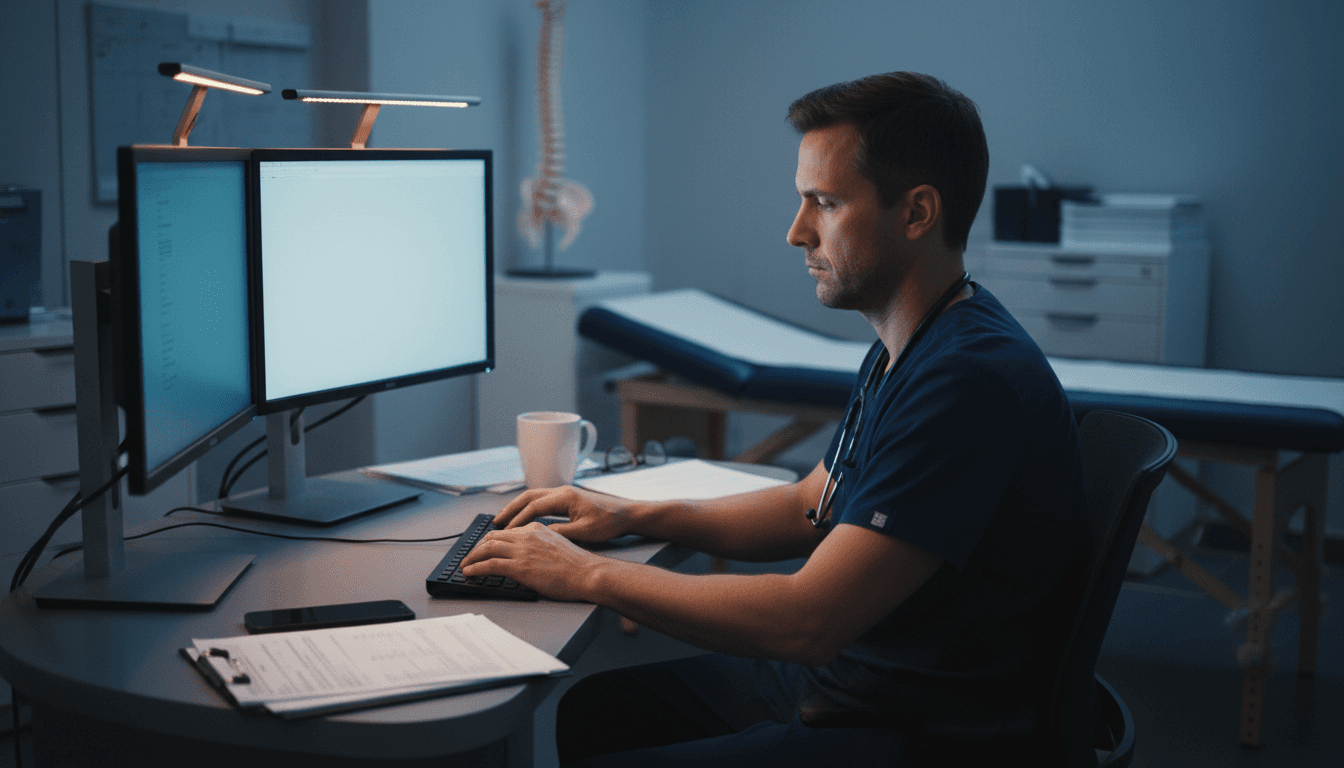
You became a chiropractor to help people move better, feel better, and live better. Not to type the same spinal adjustment notes into an EHR system forty times a day. Yet here you are — documenting nearly identical thoracic manipulations, extremity adjustments, and soft tissue therapies visit after visit, patient after patient, until the language starts to blur together and your fingers ache almost as much as your patients' spines did before they walked in.
If that sounds familiar, you're not alone. And you're not doing anything wrong. The documentation burden placed on chiropractors in 2026 is structurally broken — and it's time to talk about why.
The Problem No One Talks About
Here's what nobody warned you about in chiropractic school: the sheer repetitiveness of clinical documentation would become one of the most draining parts of your career.
Think about your typical day. A patient comes in for their sixth visit in a lumbar disc protocol. You perform a diversified adjustment at L4-L5, do some myofascial release on the QL, apply interferential current for twelve minutes, and send them home with updated home exercises. The clinical encounter takes twelve minutes. The documentation? Another eight to ten — often more if you're being thorough about differentiating this visit from the last five.
Now multiply that by twenty-five or thirty patients. You're spending hours each day writing notes that are functionally similar to notes you wrote yesterday, and the day before, and the day before that. The adjustments change by a segment. The treatment times shift by a few minutes. The subjective complaints evolve incrementally. But the documentation process treats every visit as if you're starting from scratch.
This isn't a minor inconvenience. It's a systemic problem that erodes your clinical focus, your energy, and your love for the work itself.
Why This Keeps Happening
Repetitive documentation persists in chiropractic practice for several deeply entrenched reasons, and none of them are your fault.
EHR systems weren't built for chiropractic workflows. Most electronic health records were designed with primary care or hospital medicine in mind. They don't understand that a chiropractor might perform the same category of adjustment across dozens of patients daily, with meaningful but subtle variations that matter clinically but are tedious to document individually. The templates are either too rigid — forcing you into click-heavy dropdown menus — or too open-ended, leaving you to free-type the same phrases over and over.
Compliance requirements demand specificity. Insurance payers and Medicare require that each visit note demonstrates medical necessity, documents the specific segments adjusted, records the patient's subjective response, and differentiates from prior visits. You can't simply write "same as last visit." Every note must stand on its own, even when the clinical reality is incremental progress within a consistent treatment plan.
Copy-forward is a trap. Many chiropractors resort to cloning previous notes and making small edits. It saves time in the short run, but it creates audit risk. Cloned notes are one of the most common red flags in payer audits, and they can result in recoupment demands, penalties, or worse. You know this, so you either clone and worry, or you write fresh and lose time. Neither option feels right.
Your training emphasized clinical excellence, not documentation efficiency. Chiropractic education prepares you to assess, diagnose, and treat. It doesn't prepare you for the administrative reality that documentation will consume a third of your working hours — or that the most repetitive part of your clinical life will be describing what you do, rather than doing it.
The Real Cost of Repetitive Adjustment and Treatment Documentation Every Visit
The cost goes far beyond time, though time alone would be enough to demand a solution.
Clinical burnout. When you spend your evenings catching up on notes — writing the same adjustment descriptions you wrote that morning — you're not resting, you're not with your family, and you're not recharging for tomorrow's patients. Repetitive documentation is one of the leading drivers of burnout among chiropractors, not because any single note is hard, but because the cumulative weight of writing the same things hundreds of times per week is psychologically exhausting.
Reduced patient volume or quality. Every minute spent documenting is a minute not spent with patients. Some chiropractors cap their schedules to leave time for notes. Others rush through documentation to see more patients, producing notes that are thin, vulnerable to audit, and clinically less useful. Either way, your practice suffers.
Inconsistent note quality. By patient twenty-five, your documentation is not as sharp as it was for patient three. Fatigue introduces errors — wrong segment listed, treatment time omitted, subjective complaint copied from the wrong visit. These small mistakes compound into real problems during audits or when continuity of care depends on accurate records.
Financial vulnerability. Insufficient or repetitive documentation is a leading cause of claim denials and audit recoupments in chiropractic. When every note looks the same, payers question whether the visits were truly necessary. When notes lack specificity, claims get denied. The documentation that's supposed to protect your revenue becomes the thing that undermines it.
Lost passion. This might be the most important cost. You chose this profession because you believe in the power of chiropractic care. Every hour spent on redundant paperwork is an hour that chips away at that belief — not because the work isn't meaningful, but because the administrative burden makes it feel less so.
What Leading Chiropractors Are Doing Differently in 2026
The chiropractors who have solved this problem didn't do it by typing faster, hiring more staff, or finding a better template. They did it by fundamentally changing how documentation happens.
The shift is simple in concept: instead of the chiropractor writing the note, the note writes itself — generated from the natural conversation and clinical encounter that's already happening in the treatment room.
AI-powered ambient medical scribing has matured significantly. In 2026, the technology can listen to a chiropractic encounter, understand the clinical context, identify the specific adjustments performed, capture the patient's subjective report, and produce a complete, compliant SOAP note — without the chiropractor touching a keyboard.
For repetitive visit documentation specifically, this is transformative. The AI doesn't get fatigued. It doesn't accidentally clone yesterday's note. It doesn't skip the segment listing or forget to document the treatment time. It captures what actually happened in this visit, every visit, with the specificity that compliance demands and the consistency that protects your practice.
Forward-thinking chiropractors are treating documentation as a solved problem — something that happens automatically in the background while they focus entirely on the patient in front of them.
How Scribing.io Solves Repetitive Adjustment and Treatment Documentation Every Visit
Scribing.io was built for exactly this problem. It's an AI medical scribe that listens to your clinical encounters and generates accurate, detailed documentation in real time — so you never have to write the same adjustment note twice.
It captures the nuance that matters. When you tell your patient, "I'm going to adjust T6-T7 today — it's still restricted on the right," Scribing.io translates that into proper clinical documentation: the specific segments, the listing, the technique. It understands chiropractic terminology and workflows because it was designed for healthcare providers who do hands-on, repetitive treatments.
Every note is unique because every visit is unique. Even when you're performing similar adjustments across a treatment plan, Scribing.io captures the specific subjective complaints, objective findings, and clinical reasoning from each encounter. No cloning. No copy-forward risk. Each note accurately reflects what happened that day, which is exactly what payers and auditors want to see.
It works the way you work. You don't need to change your clinical workflow. You don't need to dictate into a microphone using rigid commands. You talk to your patient, perform your adjustments, explain the home care — and Scribing.io handles the rest. The note is ready for your review before the patient has finished scheduling their next appointment.
It eliminates the after-hours documentation trap. When every note is generated during the encounter, there's nothing to catch up on at the end of the day. No stack of charts waiting. No evening documentation sessions. You finish your last patient and you're done — actually done.
It protects your practice. Detailed, visit-specific notes reduce claim denials, strengthen your position in audits, and create a clinical record that genuinely reflects the quality of care you provide. The documentation becomes an asset rather than a liability.
Getting Started Takes Less Than 10 Minutes
You don't need new hardware. You don't need to switch EHR systems. You don't need to block off an afternoon for training.
Scribing.io is designed to integrate into your existing workflow immediately. Sign up, familiarize yourself with the interface, and start your next patient encounter. By the time you're done with that first adjustment, you'll have a complete note waiting for your review — and you'll wonder how you ever practiced without it.
The chiropractors who adopt AI scribing don't go back. Not because the technology is flashy, but because it gives them back something they'd lost: the ability to be fully present with every patient, without paying for it in hours of documentation later.
If you're tired of writing the same adjustment notes over and over — if you're ready to reclaim your time, your energy, and your focus — this is the moment to make the change.
Try Scribing.io Free and see what your practice feels like when documentation is no longer on your shoulders.


