Posted on
Jan 29, 2026
Why Critical Care Physicians Are Still Losing Hours to High-Acuity ICU Documentation Burden and Complexity in 2026 (And How to Stop)
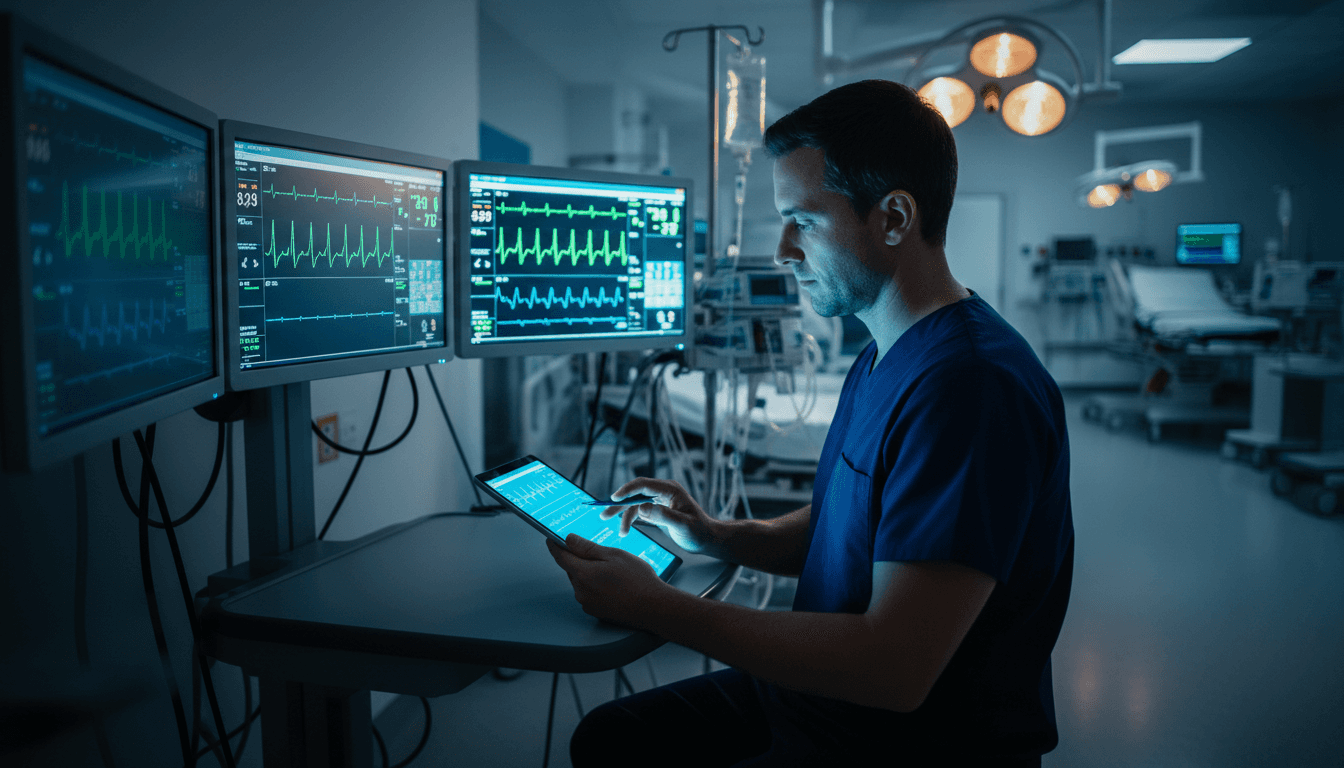
You didn't spend years of fellowship training to become the fastest typist in the ICU. Yet here you are — toggling between ventilator flowsheets, vasopressor titration logs, and multi-system progress notes at 2 AM, documenting a patient you already saved hours ago.
The Problem No One Talks About
Critical care medicine is arguably the most documentation-intensive specialty in all of healthcare. And yet, the conversation about documentation burden in the ICU rarely matches the severity of the problem.
Every shift, you manage patients on mechanical ventilation, continuous renal replacement therapy, multiple vasoactive drips, and complex sedation protocols — simultaneously. Each of those interventions generates its own cascade of required documentation: ventilator mode changes with corresponding ABG interpretations, hourly hemodynamic assessments, sedation scoring, nutrition calculations, daily spontaneous breathing trial documentation, and lines-tubes-drains inventories that change by the hour.
And that's just one patient. You're covering twelve. Maybe sixteen.
The note you write for a septic shock patient on three pressors with acute kidney injury, ARDS, and a new-onset atrial fibrillation isn't a simple progress note — it's a medical-legal document, a billing justification, a communication tool for the night team, and a clinical reasoning artifact, all compressed into one impossible deliverable. You know exactly how long these notes take because you feel every minute of it: the cognitive switching between the patient's bedside reality and the EHR's rigid templates, the redundant data entry that the system should handle but doesn't, the soul-crushing realization that you're spending more time documenting critical care than delivering it.
This isn't a minor inconvenience. This is a crisis hiding in plain sight.
Why This Keeps Happening
The ICU documentation problem persists in 2026 because it sits at the intersection of several compounding forces that no single intervention has adequately addressed.
EHR systems were never designed for critical care complexity. Most electronic health records were built around the outpatient encounter or the general medical admission. The ICU — where a patient's clinical status can change dramatically within minutes, where multiple organ systems fail simultaneously, and where dozens of data points need to be synthesized into a coherent clinical narrative — breaks these systems. Templates designed for a straightforward pneumonia admission collapse under the weight of a multi-organ failure case requiring ECMO.
Regulatory and billing requirements have only intensified. Critical care time-based billing (CPT 99291/99292) demands meticulous documentation of time spent, medical decision-making complexity, and the specific nature of the critical illness. CMS audits targeting critical care services mean that vague or incomplete documentation doesn't just risk communication failures — it risks revenue loss and compliance violations. The documentation bar is higher for intensivists than almost any other specialty, and it keeps rising.
The acuity itself is the problem. A family medicine physician documenting a well-visit and an intensivist documenting a patient on four organ-support devices are using the same EHR, but they are doing fundamentally different cognitive work. High-acuity patients generate exponentially more data, more decision points, and more documentation requirements. There is no "quick note" in the ICU. Every patient is complex. Every note demands precision.
Human scribes can't keep up either. Traditional in-person scribes struggle in the ICU environment. The terminology is dense and subspecialized. The workflows are nonlinear — you might assess a patient, get called to an emergent intubation, return to adjust a different patient's CRRT settings, and circle back to finish your original assessment thirty minutes later. Expecting a human scribe to track that cognitive thread across interruptions, accurately capture your medical reasoning, and produce a compliant note is asking for a skill set that's extraordinarily rare and expensive.
The Real Cost of High-Acuity ICU Documentation Burden and Complexity
The costs here extend far beyond wasted time, though the time alone is staggering. Intensivists routinely report spending two or more hours per shift on documentation alone — hours that accumulate into weeks of lost clinical presence over a year.
Patient safety suffers. When you're buried in documentation, you're not at the bedside. You're not catching the subtle hemodynamic trend that precedes a cardiac arrest. You're not having the goals-of-care conversation with the family who just arrived. Cognitive bandwidth consumed by charting is cognitive bandwidth stolen from clinical vigilance — and in the ICU, that tradeoff can be lethal.
Burnout is accelerating. Critical care already carries one of the highest burnout rates among medical specialties. Documentation burden is consistently cited as a primary driver. The tragedy is that most intensivists love the clinical work — the rapid decision-making, the physiology, the privilege of caring for the sickest patients. What they don't love is reconstructing that clinical work in an EHR at midnight. The documentation isn't the medicine. But it's consuming the people who practice it.
Note quality degrades under pressure. When documentation becomes a survival exercise — just get something in the chart before the next admission rolls in — clinical reasoning gets compressed, nuance gets lost, and notes devolve into copy-forwarded templates that obscure rather than illuminate the patient's trajectory. This creates downstream problems: handoff errors, missed diagnoses on readmission, and audit vulnerabilities.
Revenue is left on the table. Underdocumented critical care time means unbilled critical care time. When an intensivist spends 74 minutes of direct critical care time with a patient but only documents 45 minutes because the rest was spent in tasks they forgot to attribute, the practice loses revenue on every encounter. Multiply that across a busy unit, and the financial impact is substantial.
What Leading Critical Care Physicians Are Doing Differently in 2026
The intensivists who have broken free from this cycle share a common realization: the solution isn't working harder or faster at documentation. The solution is fundamentally changing how documentation happens.
In 2026, forward-thinking critical care groups are adopting AI-powered ambient documentation tools that integrate into the chaotic, nonlinear workflow of the ICU rather than demanding that the ICU conform to a rigid documentation paradigm.
Instead of sitting down after rounds to reconstruct what happened from memory and scattered data, these physicians are generating notes in real time — speaking naturally during patient assessments and allowing AI to structure, organize, and draft the documentation around their clinical reasoning. The physician reviews, edits, and signs. The cognitive burden shifts from creation to verification, which is a fundamentally different and far less exhausting task.
This isn't about replacing clinical judgment or automating away the physician's voice. It's about eliminating the mechanical labor of translating clinical thinking into chart-ready documentation — the part that adds no clinical value but consumes enormous energy.
The best of these tools understand critical care terminology natively. They know the difference between SIMV and APRV. They correctly attribute time-based critical care billing elements. They handle the multi-system complexity of an ICU progress note without flattening it into a generic template. And critically, they work with the interruption-heavy reality of ICU practice rather than requiring uninterrupted dictation sessions that simply don't exist in this environment.
How Scribing.io Solves High-Acuity ICU Documentation Burden and Complexity
Scribing.io was built to handle exactly the kind of documentation complexity that defines critical care medicine. It's an AI medical scribe that listens to your patient encounters and generates structured, detailed clinical notes — purpose-built for high-acuity, multi-system documentation.
It captures the complexity you actually manage. Scribing.io doesn't reduce your 14-problem ICU patient to a simplified template. It generates comprehensive notes that reflect ventilator management, hemodynamic support, renal replacement, infectious disease management, nutrition, sedation, prophylaxis, and every other domain you're actively managing — because it was trained to understand how intensivists think and document.
It works within your actual workflow. The ICU doesn't pause for documentation. Scribing.io is designed for the reality of your practice: fragmented assessments, bedside conversations interrupted by emergencies, and the nonlinear way critical care decisions unfold across a shift. You don't need to carve out a quiet thirty-minute block to dictate. You document as you work.
It supports compliant critical care billing. Accurate capture of critical care time, medical decision-making complexity, and the specific elements that justify high-acuity billing codes means you're not leaving revenue behind. Scribing.io helps ensure your notes reflect the true intensity of the care you deliver.
It gives you back your clinical presence. When documentation takes minutes instead of hours, you're back at the bedside. You're back with the family. You're back doing the work that made you choose critical care in the first place — and you're going home at something resembling a reasonable hour.
It learns and adapts. Your documentation preferences, your note structure, your clinical voice — Scribing.io adapts to how you practice, not the other way around. The result is notes that sound like you wrote them, because the clinical thinking is yours. The mechanical labor simply isn't.
Getting Started Takes Less Than 10 Minutes
You can be up and running with Scribing.io before your next shift starts. There's no lengthy implementation process, no hardware to install, and no EHR overhaul required.
Sign up and configure your specialty preferences for critical care documentation.
Use Scribing.io during your next patient encounter — at the bedside, during rounds, however you work.
Review the generated note, make any edits you want, and sign it into your chart.
Most intensivists report that the first note alone makes the value immediately obvious. The hours you reclaim over a week will make you wonder how you tolerated the old way for so long.
You chose critical care because you wanted to be the last line of defense for the sickest patients. Not the last one typing in the charting room. It's time to practice like it.


