Posted on
Mar 21, 2026
Why DPC Physicians Are Still Losing Hours to Documentation Efficiency in Membership-Based Primary Care in 2026 (And How to Stop)
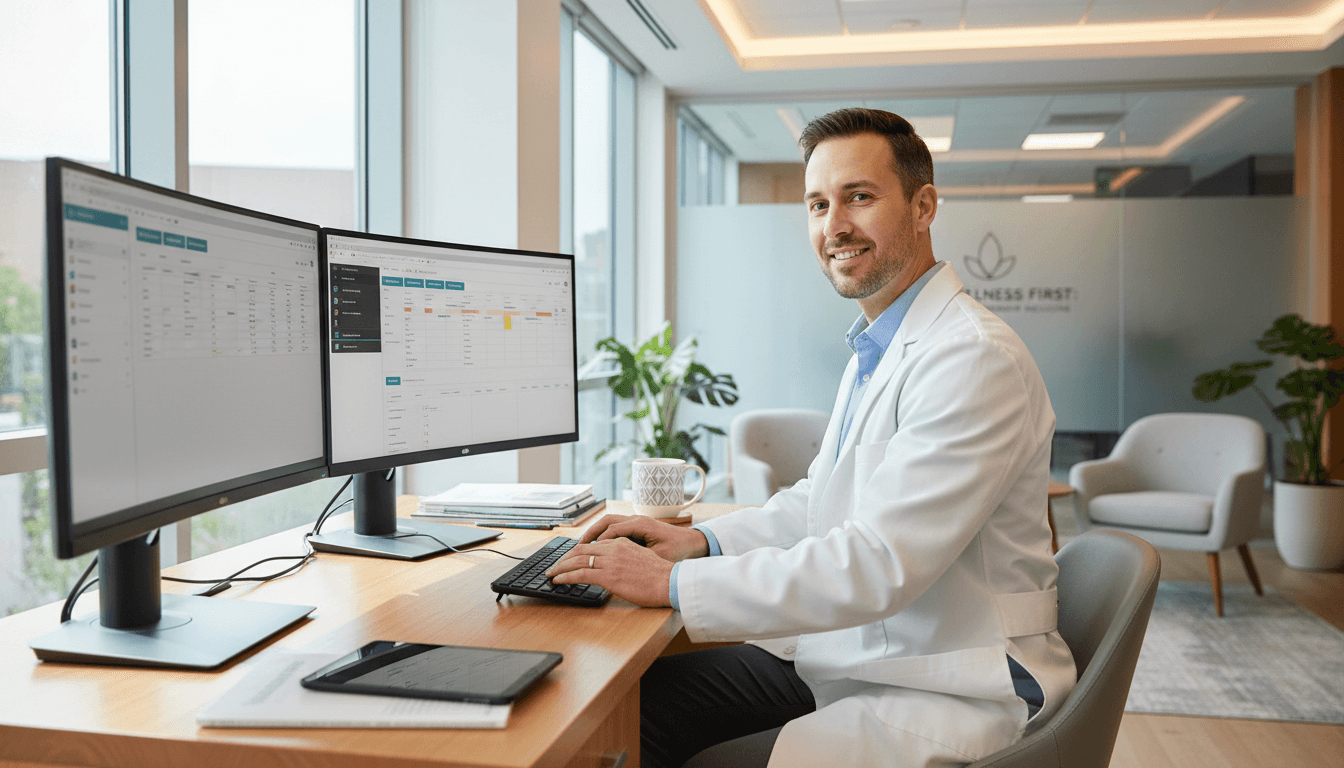
You left fee-for-service medicine for a reason. You were tired of the hamster wheel — the 15-minute visits, the coding gymnastics, the soul-crushing feeling that your EHR mattered more than your patients. Direct Primary Care was supposed to change everything.
And in many ways, it did. Longer visits. Deeper relationships. Medicine practiced the way you always imagined it could be.
But here you are, after your last patient leaves, sitting in front of a screen. Again. Documenting. Still.
The Problem No One Talks About
The DPC community celebrates freedom from insurance — and rightfully so. But there's a quieter struggle that rarely makes it into the conferences or the subreddit threads: even without billing codes and prior authorizations, documentation in membership-based primary care is still consuming an enormous part of your day.
You're spending 30, 45, even 60-plus minutes of your evening reconstructing conversations you had hours ago. You're toggling between your EHR and your memory, trying to capture the nuance of a complex chronic care visit or a lengthy mental health discussion that your DPC model actually allows you to have.
Here's the cruel irony: the longer, more meaningful visits that define DPC create more documentation, not less. You traded one set of administrative burdens for another. And because most DPC practices are solo or micro-practices, there's no support staff to absorb the load. It's just you, your laptop, and the clock ticking past your kids' bedtime.
You didn't build a membership-based practice to spend your evenings charting. But that's exactly what's happening.
Why This Keeps Happening
The documentation problem in DPC persists for reasons that are structural, not personal. It's not a discipline issue. It's not that you haven't tried hard enough to build templates or batch your notes. The problem runs deeper.
Your visits are genuinely longer and more complex. A typical DPC visit might run 30 to 60 minutes. That's three to four times the length of a conventional primary care encounter. More time with patients means more clinical detail, more shared decision-making, and more documentation to capture it all accurately.
You're wearing every hat. In a solo or small DPC practice, you're the physician, the scribe, the coder (even if simplified), the administrator, and often the marketer. Documentation competes with every other operational demand for your finite attention.
EHRs weren't designed for DPC. Most electronic health records were architected around the fee-for-service model — built to optimize billing capture, not clinical storytelling. The templates feel wrong. The workflows assume a reality that doesn't match yours. So you end up fighting the tool instead of being supported by it.
You hold yourself to a higher standard. You chose DPC because you care deeply about doing medicine right. That same conscientiousness makes you unwilling to cut corners on documentation. You know that thorough notes protect your patients and reflect the quality of care you're providing. So you spend the extra time, even when it costs you.
None of these factors are going away on their own. The model you love creates documentation demands that willpower alone can't solve.
The Real Cost of Documentation Efficiency in Membership-Based Primary Care
When documentation efficiency breaks down in a DPC practice, the consequences ripple outward in ways that threaten the very foundation of why you chose this model.
Your patient panel stays artificially small. If every patient encounter generates 20 to 30 minutes of after-hours charting, your capacity is capped not by your clinical skill, but by your documentation bandwidth. You can't grow your membership — and your revenue — without either sacrificing your evenings or cutting visit quality. Neither option is acceptable.
Burnout follows you out of fee-for-service. The research on physician burnout consistently identifies documentation burden as a primary driver. Leaving insurance doesn't immunize you. If you're still spending hours on notes after clinic, the emotional exhaustion accumulates the same way. Many DPC physicians report feeling a particular kind of disillusionment when they realize that administrative burden followed them into a model they built specifically to escape it.
The relationship-centered care you promised starts to erode. When you're mentally cataloging what you need to document during a visit, you're not fully present. When you're exhausted from last night's charting marathon, you're less engaged in today's conversations. Your members are paying for you — your attention, your expertise, your presence. Documentation inefficiency steals exactly what they're paying for.
Your business sustainability is at risk. DPC practices live and die by retention and word-of-mouth. If documentation burden forces you to limit your panel, rush your notes, or burn out entirely, the financial model becomes precarious. You can't build a sustainable practice on a foundation of unsustainable work hours.
This isn't a minor inconvenience. For DPC physicians, documentation inefficiency is an existential threat to both the practice and the practitioner.
What Leading DPC Physicians Are Doing Differently in 2026
The DPC physicians who are thriving in 2026 — growing their panels, maintaining deep patient relationships, and actually going home at a reasonable hour — have recognized a fundamental truth: the solution to documentation burden isn't working harder or faster. It's removing yourself from the documentation bottleneck entirely.
They've stopped trying to optimize a broken workflow and started delegating documentation to AI ambient scribes that capture the clinical encounter in real time.
This isn't about dictation software that requires you to narrate your notes after the visit. It's not about voice-to-text that dumps unstructured paragraphs into your EHR. The physicians who've solved this problem are using AI that listens to the natural conversation between doctor and patient and produces structured, accurate clinical notes — automatically.
The shift is profound. Instead of reconstructing a visit from memory at 9 PM, they review and sign a note that's already been drafted by the time the patient walks out the door. The documentation happens during the visit, invisibly, without disrupting the human connection that makes DPC what it is.
For solo DPC practices especially, this represents something that wasn't previously possible: having the equivalent of a highly trained medical scribe in the room — without the salary, the scheduling complexity, or the physical space requirements.
How Scribing.io Solves Documentation Efficiency in Membership-Based Primary Care
Scribing.io was built for exactly this moment — for physicians who need documentation to happen seamlessly, accurately, and without stealing time from patients or family.
It listens while you practice medicine. Scribing.io's AI ambient scribe captures the natural flow of your patient conversation and generates a complete, structured clinical note. You don't change how you practice. You don't narrate. You don't dictate. You just talk to your patient the way you always have.
It understands the DPC visit. Unlike tools built for 15-minute fee-for-service encounters, Scribing.io handles the longer, more nuanced conversations that define membership-based primary care. Complex chronic disease management discussions, extended mental health visits, lifestyle coaching conversations — the AI captures the clinical substance without losing the detail.
Notes are ready when you are. By the time your patient leaves, a draft note is waiting for your review. Most physicians find they can review and finalize in under two minutes. That's the difference between documentation happening in real time and documentation happening at your kitchen table after dinner.
It works with your EHR, not against it. Scribing.io integrates with the EHR systems DPC physicians actually use. The notes flow into your existing workflow, formatted and structured the way you need them.
Your patients don't notice — except that you seem more present. There's no awkward device on the table, no obvious technology creating a barrier. Members of DPC practices consistently describe the experience of having their doctor fully engaged in conversation rather than typing. Scribing.io enables exactly that.
For a solo DPC physician seeing a full panel, the math is straightforward: if Scribing.io saves even 15 minutes of charting per patient across a full day of visits, that's hours returned — every single day. Hours you can reinvest in growing your panel, developing your practice, or simply being home for dinner.
Getting Started Takes Less Than 10 Minutes
You didn't spend years building a DPC practice to be defeated by documentation. And you don't need to spend weeks implementing a new system to fix it.
Scribing.io is designed to be operational in minutes, not months. There's no complex onboarding, no IT infrastructure to build, no learning curve that requires a weekend of training.
Here's what it looks like:
Sign up and configure your preferences. Tell Scribing.io your note style, your preferred structure, and any specialty-specific terminology you use regularly.
Start your next patient visit. Let Scribing.io listen to the natural conversation.
Review your note. Make any adjustments, sign, and move on with your day.
That's it. By your second or third patient, the workflow feels invisible. By the end of your first week, you'll wonder how you ever practiced without it.
You chose DPC to practice medicine on your terms. It's time your documentation worked the same way.
Try Scribing.io Free and take back the hours that documentation has been stealing from your practice, your patients, and your life.


