Posted on
Mar 14, 2026
Why FQHC Medical Directors Are Still Losing Hours to High-Volume, Low-Resource Documentation Challenges in 2026 (And How to Stop)
The Problem No One Talks About
You became a Medical Director at a Federally Qualified Health Center because you believe healthcare should reach everyone—not just the people who can afford concierge medicine. You took on the administrative weight, the regulatory complexity, and the constant budget negotiations because the mission matters.
But here's what no one warned you about: the documentation burden at an FQHC doesn't scale like it does at a well-funded health system. Your patient panels are enormous. Your clinicians are stretched impossibly thin. And when someone leaves—a provider, a medical assistant, an office manager—the documentation doesn't pause. It compounds.
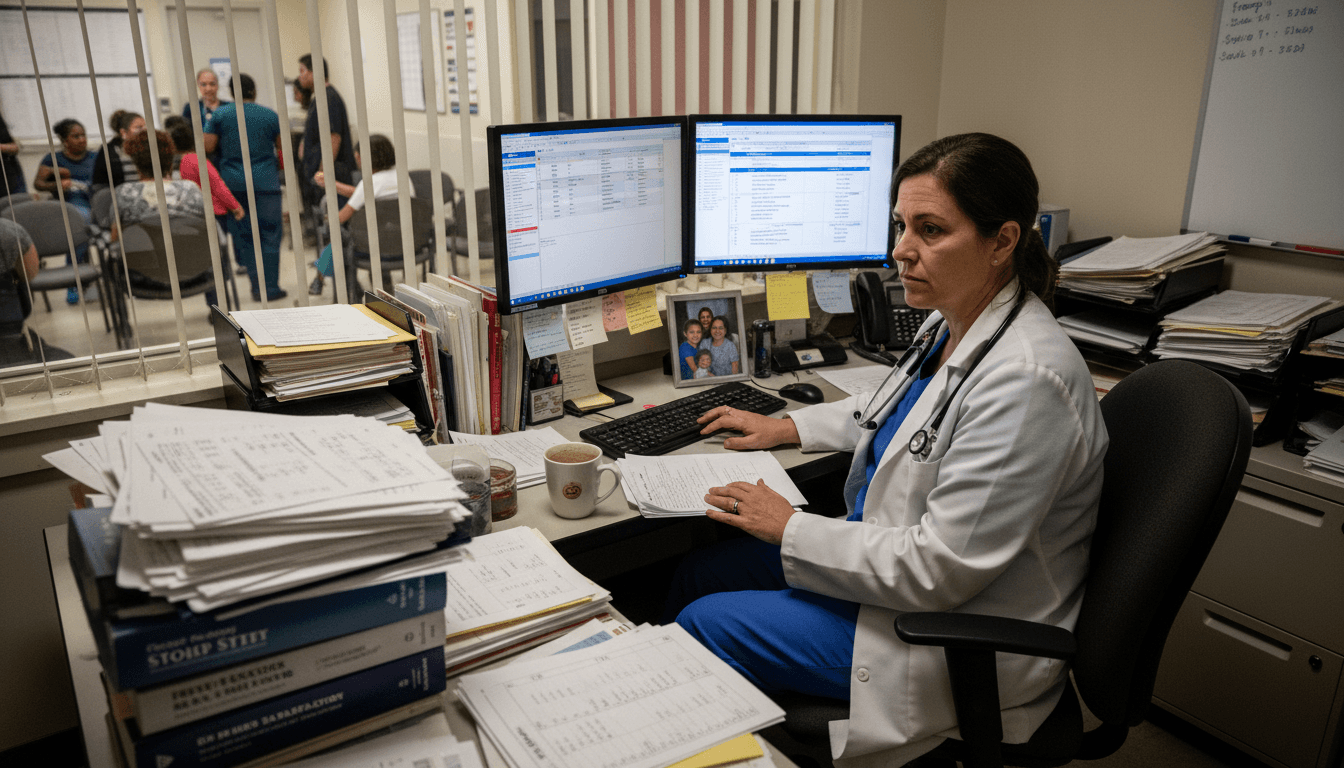
You're watching your best clinicians stay hours after their last patient, charting into the evening. You see the resignation in their faces during Monday morning huddles. You know exactly what's happening because you're doing it too—finishing your own notes at 10 PM, toggling between quality reporting requirements, UDS data obligations, and the relentless demands of payers who seem to think your clinic has the same back-office infrastructure as a hospital system.
This isn't a minor operational inefficiency. This is the crisis quietly hollowing out community health centers from the inside.
Why This Keeps Happening
FQHCs operate in a structurally different reality than most healthcare organizations, yet they're expected to meet the same—or even more demanding—documentation standards. Here's why the problem persists:
Reimbursement doesn't fund documentation infrastructure. Prospective Payment System (PPS) rates and sliding-fee-scale revenue don't leave room for dedicated scribes, robust HIT teams, or documentation specialists. Every dollar is triaged toward direct patient care, as it should be—but documentation still has to get done.
Volume is non-negotiable. HRSA scope requirements, community need, and financial sustainability all demand high patient volumes. You can't simply see fewer patients. The people walking through your doors often have nowhere else to go.
EHR systems weren't designed for safety-net workflows. Most electronic health records were built for fee-for-service environments with ample support staff. FQHC-specific workflows—tracking enabling services, documenting social determinants, managing behavioral health integration—layer additional complexity onto systems that already feel clunky.
Turnover creates a documentation death spiral. When a burned-out clinician leaves, remaining providers absorb their patients. Documentation backlogs grow. Quality metrics slip. The next clinician starts looking for the exit. Recruiting replacements to under-resourced clinics takes months—sometimes longer.
Compliance requirements keep expanding. UDS reporting, PCMH recognition, value-based care contracts, HRSA operational site visits—each layer adds documentation obligations without adding documentation capacity.
You already know all of this. You live it. The question isn't why it's happening. The question is why the solutions available to you have historically been so inadequate.
The Real Cost of High-Volume, Low-Resource Documentation Challenges
The costs extend far beyond late nights and frustrated providers. When documentation becomes the bottleneck in a high-volume, low-resource environment, the damage is systemic:
Clinical quality erodes quietly. Fatigued clinicians writing notes at the end of long days produce less accurate documentation. Critical details get missed—not because providers don't care, but because human cognition deteriorates after hours of relentless patient encounters without adequate support.
Revenue leakage goes undetected. Under-coded visits are endemic in FQHCs where providers are too exhausted to document to the full complexity of the care they delivered. When you're seeing 25 patients a day with minimal support, capturing every HCC code and every qualifying element for a higher E/M level falls off the priority list.
Burnout drives attrition you can't afford. Replacing a single physician can cost a health center hundreds of thousands of dollars when you factor in recruitment, onboarding, lost productivity, and the impact on patient continuity. For FQHCs competing with better-resourced employers, every preventable departure is devastating.
Patient access suffers. When providers spend more time documenting, they have less time for patients. Appointment slots shrink. Wait times grow. The community you exist to serve pays the ultimate price.
Your own sustainability is at risk. Incomplete documentation threatens grant renewals, payer contracts, and HRSA compliance. The very funding that keeps your doors open depends on documentation your team doesn't have the bandwidth to complete properly.
As a Medical Director, you carry the weight of all of this simultaneously. You're responsible for clinical quality, provider wellbeing, operational performance, and regulatory compliance—with a fraction of the resources your counterparts at large health systems enjoy.
What Leading FQHC Medical Directors Are Doing Differently in 2026
The Medical Directors who are breaking this cycle in 2026 aren't doing it by hiring more staff they can't afford or by accepting documentation shortcuts that compromise quality. They're leveraging AI-powered ambient documentation technology—purpose-built tools that listen to the patient encounter and generate accurate, compliant clinical notes in real time.
This isn't speculative technology. Ambient AI scribes have matured rapidly, and forward-thinking FQHC leaders are deploying them because the value proposition is uniquely powerful in safety-net settings:
No new hires required. AI scribes don't need salaries, benefits, training periods, or PTO coverage. For FQHCs where every FTE decision goes through a budget committee, this changes the calculus entirely.
Providers reclaim the patient encounter. When a clinician can focus entirely on the person in front of them—making eye contact, asking the follow-up question, noticing the subtle cue—care quality improves in ways that documentation alone can never capture.
Notes are completed before the next patient walks in. The after-hours charting marathon ends. Providers go home on time. The Monday morning huddle feels different when your team actually rested over the weekend.
Documentation accuracy improves. AI doesn't get tired at 4 PM. It captures the clinical details as they're spoken, reducing the recall errors that inevitably creep into notes written hours after the encounter.
This shift isn't about replacing clinical judgment. It's about giving your clinicians the one resource they've never had: a documentation partner that costs a fraction of a human scribe and works for every provider on your team simultaneously.
How Scribing.io Solves High-Volume, Low-Resource Documentation Challenges
Scribing.io was built with exactly this problem in mind. It's an AI-powered medical scribe that integrates into the clinical workflow your providers already use—listening to natural patient-provider conversations and generating structured, accurate clinical documentation in real time.
Here's why FQHC Medical Directors are choosing Scribing.io specifically:
Designed for real-world clinical conversations. Scribing.io handles the complexity of FQHC encounters—multilayered visits where a patient presents with diabetes management, a housing crisis, a medication access barrier, and a behavioral health concern all in the same 20-minute slot. It captures the clinical narrative as it unfolds, without requiring providers to slow down or dictate in an unnatural way.
Affordable at FQHC scale. Traditional human scribes might cost $15–$20+ per hour per provider. Scribing.io delivers comprehensive documentation support at a price point that makes sense for community health center budgets. You can deploy it across your entire clinical team without a capital campaign.
Reduces pajama time immediately. Providers using Scribing.io consistently report finishing their documentation during—or immediately after—the clinical session. The backlog of unsigned notes that keeps your Medical Director dashboard red starts clearing within the first week.
Supports accurate coding. By capturing the full clinical conversation, Scribing.io helps ensure that the documentation reflects the true complexity of the visit. This supports appropriate coding and helps reduce the revenue leakage that plagues under-resourced clinics.
No complex IT implementation. FQHCs rarely have dedicated IT departments. Scribing.io is designed for rapid deployment without requiring extensive technical infrastructure or EHR customization.
Provider autonomy preserved. Every note is reviewed and signed by the clinician. Scribing.io handles the documentation labor; your providers retain full clinical authority over the final record.
For a Medical Director managing a team of overwhelmed clinicians in a high-volume environment, Scribing.io isn't a nice-to-have. It's the documentation infrastructure your health center has always needed but could never afford—until now.
Getting Started Takes Less Than 10 Minutes
You don't have months to evaluate vendors. You don't have bandwidth for a six-week implementation project. That's why Scribing.io is designed to go from sign-up to first clinical note in under 10 minutes.
Here's what that looks like:
Create your account. No lengthy procurement process. No committee approvals needed just to see if it works for your team.
Start your first encounter. Scribing.io begins listening when your provider begins talking. No special commands, no rigid templates, no workflow disruption.
Review and sign. The generated note appears for provider review. Edit if needed, sign, and move on to the next patient—on time, for once.
Start with one provider. Let them try it for a day. Watch what happens when they finish their last note before they leave the building. Then imagine that across your entire clinical team.
Your clinicians chose community health because they believe in the mission. Give them the tool that lets them focus on patients instead of paperwork.


