Posted on
Jan 18, 2026
Why Gastroenterologists Are Still Losing Hours to Procedure and Follow-Up Documentation Burden in GI Practice in 2026 (And How to Stop)
The Problem No One Talks About
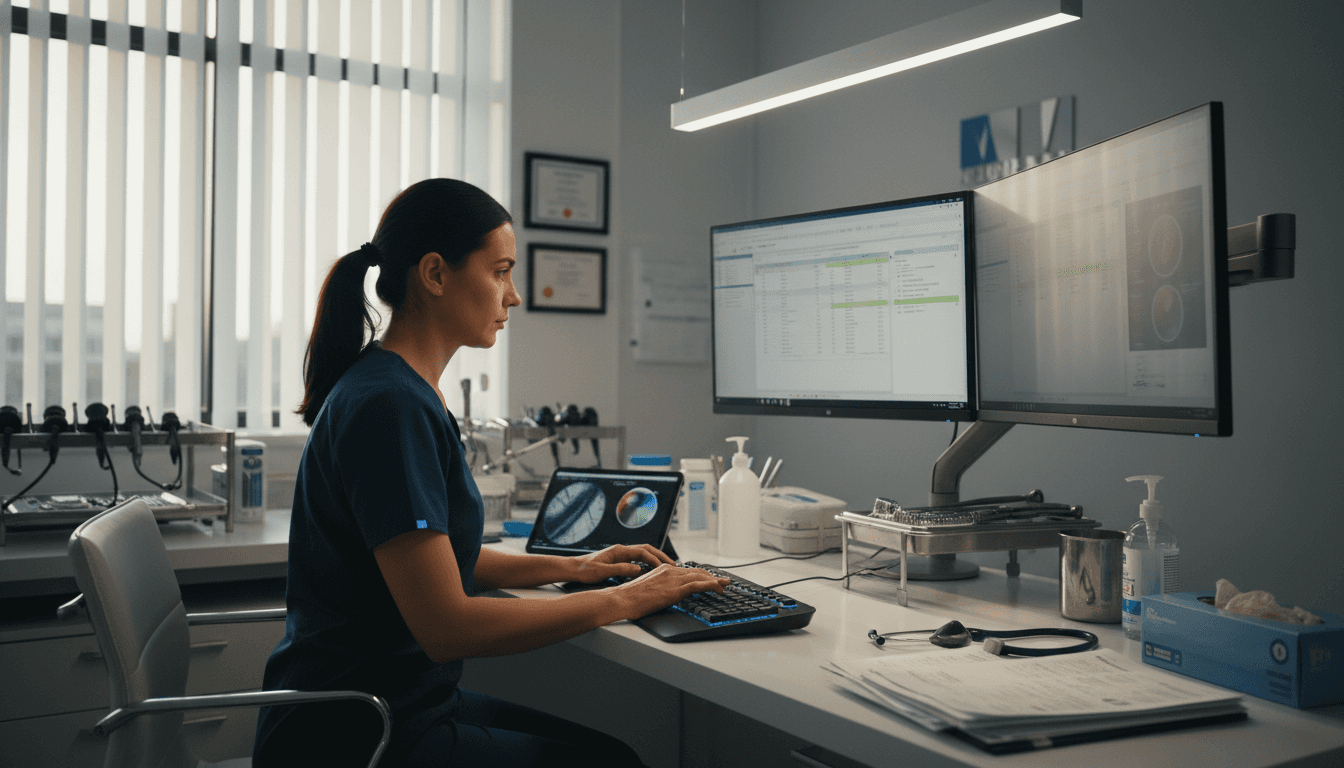
You just finished your seventh colonoscopy of the day. The sedation has worn off for your last patient, and they're asking about the two polyps you removed. You answer their questions clearly, reassure them, walk them to recovery — and then you sit down at a workstation to document what already happened hours ago.
By the time you get to the procedure notes for your afternoon cases, the details are blurring together. Was the 2 cm sessile polyp in the ascending colon for Mrs. Torres or Mrs. Patel? Did you use a hot snare or cold snare on that diminutive polyp in the sigmoid? You know you did it right — you always do — but now you're reconstructing the narrative from memory, toggling between pathology order fields, dropdown menus, and free-text boxes that never quite capture what actually happened.
And then there are the follow-up notes. The surveillance colonoscopy intervals. The letters to referring physicians. The medication adjustments for your IBD patients. The instructions you gave verbally that now need to exist in the chart so the care plan doesn't evaporate into thin air.
This is the part of gastroenterology no one warned you about in fellowship. Not the complexity of the procedures — you trained for that. The documentation that follows every single one of them.
Why This Keeps Happening
GI is unique among medical specialties in the sheer volume of procedural documentation it demands. A busy endoscopist may perform 15 to 25 procedures per day, and each one requires a detailed procedure report, pathology requisitions, post-procedure instructions, complication assessments, and follow-up surveillance recommendations — all of which must be accurate, timely, and compliant.
But here's the structural problem: most EHR systems were not designed for procedure-heavy specialties. They were built around the office visit model — a chief complaint, an exam, an assessment and plan. Procedure documentation in these systems feels like an afterthought because, in many cases, it was.
Endoscopy reporting tools like EndoWriter or ProVation have helped standardize some of this, but they often create a parallel documentation universe. You're now maintaining records in two systems, with data that doesn't always flow cleanly into the main EHR. Follow-up notes, referral letters, and surveillance scheduling still fall back on the gastroenterologist to manually complete.
Add to this the increasingly complex quality metrics — adenoma detection rates, cecal intubation rates, withdrawal times, Boston Bowel Prep Scale scores — and you have a documentation environment that keeps expanding while your time remains fixed.
The result? You finish your procedures on time, but you don't finish your documentation until late evening. Or the weekend. Or never, accumulating a growing backlog of unsigned notes that hangs over you like a clinical debt you can never fully repay.
The Real Cost of Procedure and Follow-Up Documentation Burden in GI Practice
The costs of this burden are measurable, but they don't show up on a balance sheet in any obvious way. They accumulate silently.
Clinical accuracy erodes. When you're documenting your eighth EGD from memory at 7 PM, the risk of errors — wrong location, missed findings, incomplete pathology correlation — goes up. These aren't negligent mistakes. They're the inevitable consequence of asking a human brain to reconstruct detailed procedural narratives hours after the fact.
Follow-up gaps widen. When documentation is delayed, follow-up recommendations are delayed. Surveillance intervals get lost. Referring physicians receive vague or late communications. Patients with high-risk polyps don't get called back on time. The downstream clinical consequences of documentation delay are real and serious.
Revenue leaks. Incomplete or imprecise procedure documentation leads to under-coding. If your report doesn't clearly distinguish between a diagnostic EGD and one with intervention, or doesn't document the complexity of a polypectomy technique, you're leaving reimbursement on the table — consistently, across hundreds of procedures per month.
Burnout deepens. You didn't spend years mastering ERCP and EUS to become a data entry specialist. Every hour spent on documentation after your last patient has left is an hour stolen from your family, your rest, your ability to show up as the physician you want to be tomorrow morning. The documentation burden in GI is one of the most potent drivers of career dissatisfaction in the specialty.
What Leading Gastroenterologists Are Doing Differently in 2026
The gastroenterologists who have broken free from this cycle share a common realization: the documentation doesn't have to happen the way it's always happened.
They've stopped accepting the premise that procedure notes must be typed by the physician. They've stopped treating follow-up documentation as something that can only be done manually after hours. And they've stopped relying on human scribes who may lack the specialized vocabulary to accurately capture GI-specific findings.
Instead, they're turning to AI-powered ambient documentation tools — specifically ones designed to understand the language and workflow of procedural medicine. These systems listen during the procedure, capture the physician's real-time narration, and generate structured procedure reports, follow-up plans, and patient communications automatically.
This isn't theoretical. It's happening now, in GI practices across the country, and the gastroenterologists using these tools report something that sounds almost too simple to be true: they finish their documentation before they leave the endoscopy suite.
How Scribing.io Solves Procedure and Follow-Up Documentation Burden in GI Practice
Scribing.io was built for exactly this kind of clinical workflow — high-volume, procedure-intensive, detail-critical documentation that demands both speed and accuracy.
Here's how it works in a GI context:
During the procedure, you narrate as you normally would — describing findings, interventions, locations, and techniques. Scribing.io's AI captures this narration in real time and converts it into a structured, specialty-appropriate procedure report. Polyp size, morphology, location, removal technique, retrieval method — all documented as you speak, in the format your EHR and quality reporting systems expect.
For follow-up documentation, Scribing.io generates surveillance recommendations based on the findings you've described, drafts follow-up notes, and creates patient-facing summaries that align with current guideline-based intervals. No more manually calculating when a patient with three tubular adenomas needs their next colonoscopy.
For post-procedure communication, Scribing.io auto-generates referring physician letters and patient instructions that reflect what actually happened during the case — not a generic template, but a personalized, accurate summary.
For quality reporting, the structured data captured by Scribing.io maps directly to the quality metrics that matter — ADR, cecal intubation, prep quality scores — reducing the manual abstraction work that often falls on your staff or on you.
The AI understands GI terminology natively. It knows the difference between a Paris classification IIa and IIb lesion. It distinguishes between cold forceps polypectomy, cold snare polypectomy, and EMR. It doesn't guess — it documents what you said, structured the way it needs to be structured.
And because Scribing.io integrates with your existing EHR, there's no parallel documentation universe. One workflow. One record. Completed before your next case.
Getting Started Takes Less Than 10 Minutes
You don't need to overhaul your practice, retrain your staff, or migrate to a new system. Scribing.io is designed for immediate adoption.
Sign up and configure your GI-specific documentation preferences — procedure types, report formats, follow-up templates.
Start your next procedure day with Scribing.io running. Narrate as you normally would.
Review your completed notes before you leave the suite. Edit if needed — though most gastroenterologists find the output requires minimal revision.
That's it. No lengthy implementation. No learning curve that adds to your burden before it reduces it.
The documentation load you've been carrying doesn't have to follow you home tonight.
Try Scribing.io Free — and finish your notes before your last patient leaves recovery.


