Posted on
Jan 11, 2026
Why Geriatricians Are Still Losing Hours to Multi-Morbidity Documentation and Care Coordination Complexity in 2026 (And How to Stop)
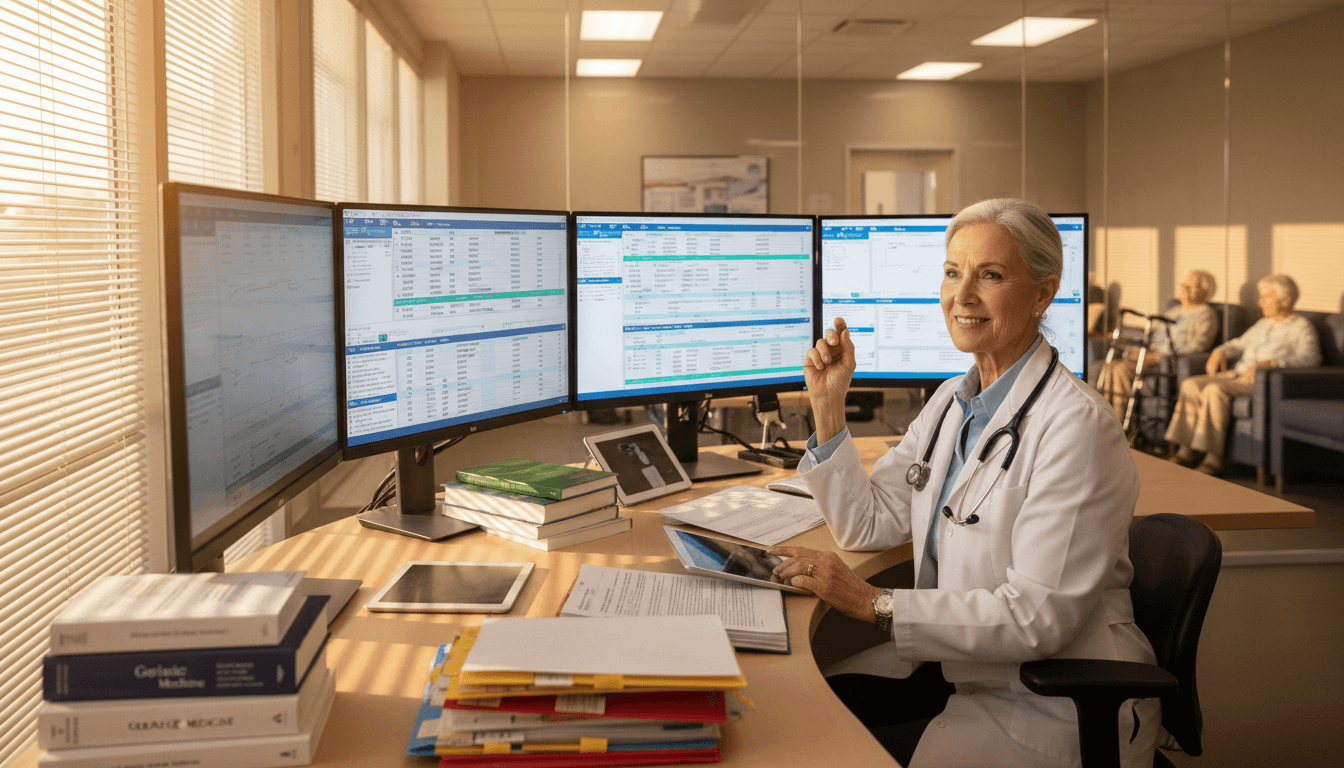
The Problem No One Talks About
You chose geriatrics because you believe older adults deserve a physician who sees the whole person — not just a problem list. Someone who listens patiently, untangles the web of intersecting conditions, and advocates fiercely across a fragmented healthcare system.
But here's what no one warned you about: the documentation burden of caring for patients with five, eight, twelve active diagnoses doesn't just add time to your day. It fundamentally distorts the way you practice medicine.
Your 82-year-old patient with heart failure, COPD, type 2 diabetes, chronic kidney disease, osteoarthritis, depression, and mild cognitive impairment walks into your office. You already know what's coming — not the clinical complexity, which you trained for and welcome, but the administrative avalanche that follows. Each condition requires its own documentation trail. Each medication interaction needs justification. Each specialist's recommendation must be reconciled. Each care transition demands a summary that captures the full picture.
You spend the visit doing what you do best: synthesizing, prioritizing, making nuanced clinical decisions that no algorithm could replicate. Then you spend twice as long documenting it.
And by the time you finish, it's 8 PM, and your notes from this morning's patients still aren't done.
If this sounds like your life, you're not alone. And you're not failing. The system was never designed for the complexity of what you do.
Why This Keeps Happening
Geriatrics sits at the intersection of every structural flaw in modern healthcare documentation.
EHR systems were built around single-problem encounters. A patient comes in with a sore throat. You document a focused history, an exam, a treatment plan, and you're done. The templates, the click-paths, the billing logic — all of it assumes a relatively bounded clinical scenario.
Multi-morbidity shatters that assumption entirely.
When your patient has eight active conditions, you're not conducting one encounter — you're conducting eight micro-encounters woven into a single visit. Each condition may interact with the others. A medication change for one problem may destabilize another. A functional decline may signal progression across multiple disease processes simultaneously.
Your clinical reasoning is inherently integrative. But your documentation tools force you to fragment it — one problem at a time, one template at a time, one checkbox at a time.
Then there's care coordination. Your patients see cardiologists, pulmonologists, endocrinologists, nephrologists, psychiatrists, physical therapists, home health agencies, and sometimes palliative care teams. Each generates their own notes, their own plans, their own medication lists. You're the one expected to synthesize all of it into a coherent narrative — and document that synthesis in a way that satisfies payers, auditors, and quality metrics.
The cognitive load is extraordinary. The documentation load is punishing. And neither has meaningfully improved despite decades of EHR "optimization."
Voice-to-text dictation helps with speed but not with structure. Pre-built templates help with structure but not with the nuance your patients require. Copy-forward saves time but creates bloated, inaccurate records that can compromise care. None of these tools were designed for the kind of medicine you practice.
The Real Cost of Multi-Morbidity Documentation and Care Coordination Complexity
The cost is measured in hours, but it's felt in ways that are harder to quantify.
Clinical quality suffers. When documentation takes twice as long as the visit itself, something gets compressed. Often it's the visit. You find yourself unconsciously limiting the scope of what you address because you know what documenting a comprehensive geriatric assessment actually entails. Your patients get less of your attention, not because you don't care, but because the system punishes thoroughness.
Care coordination gaps widen. When summarizing a complex patient's status for a specialist referral takes 20 minutes of writing, you sometimes settle for a brief, insufficient note. The specialist doesn't get the full picture. The patient gets fragmented care. The very thing you entered geriatrics to prevent.
Burnout accelerates. Geriatricians already report some of the highest rates of emotional exhaustion among medical specialties. The relentless documentation burden compounds the moral injury — the sense that you're spending your expertise on paperwork instead of patients. Every evening spent charting is an evening not spent recovering, not spent with family, not spent doing anything that sustains you.
Revenue is left on the table. Complex geriatric visits often qualify for higher-level billing codes, chronic care management reimbursement, and care coordination fees. But capturing that value requires meticulous documentation that reflects the true complexity of what you did. When you're exhausted and behind, you under-document. You bill for less than the care you provided. Over months and years, this represents significant lost income for you or your practice.
Your patients feel the difference. They came to you because they wanted a doctor who would take the time. When documentation pressure forces you to rush, they sense it. The therapeutic relationship — the foundation of everything in geriatrics — erodes quietly.
What Leading Geriatricians Are Doing Differently in 2026
The geriatricians who have found a sustainable path aren't working harder. They haven't discovered some hidden efficiency in their EHR. They haven't resigned themselves to pajama-time charting as an inevitable part of the specialty.
They've recognized a fundamental truth: the bottleneck isn't their clinical skill or their time management. It's the translation layer — the gap between the rich, integrative clinical reasoning they perform in real time and the structured, multi-layered documentation the system demands.
And they've started using AI-powered medical scribing to bridge that gap.
Not the dictation tools of five years ago. Not the template-fillers that produce generic notes. A new generation of AI scribe technology that can listen to a complex, multi-problem geriatric encounter and produce documentation that actually reflects the nuance of what happened.
This is the shift: instead of spending the visit thinking about documentation, these geriatricians spend the visit thinking about their patient. The documentation happens in the background, structured and comprehensive, ready for review when the visit ends.
The difference isn't incremental. It's transformative.
How Scribing.io Solves Multi-Morbidity Documentation and Care Coordination Complexity
Scribing.io was built to handle exactly the kind of clinical complexity that defines geriatric medicine.
It captures multi-problem encounters as they actually unfold. When you move fluidly between discussing a patient's worsening heart failure, adjusting their diabetes management, addressing their fall risk, and revisiting their goals of care — Scribing.io follows that conversation. It doesn't need you to dictate in problem-list order. It organizes the clinical content into structured, coherent documentation that reflects the integrative nature of your assessment.
It documents care coordination in real time. When you reference a cardiology note, reconcile conflicting medication recommendations, or explain why you're deviating from a specialist's suggestion based on the patient's overall clinical picture, Scribing.io captures that reasoning. The documentation doesn't just record what you did — it preserves why you did it, which is essential for both continuity and billing justification.
It supports the complexity-based coding your visits deserve. Comprehensive geriatric assessments, chronic care management, and high-complexity medical decision-making all require documentation that demonstrates the work you actually performed. Scribing.io generates notes with the specificity and structure needed to support appropriate reimbursement — without you manually checking boxes or inflating templates.
It gives you back your evenings. Geriatricians using Scribing.io consistently report finishing their documentation during or shortly after clinic hours. Not because the notes are superficial, but because the AI handles the translation from conversation to documentation — the step that was consuming hours of your day.
It learns the language of geriatrics. Functional status. Polypharmacy rationale. Goals-of-care discussions. Capacity assessments. Caregiver dynamics. These aren't edge cases for Scribing.io — they're core capabilities. The platform understands that geriatric documentation isn't just medical documentation with older patients. It's a distinct clinical language, and Scribing.io speaks it.
Getting Started Takes Less Than 10 Minutes
You don't need IT approval to try this. You don't need to overhaul your workflow. You don't need to learn a new system.
Scribing.io works with your existing setup. You sign up, start your encounter, and let it listen. After the visit, you review the generated note, make any adjustments, and finalize. That's it.
Most geriatricians see the impact within their first clinic session. Not because the technology is complicated, but because the problem it solves is so acute that even partial relief feels dramatic.
You became a geriatrician to care for the most complex, most vulnerable patients in medicine. You shouldn't have to sacrifice your wellbeing to document that care.
Try Scribing.io Free — and find out what your practice feels like when the documentation matches the medicine you're already practicing.


