Posted on
Mar 19, 2026
Why Locum Physicians Are Still Losing Hours to Adapting Documentation Systems Across Different Practice Settings in 2026 (And How to Stop)
The Problem No One Talks About
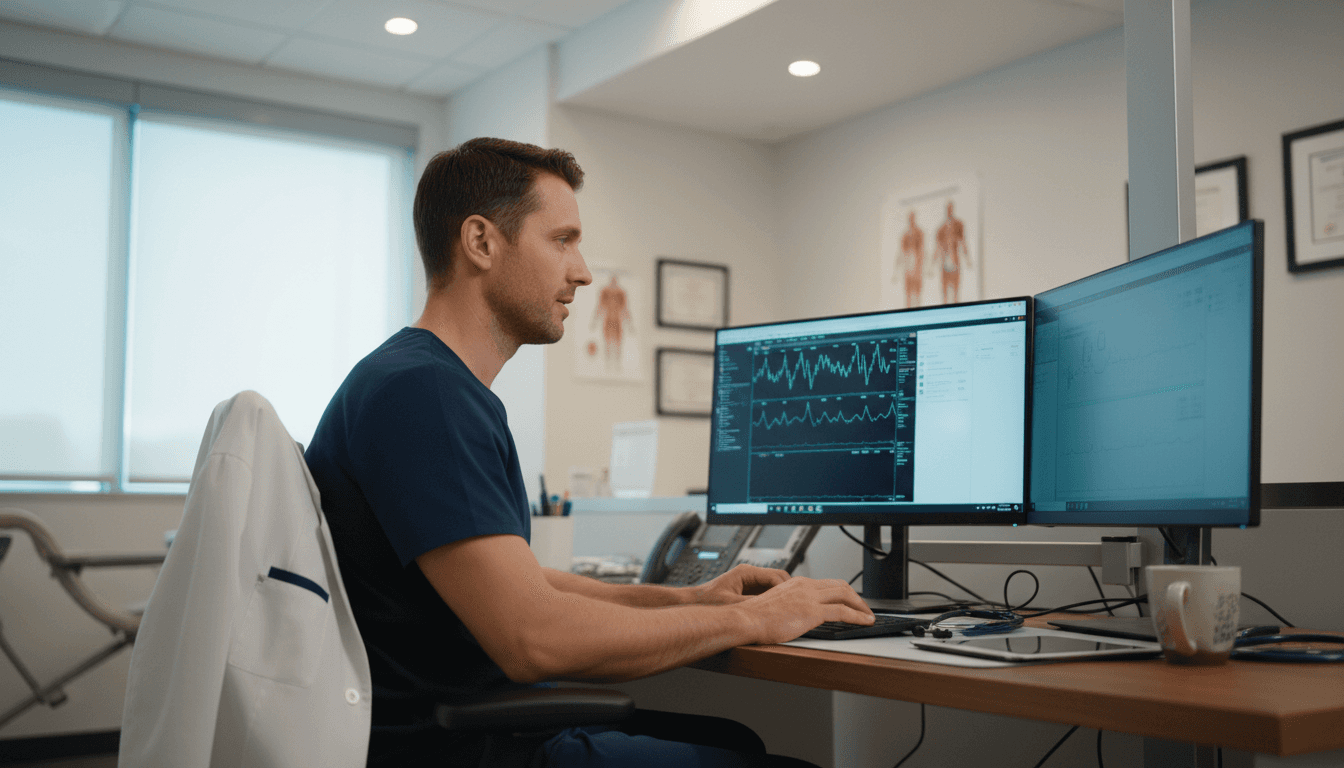
You accepted the locum assignment because the location was right, the pay was fair, and the schedule worked. But no one mentioned you'd be charting in a version of Epic you've never seen configured this way. Or that the last facility used Cerner, and this one runs eClinicalWorks with custom templates that make no intuitive sense. Or that the urgent care down the road where you're covering next week uses a completely different system altogether.
So here you are — a board-certified physician with years of clinical expertise — spending your first hours (sometimes your first full day) not caring for patients, but clicking through unfamiliar menus, hunting for order sets, and trying to figure out where someone decided to bury the assessment and plan section.
This is the quiet tax of locum tenens work. Not the travel. Not the credentialing. The documentation adaptation. And it follows you to every single new assignment.
You didn't go into medicine to become an expert at navigating seventeen different EHR configurations. Yet that's exactly what locum work demands of you — over and over again, at every new facility, with zero continuity and minimal onboarding.
If you've felt the frustration of finishing a shift and realizing you still have two hours of charting ahead because the system slowed you down, you're not alone. And you're not the problem.
Why This Keeps Happening
The healthcare industry has a fragmentation problem it refuses to fully acknowledge. There are dozens of EHR platforms in active use across the United States, and even facilities running the same platform rarely configure it the same way. Custom templates, unique workflows, facility-specific documentation requirements, idiosyncratic dropdown menus — every practice setting is its own ecosystem.
For permanent physicians, this is a one-time learning curve. You adapt once, build muscle memory, and move on. For locum physicians, it's a recurring obstacle. Every new contract means a new system, new templates, new expectations for how a note should look and what it should contain.
The onboarding you receive is almost always inadequate. A quick walkthrough with an IT coordinator who has never documented a patient encounter. A PDF guide you'll never have time to read. Maybe a colleague who can answer questions — if they're not already overwhelmed with their own patient load.
Meanwhile, the facility expects you to hit the ground running. They brought you in because they're short-staffed. They need you seeing patients at full speed from day one. The cognitive dissonance is staggering: learn an entirely new documentation environment while maintaining the same throughput as someone who's been charting in it for years.
And here's what makes it worse — you know how to document. You've been doing it for your entire career. The clinical knowledge isn't the barrier. The barrier is the interface between your clinical thinking and whatever system someone else chose and configured without you in mind.
The Real Cost of Adapting Documentation Systems Across Different Practice Settings
The costs are real, even when they're invisible on a balance sheet.
Time: Locum physicians routinely report spending significantly longer on documentation during their first several shifts at a new facility compared to their steady state. Those are hours you're not seeing patients, not resting, not doing the work you were hired to do. When you're paid by the shift, that unpaid charting time effectively cuts your hourly rate.
Cognitive load: Every moment you spend thinking about where to document is a moment you're not thinking about what to document. Decision fatigue from navigating unfamiliar systems compounds over the course of a shift, and there's growing recognition in the medical community that EHR-related cognitive burden contributes to diagnostic thinking errors — not because the physician lacks competence, but because the system consumes bandwidth that should be reserved for clinical reasoning.
Burnout: The American Medical Association has extensively documented the relationship between EHR burden and physician burnout. For locum physicians, this burden is amplified by repetition. You never get to settle in. Just when one system starts feeling natural, you move on to the next. The cumulative psychological weight of perpetual adaptation is a burnout accelerant that rarely gets discussed in workforce planning conversations.
Documentation quality: When you're fighting the system, your notes suffer. Not because you don't care, but because the friction between your clinical thinking and the documentation interface creates gaps. Missed elements, incomplete assessments, notes that technically satisfy compliance but don't reflect the depth of care you actually provided. This has downstream implications for continuity of care, billing accuracy, and medicolegal protection.
Career sustainability: Many talented physicians eventually leave locum work — not because they dislike the clinical variety or the flexibility, but because the administrative overhead of constant system adaptation makes the work unsustainable. The profession loses experienced, adaptable clinicians to a problem that's fundamentally technological, not clinical.
What Leading Locum Physicians Are Doing Differently in 2026
The locum physicians who are thriving in 2026 have made a critical shift in their thinking. They've stopped trying to master every EHR system and instead adopted tools that make the specific system irrelevant to their documentation workflow.
The insight is simple but powerful: if your documentation process is anchored to your voice and your clinical encounter rather than to a specific EHR interface, the system on the screen becomes just a destination — not a workflow.
These physicians are using AI-powered ambient medical scribing technology that listens to the patient encounter, captures the clinical content in real time, and generates a structured, comprehensive note that can be reviewed, edited, and placed into whatever EHR the facility happens to use. The documentation follows the physician, not the other way around.
This approach eliminates the adaptation problem at its root. You don't need to learn where the assessment field is in a new system, because your note is already written. You don't need to navigate custom templates, because the AI generates documentation that matches standard medical note structures. You don't need to spend your first day fumbling through menus, because the hours you used to lose to system adaptation are simply returned to you.
The physicians who've adopted this approach describe it as the single most impactful change they've made in their locum careers. Not because the technology is flashy, but because it solves the one problem that made every other part of the work harder.
How Scribing.io Solves Adapting Documentation Systems Across Different Practice Settings
Scribing.io was built for exactly this scenario — physicians who need their documentation to work the same way regardless of where they're practicing.
System-agnostic by design: Scribing.io doesn't depend on EHR integrations to function. It captures your patient encounter through ambient AI listening and generates a complete, structured medical note. Whether the facility runs Epic, Cerner, Athenahealth, eClinicalWorks, or a legacy system you've never heard of, your documentation process remains identical. You speak, it scribes, you review, you paste or transfer the note. The EHR becomes a repository, not a workflow.
Consistency across assignments: For locum physicians, this means something profound — your notes maintain the same quality, structure, and thoroughness at every facility, on every shift, from day one. No ramp-up period. No degraded documentation during the adaptation phase. Your clinical documentation reflects your actual standard of care, not the limitations of an unfamiliar interface.
Specialty-aware intelligence: Scribing.io understands medical context. Whether you're covering an emergency department, an internal medicine practice, or a surgical clinic, the AI adapts its note structure to the clinical context of the encounter. It captures the relevant history, exam findings, clinical reasoning, and plan in a format that's both clinically rigorous and compliance-ready.
Real-time generation: Notes are generated during or immediately after the encounter, which means your documentation is essentially complete before you even open the facility's EHR. This transforms the end-of-shift charting marathon that plagues so many locum assignments into a brief review-and-finalize process.
Portable and private: You carry Scribing.io with you. It works on your device, on your schedule, across every practice setting. Your documentation workflow becomes truly portable — the one constant in a career defined by change.
For locum physicians, Scribing.io doesn't just reduce documentation time. It eliminates the entire category of problems associated with system adaptation. That's not an incremental improvement. It's a structural change in how locum work feels.
Getting Started Takes Less Than 10 Minutes
You can set up Scribing.io before your next assignment. There's no complex installation, no IT department involvement, no EHR-specific configuration required.
Create your account — straightforward, fast, designed for physicians who don't have time for lengthy onboarding.
Set your preferences — select your specialty context and preferred note format so the AI aligns with how you think and document.
Start your first encounter — speak naturally with your patient while Scribing.io captures the clinical content in the background.
Review and finalize — a complete, structured note is ready for your review within moments. Edit as needed, then transfer it into whatever EHR system the facility uses.
That's it. No adaptation period. No learning curve that resets at every new facility. Just your clinical expertise, captured accurately, every time.
The next assignment doesn't have to start with documentation frustration. It can start with patient care.


