Posted on
Feb 16, 2026
Why Medical School Directors Are Still Losing Hours to Balancing Teaching Responsibilities with Documentation Demands in 2026 (And How to Stop)
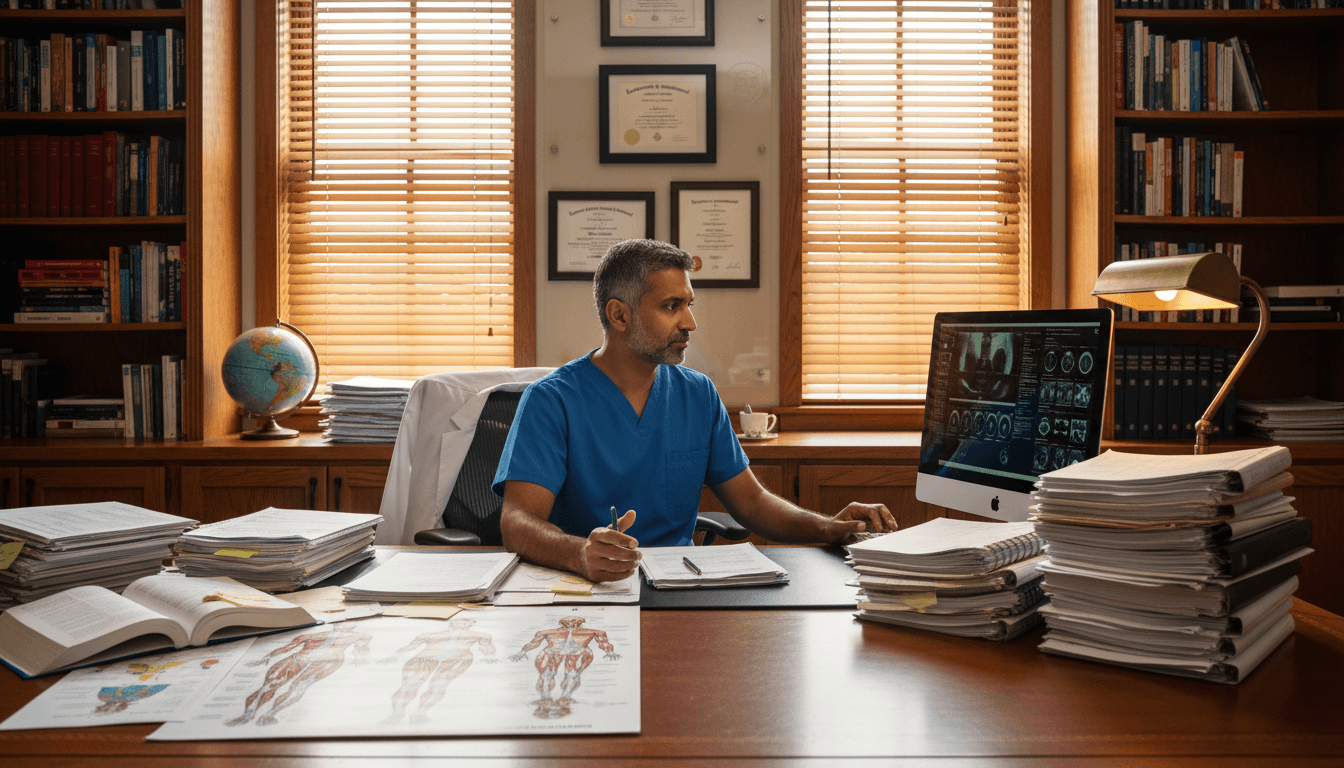
The Problem No One Talks About
You went into academic medicine to shape the next generation of physicians. You imagined mentoring residents through their first difficult diagnoses, refining simulation curricula, and being present — truly present — when a student finally connects the dots on a complex case.
Instead, it's 9:47 PM on a Tuesday, and you're still finishing documentation from clinic hours that ended at 4. Tomorrow morning, you're leading a clinical skills workshop you haven't had time to update since last semester. The lecture slides still reference an outdated treatment protocol. You know this. It gnaws at you.
The cruel irony of being a medical school director in 2026 is that the two roles you care about most — clinician and educator — are constantly cannibalizing each other. Every hour spent perfecting a patient note is an hour stolen from curriculum development. Every afternoon spent in a documentation backlog is an afternoon you weren't available for the struggling third-year who needed guidance.
You're not failing at either role. You're being asked to do two full-time jobs simultaneously, and the documentation burden is the invisible weight that makes the teaching role feel perpetually underfunded with your most finite resource: time.
Why This Keeps Happening
Academic medical centers have always demanded dual excellence — clinical productivity and educational impact. But the documentation side of that equation has quietly metastasized over the past decade.
Regulatory requirements have grown more complex. EHR systems, despite incremental improvements, still demand significant manual input. Quality metrics, compliance documentation, and payer requirements layer additional administrative tasks onto every patient encounter. For medical school directors who also maintain active clinical practices, these demands don't pause because you have a lecture to prepare or a curriculum committee meeting in the morning.
Meanwhile, medical education itself has become more documentation-heavy. Competency-based assessments, LCME accreditation requirements, student evaluation narratives, and simulation debriefing records all require thoughtful, detailed written output. You're documenting on both sides of your professional identity.
The systemic assumption is that academic physicians will simply absorb this expanding workload. Institutions hire scribes for high-volume emergency departments but rarely extend that support to faculty who split their time between clinic and classroom. The result is predictable: documentation bleeds into evenings, weekends, and the margins of time that should belong to teaching, scholarship, or personal recovery.
This isn't a time management problem. It's a structural one. And no amount of inbox-zero strategies or productivity hacks will fix a workload designed for two people being carried by one.
The Real Cost of Balancing Teaching Responsibilities with Documentation Demands
The costs are real, measurable, and compounding — even when institutions choose not to measure them.
Educational quality suffers silently. When documentation consumes your cognitive reserves, you show up to the classroom depleted. Lectures become maintenance rather than inspiration. You rely on last year's materials because there's no bandwidth to innovate. Students notice — not always consciously, but in the difference between a professor who is fully engaged and one who is running on fumes.
Clinical documentation itself degrades. Rushed notes written at 10 PM after a full teaching day are more prone to errors, omissions, and copy-paste artifacts. This creates downstream risks for patient safety, billing accuracy, and medicolegal exposure — risks that fall squarely on your shoulders.
Burnout accelerates. The American Medical Association has extensively documented the relationship between administrative burden and physician burnout. For medical school directors, this burden is amplified by the emotional weight of feeling like you're shortchanging students who depend on you. The guilt is specific and relentless: you became an educator because it mattered to you, and documentation is the thing standing between you and doing it well.
Retention and recruitment suffer. When talented clinician-educators watch their directors drowning in documentation, they question whether academic medicine is sustainable as a career. Institutions lose faculty not to higher salaries elsewhere, but to the quiet realization that the workload is incompatible with the work they actually want to do.
Scholarship stalls. Research, publication, and curriculum innovation — the activities that advance careers and institutional reputation — require protected time that documentation relentlessly erodes. Promotion timelines stretch. Grant applications go unwritten. The academic mission suffers at its foundation.
What Leading Medical School Directors Are Doing Differently in 2026
The medical school directors who have reclaimed their time in 2026 didn't do it by working harder or sleeping less. They did it by fundamentally rethinking which parts of their workflow require their unique expertise — and which don't.
The insight is straightforward: your clinical judgment, your diagnostic reasoning, your ability to connect with a patient and synthesize a complex presentation — these are irreplaceable. The act of translating that encounter into structured documentation, however, is a task that AI can now handle with remarkable accuracy.
Forward-thinking academic physicians are integrating AI medical scribing into their clinical workflows, not as a novelty but as essential infrastructure. They're dictating naturally during or after patient encounters and receiving polished, accurate clinical notes within minutes — notes that would have taken 15 to 30 minutes of manual EHR entry to produce.
The reclaimed time isn't trivial. If you see even a modest number of patients per week alongside your teaching duties, eliminating manual documentation can return hours to your schedule every single week. Hours that go directly back into the work that defines your career: teaching, mentoring, curriculum development, and being genuinely available to your students and residents.
This isn't about replacing clinical rigor. It's about refusing to let administrative mechanics consume the time that should belong to education and patient care.
How Scribing.io Solves Balancing Teaching Responsibilities with Documentation Demands
Scribing.io was built for exactly this tension — the clinician who needs documentation to be accurate and thorough, but who also has somewhere critically important to be afterward.
Ambient AI scribing that works with your workflow, not against it. Scribing.io captures your patient encounters and generates structured, specialty-aware clinical notes automatically. You review, edit if needed, and finalize. The cognitive load of documentation drops dramatically.
Notes that meet the standard you'd set for yourself. As a medical school director, you teach students how to write proper notes. Scribing.io produces documentation that reflects clinical best practices — detailed, organized, and compliant. You're not sacrificing quality; you're protecting it by ensuring notes are generated when your encounter is fresh, not hours later when details have faded.
Time recaptured where it matters most. The 60 to 90 minutes per day that many physicians spend on after-hours documentation is time that, for you, has an outsized opportunity cost. That's a lecture refined. A struggling student mentored. A simulation exercise redesigned. A research abstract finally submitted. Scribing.io gives that time back.
No IT integration headaches. Academic medical centers have notoriously complex technology ecosystems. Scribing.io is designed for rapid adoption — it doesn't require months of IT coordination or institutional procurement cycles to start delivering value.
Built for the physician who teaches. Many AI scribing tools are designed for high-volume clinical settings. Scribing.io understands that some of its most important users are physicians whose clinical practice is one half of a dual mission. The platform is designed to be fast, flexible, and respectful of the fact that your next obligation after clinic might be a lecture hall, not another patient room.
Getting Started Takes Less Than 10 Minutes
You've spent years developing the expertise to train future physicians. You shouldn't have to spend your evenings proving that expertise to an EHR system one click at a time.
Scribing.io takes less than 10 minutes to set up. There's no lengthy onboarding, no complex integration, no waiting for institutional approval to begin exploring how it works.
Start with your next clinic session. Experience what it feels like to walk out of your last patient encounter and head straight to your teaching responsibilities — without a documentation backlog following you home.
Your students deserve a director who has the time and energy to teach at their best. Your patients deserve notes written with full attention. You deserve to stop choosing between the two roles you worked your entire career to hold simultaneously.
Try Scribing.io Free — and find out what your evenings look like when documentation no longer owns them.


