Posted on
Jan 15, 2026
Why Neurologists Are Still Losing Hours to Complex Neurological Assessment and Examination Documentation in 2026 (And How to Stop)
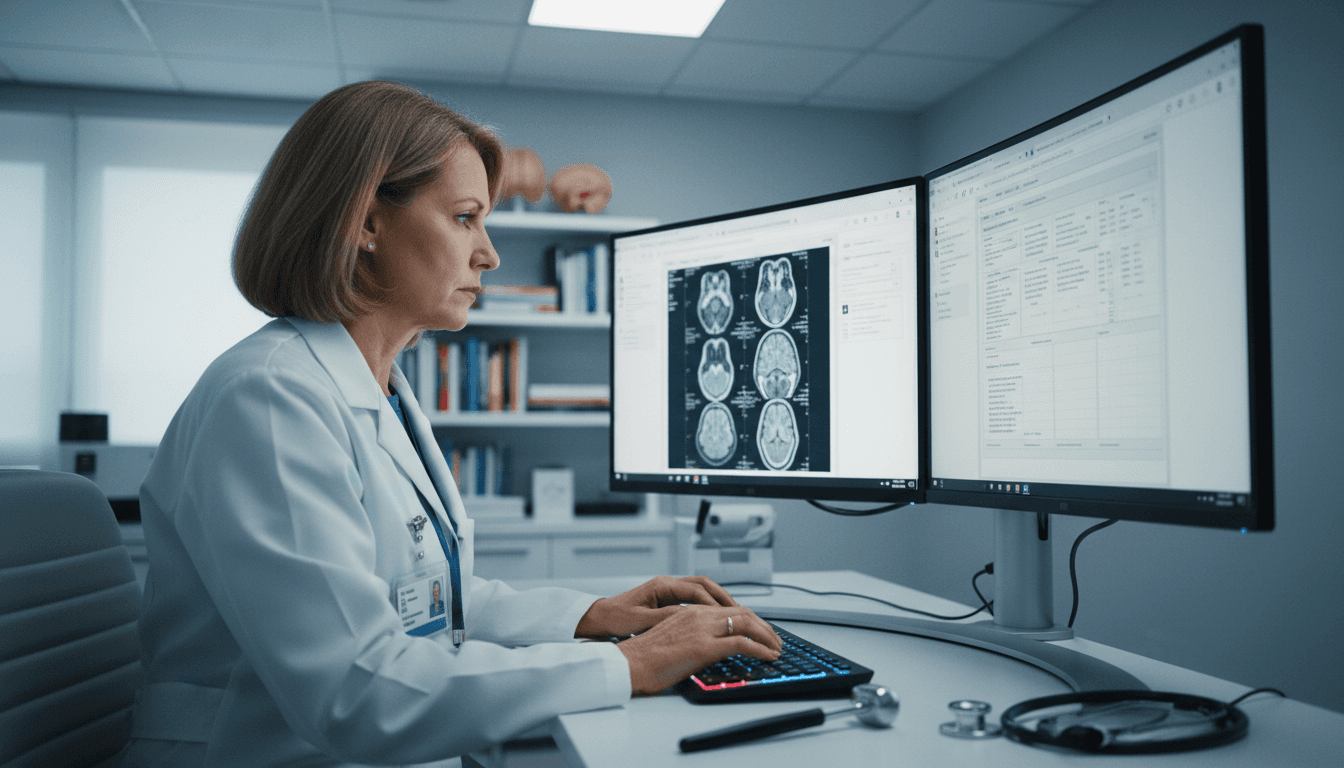
The Problem No One Talks About
You just finished a forty-five-minute evaluation of a patient with progressive gait instability, mixed upper and lower motor neuron signs, subtle cerebellar findings, and a cranial nerve exam that told three different stories depending on how you interpreted the fatigue component. You know exactly what you found. You understand the clinical significance of every reflex grade, every drift pattern, every saccadic intrusion.
Now you have to translate all of that — the full mental status examination, the twelve cranial nerves, the detailed motor and sensory assessment, the coordination testing, the gait analysis, the reflex map — into documentation that's medically precise, legally defensible, billable, and actually useful to the next clinician who reads it.
And you have eleven minutes before your next patient walks in.
This is the moment that quietly erodes the careers of brilliant neurologists. Not the clinical complexity — you trained for that. The documentation of that complexity. The part where you sit in front of a screen trying to capture the nuance of a neurological examination that took years of training to perform, while an EHR template fights you at every turn with checkboxes that were clearly designed for a different specialty.
If you've ever stayed two hours past your last patient to finish notes, if you've ever felt that creeping dread on Sunday night knowing Monday's documentation is still waiting, if you've ever caught yourself rushing through an exam because you were already behind on charting — you're not alone. And you're not failing. The system is failing you.
Why This Keeps Happening
Neurology is, by its nature, the most documentation-intensive specialty in medicine. No other field requires the same density of structured physical examination findings in a single encounter. A comprehensive neurological exam can involve dozens of discrete, lateralized findings across multiple functional domains — each of which carries diagnostic weight and must be recorded with precision.
Yet the tools most neurologists are given to document this work were built for generalists. Standard EHR templates collapse the neurological exam into a handful of normal/abnormal toggles. They don't accommodate lateralized reflex grading. They don't capture the difference between a pronator drift and an upward drift with finger spreading. They don't distinguish between appendicular and truncal ataxia. They certainly don't allow you to narrate the subtle progression pattern you noticed when comparing today's exam to one from six months ago.
So neurologists develop workarounds. Some build elaborate dot phrases and macros. Some dictate lengthy free-text notes and hope they'll be coherent when reviewed. Some resort to templated normals and only document positives, knowing this creates medicolegal risk. Some hire human scribes — when they can find them, afford them, and train them to understand the difference between dysdiadochokinesia and dysmetria.
Every workaround costs something. Time. Accuracy. Completeness. Revenue. Sanity.
The fundamental problem hasn't changed: the volume and complexity of neurological documentation has only increased — with expanding quality metrics, prior authorization requirements, and payer scrutiny — while the time available to complete it has only decreased.
The Real Cost of Complex Neurological Assessment and Examination Documentation
The cost is not abstract. It compounds daily and manifests in ways that are both measurable and deeply personal.
Clinical time lost: Neurologists routinely report spending more time on documentation than on direct patient care. Every hour spent charting after clinic is an hour not spent with family, not spent on continuing education, not spent recovering from the cognitive demands of a specialty that requires relentless pattern recognition.
Diagnostic fidelity at risk: When documentation is rushed, critical findings get compressed or omitted. A subtle asymmetry in plantar responses that wasn't captured today becomes invisible to the neurologist reviewing the chart in three months. The longitudinal narrative — the single most valuable diagnostic tool in neurology — degrades.
Revenue left behind: Complex neurological evaluations often support higher-level E/M coding and justify the medical necessity of advanced imaging, electrodiagnostic studies, and specialty referrals. When documentation doesn't fully reflect the complexity of the encounter, practices under-code. Over time, this revenue gap is substantial.
Burnout that drives attrition: Documentation burden is consistently identified as a primary driver of physician burnout across specialties, and neurology's documentation demands are among the highest. The specialty is already facing workforce shortages. Every neurologist who reduces clinical hours or leaves practice because of administrative burden represents a loss the healthcare system cannot easily absorb.
Perhaps most painfully: you didn't endure a neurology residency — the long call nights, the grueling board preparation, the years of fellowship — to become a data entry specialist. The documentation burden isn't just inefficient. It's an insult to your expertise.
What Leading Neurologists Are Doing Differently in 2026
The neurologists who have found a sustainable way forward share a common realization: the solution isn't working harder at documentation. It's fundamentally changing how documentation happens.
In 2026, AI-powered ambient medical scribing has matured beyond the early-generation tools that struggled with medical terminology and produced notes requiring extensive editing. The current generation of AI scribes can listen to a complex neurological encounter in real time — including the rapid-fire findings of a cranial nerve exam, the lateralized details of motor testing, and the nuanced language neurologists use to describe gait patterns — and produce structured, comprehensive documentation that reflects the actual clinical encounter.
Forward-thinking neurologists are no longer choosing between thoroughness and efficiency. They're conducting their exams the way they were trained, narrating their findings naturally as they examine the patient, and walking out of the room with a note that's already drafted — organized, detailed, and ready for review.
This isn't about replacing clinical judgment. It's about removing the bottleneck between clinical judgment and its documentation. The exam still requires your expertise. The interpretation still requires your training. But the transcription, organization, and formatting of that work? That's exactly the kind of task that AI handles exceptionally well — and that was never a good use of a neurologist's time in the first place.
How Scribing.io Solves Complex Neurological Assessment and Examination Documentation
Scribing.io was built for exactly this problem. Not as a generic transcription tool adapted for medicine, but as an AI medical scribe platform designed to handle the documentation demands of the most complex specialties — neurology foremost among them.
Here's what that means in practice:
It understands neurological language. Scribing.io captures and correctly documents the specialized terminology of neurological assessment — from cranial nerve findings and reflex grading to sensory modality testing and coordination exam results. When you say "four-plus reflexes at the patellae bilaterally with sustained clonus at the ankles and upgoing toes on the left," the output reflects exactly that, organized appropriately within the exam documentation.
It preserves lateralization and granularity. Neurological exams are inherently lateralized and graded. Scribing.io maintains this structure, ensuring that left-right distinctions, proximal-distal gradients, and specific grading scales are documented accurately rather than collapsed into generic summaries.
It generates notes in real time. The documentation is produced during the encounter, not after. By the time you finish with a patient, the note is ready for your review. The two-hour evening charting marathon becomes a brief review session — if that.
It supports your clinical narrative. For neurologists, the assessment and plan is where clinical thinking lives. Scribing.io captures your reasoning as you articulate it, preserving the diagnostic narrative that makes neurological documentation genuinely useful for longitudinal care.
It integrates into existing workflows. Scribing.io works with the EHR systems neurologists already use, so adoption doesn't require rebuilding your practice infrastructure. It fits into your workflow rather than demanding you reshape your workflow around it.
The result: documentation that reflects the true complexity of your neurological evaluations, completed in a fraction of the time, without sacrificing accuracy or completeness.
Getting Started Takes Less Than 10 Minutes
You've spent years mastering the neurological examination. You shouldn't have to spend years more fighting with documentation systems that weren't built for what you do.
Scribing.io is designed for rapid onboarding. You can create your account, configure your preferences, and begin using AI-assisted documentation in your next clinical session — all in under ten minutes. There's no lengthy implementation process, no mandatory training curriculum, no IT department bottleneck.
Start with a single clinic session. See what your note looks like when an AI scribe built for neurological complexity does the documentation work. Notice what it feels like to walk out of the exam room without charting debt following you home.
Then decide if you want to keep practicing the way you have been — or if you're ready to reclaim the time and energy that complex neurological documentation has been taking from you.


