Posted on
Jan 24, 2026
Why Speech Language Pathologists Are Still Losing Hours to Progress Note Documentation for Ongoing Speech Therapy Sessions in 2026 (And How to Stop)
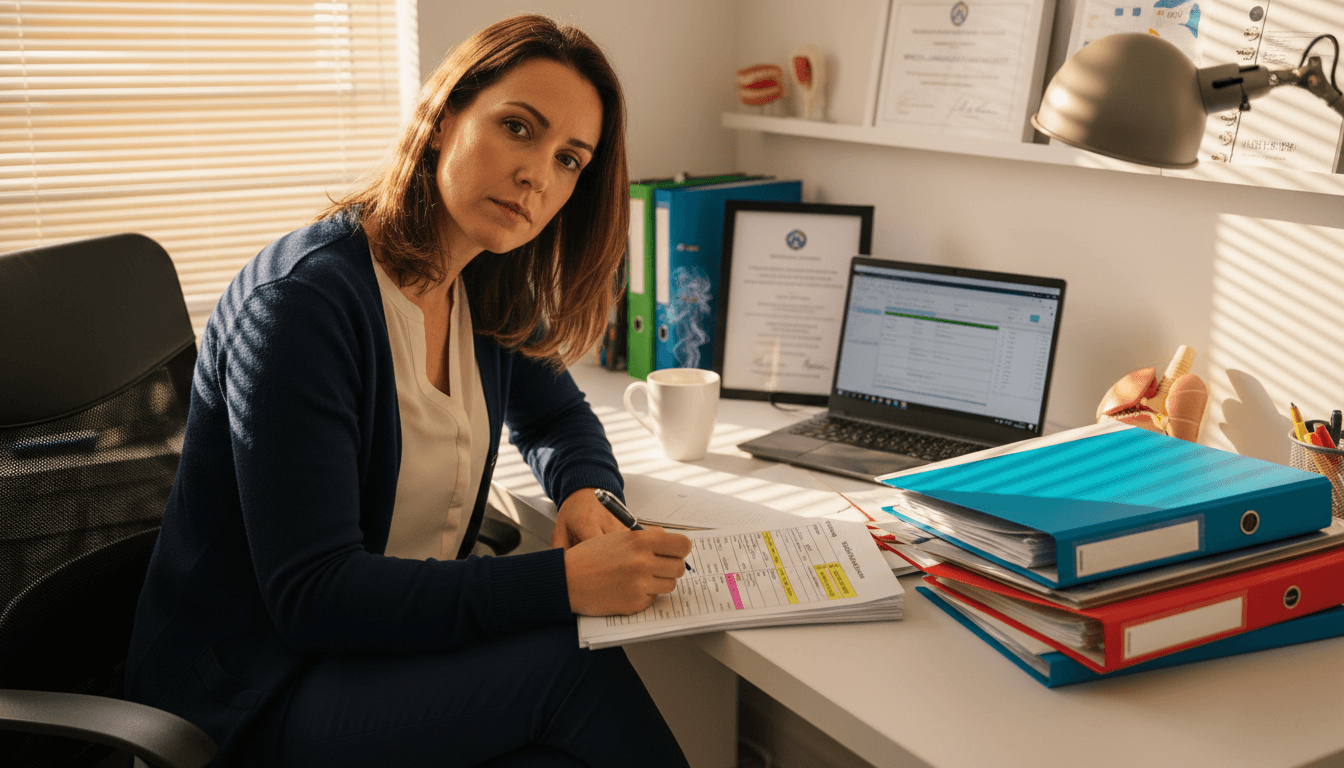
You became a Speech Language Pathologist to help a child finally say their sibling's name. To watch a stroke survivor order their own coffee again. To be the person in the room who listens more carefully than anyone else. You did not become an SLP to spend your evenings writing the same functional phrases into the same progress note templates, session after session, wondering if anyone even reads them.
And yet here you are. Again.
The Problem No One Talks About
Progress note documentation for ongoing speech therapy sessions is one of the most quietly exhausting parts of being an SLP. Not because any single note is particularly difficult — but because the notes never stop. Every session needs one. Every patient's progress needs to be captured with enough clinical specificity to satisfy insurance reviewers, enough detail to demonstrate medical necessity, and enough nuance to actually be useful if another clinician picks up the case.
The initial evaluation gets attention. Discharge summaries feel like an ending. But the progress notes for ongoing sessions? They live in a documentation purgatory — critically important, endlessly repetitive, and rarely discussed in terms of the toll they take on you.
You might see 8, 10, even 15 patients in a day. Each one needs a note that reflects their unique goals, the specific stimuli you used, their percentage accuracy across trials, the cueing hierarchy you employed, their engagement level, and your clinical interpretation of all of it. Multiply that by five days a week, by years of practice, and you start to understand why so many SLPs describe documentation as the thing that's slowly pushing them toward burnout.
The worst part? You care about doing it well. You know these notes matter. So you can't bring yourself to cut corners — which means the time has to come from somewhere. Usually, it comes from your lunch, your evening, or your weekend.
Why This Keeps Happening
There are structural reasons why progress note documentation for ongoing speech therapy sessions remains so burdensome, even in 2026.
Speech therapy documentation demands granularity that other disciplines don't always require. You're not just noting that a patient "tolerated treatment well." You're documenting specific phonemes targeted, types of dysfluencies observed, cuing levels provided (verbal, visual, tactile), response accuracy broken down by task, and how all of this maps to functional communication goals. The clinical specificity required is immense.
EHR systems weren't designed for SLP workflows. Most electronic health record platforms were built around physician encounters — chief complaint, examination, assessment, plan. SLP sessions don't follow that rhythm. You're tracking goal-by-goal progress across multiple domains (articulation, language, fluency, voice, pragmatics, swallowing) within a single session. The templates rarely fit, so you end up free-typing into text boxes that give you no structural support.
Insurance and compliance pressures keep escalating. Payers increasingly require documentation that clearly demonstrates skilled intervention, ongoing medical necessity, and measurable progress. A note that simply says "Patient made progress toward goals" won't survive an audit. You have to show your clinical reasoning in every note, which adds time and cognitive load.
Copy-forward is a trap. Many SLPs resort to copying their last progress note and modifying it. This saves a few minutes but introduces serious risks — outdated information carries over, notes start to look identical (which triggers audit flags), and the documentation stops reflecting what actually happened in the session. You know this. That's why you feel uneasy every time you do it.
You're doing the documentation alone. Physicians often have medical assistants, scribes, or residents who help with notes. SLPs almost never do. The clinician who ran the session is the same person who documents it, often hours later when the details are already fading.
The Real Cost of Progress Note Documentation for Ongoing Speech Therapy Sessions
Let's talk about what this documentation burden is actually costing you — because it goes far beyond time.
Clinical quality suffers. When you're mentally composing progress notes during a session, you're not fully present with your patient. When you're documenting at 8 PM, you're reconstructing from memory rather than capturing what you observed in real time. The notes become less accurate, and your clinical reasoning becomes harder to articulate.
Reimbursement is at risk. Incomplete or insufficiently detailed progress notes are one of the leading reasons for speech therapy claim denials. If a note doesn't clearly demonstrate why skilled intervention was necessary and what measurable progress occurred, the payer can (and will) deny or recoup payment. Every note you rush is a financial liability.
Burnout is accelerating. Research consistently shows that documentation burden is a primary driver of burnout across healthcare professions, and SLPs are no exception. The American Speech-Language-Hearing Association has repeatedly highlighted workload concerns among its members, with administrative tasks — especially documentation — cited as a major contributor to professional dissatisfaction.
You're losing the career you love. This is the cost that's hardest to quantify. You didn't train for years to become a documentation specialist. Every hour spent on progress notes is an hour not spent on continuing education, mentoring a CF, researching a new treatment approach, or simply resting so you can show up fully for tomorrow's patients. The documentation is slowly displacing the work that gives your career meaning.
What Leading Speech Language Pathologists Are Doing Differently in 2026
Something is shifting. Across clinics, hospitals, schools, and private practices, a growing number of SLPs are fundamentally rethinking how they approach progress note documentation for ongoing sessions.
The change isn't about working harder or developing better templates (you've tried that). It's about recognizing that artificial intelligence has matured enough to handle the heavy lifting of clinical documentation — not by replacing your clinical judgment, but by capturing it in real time so you don't have to reconstruct it later.
The SLPs who are reclaiming their time in 2026 share a common approach:
They document during the session, not after. Using AI-powered ambient scribing, they let technology listen to the session and generate a structured draft note in real time. The session flows naturally — no typing, no clicking, no pausing to chart.
They review and refine rather than create from scratch. Instead of staring at a blank note and pulling details from memory, they edit an AI-generated draft that already contains the relevant clinical details, goal tracking, and session specifics. Editing a good draft takes minutes. Writing from scratch takes much longer.
They maintain clinical specificity without the time penalty. Because the AI captures what was actually said and done during the session, the notes reflect the granular detail that SLP documentation requires — cueing levels, accuracy data, specific targets, and functional progress — without the clinician having to manually input every data point.
They leave work on time. This sounds simple, but for many SLPs, it's revolutionary.
How Scribing.io Solves Progress Note Documentation for Ongoing Speech Therapy Sessions
Scribing.io is an AI medical scribe platform built to understand the unique documentation demands of healthcare providers — including the specialized workflows of Speech Language Pathologists.
Here's how it addresses the specific challenges of ongoing therapy progress notes:
Ambient AI that understands SLP sessions. Scribing.io listens to your therapy session and generates a clinical progress note that captures the structure and specificity your documentation requires. It recognizes the difference between a language formulation task and an artic drill. It captures cueing hierarchies, patient responses, and the clinical narrative that connects your intervention to your patient's goals.
Notes that reflect what actually happened. Because Scribing.io works from the real-time content of your session, the resulting notes are accurate and session-specific — not recycled templates with minor edits. This reduces audit risk and ensures each note genuinely reflects the skilled intervention you provided.
Built for the way SLPs work. Unlike EHR documentation tools that force you into physician-centric templates, Scribing.io generates notes that align with how speech therapy is actually delivered — goal-oriented, data-driven, and focused on functional outcomes.
Review in minutes, not hours. After your session, you review the AI-generated draft, make any adjustments, and finalize. Most clinicians using Scribing.io report that what used to take 15–20 minutes per note now takes a fraction of that time. Over a full caseload day, those minutes compound into hours returned to your life.
HIPAA-compliant and secure. Scribing.io was built for healthcare from the ground up. Your patients' information is protected with the security standards your practice demands.
Getting Started Takes Less Than 10 Minutes
You don't need IT support. You don't need to overhaul your workflow. You don't need to sit through a three-hour training module.
You sign up, familiarize yourself with the platform, and start your next session. Scribing.io works alongside you — quietly, accurately, and without disrupting the therapeutic relationship you've worked so hard to build with your patients.
If you've been spending your evenings and weekends catching up on progress notes, if you've felt the slow creep of documentation fatigue eroding your love for this profession, if you've been looking for a solution that actually understands the complexity of SLP documentation — this is it.
You deserve to finish your notes before you leave the building. You deserve to be fully present during every session. You deserve to remember why you chose this career.
Try Scribing.io Free — and find out what it feels like to get your time back.


