Posted on
Jan 26, 2026
Why Wound Care Nurses Are Still Losing Hours to Detailed Wound Measurement and Treatment Protocol Documentation in 2026 (And How to Stop)
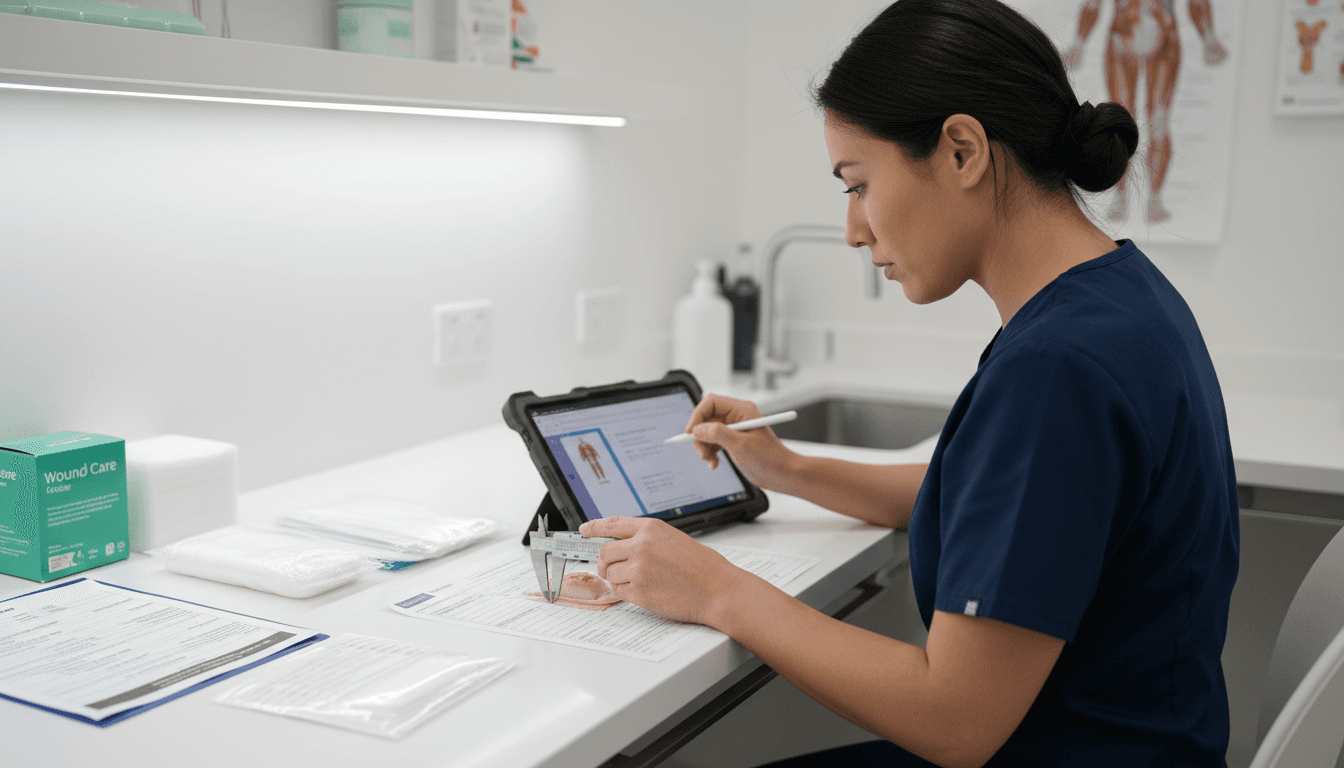
The Problem No One Talks About
You just spent forty-five minutes with a patient who has a Stage III sacral pressure injury with undermining at the 3 o'clock position, tunneling at 7 o'clock, moderate serosanguinous drainage, and a wound bed that's 60% granulation, 30% slough, and 10% eschar. You debrided. You measured — length, width, depth, tunneling depth, undermining extent. You selected a new dressing protocol, educated the patient's caregiver, and coordinated with the provider on antibiotic concerns.
Now you sit down at your computer, and you have to recreate every single detail of that encounter in documentation that will satisfy regulatory requirements, support reimbursement, demonstrate medical necessity, and communicate clearly to every clinician who touches this patient's care next.
And you have eleven more patients today.
This is the reality that wound care nurses live inside every single shift. Not the glamorous clinical challenge of wound assessment — the crushing administrative weight of translating that assessment into documentation that is simultaneously precise enough for auditors, narrative enough for continuity of care, and structured enough for EMR fields that were never designed for the complexity of wound care.
You didn't become a wound care nurse to type. You became one because you're the person who sees what others miss — the subtle color change that signals infection, the millimeter of progress that means a treatment plan is working, the patient's face when they finally see healing. But documentation has become the thing that stands between you and the next patient who needs exactly that level of attention.
Why This Keeps Happening
Wound care documentation is uniquely brutal, and there are structural reasons it hasn't gotten easier despite decades of EMR evolution.
Wound assessments are inherently multidimensional. A single wound requires documentation of location, stage or classification, dimensions (length × width × depth), wound bed composition by percentage, periwound skin condition, exudate type and volume, odor, tunneling and undermining with clock-face directional notation, pain assessment, signs of infection, and photographic evidence. Multiply that by the number of wounds per patient — and many of your patients have more than one.
Treatment protocols require layered clinical reasoning. You're not just recording what you did. You're documenting why you chose sharp debridement over enzymatic, why you switched from a foam to an alginate, why you're recommending a nutritional consult, and how this visit's findings compare to the last three assessments. Payers and auditors expect this reasoning to be explicit and defensible.
EMR templates weren't built for you. Most electronic health records treat wound documentation as a checkbox exercise or force you into free-text fields with no structure. Neither approach works. Checkboxes can't capture the nuance of a wound that's improving in one quadrant and deteriorating in another. Free text takes forever and introduces inconsistency that creates problems downstream.
Regulatory and reimbursement stakes are enormous. Incomplete wound documentation is one of the leading causes of claim denials in home health, long-term care, and outpatient wound clinics. Medicare requires specific, measurable, objective data to justify medical necessity for advanced wound care products and services. A missing depth measurement or an imprecise wound bed description can mean a denied claim — or worse, a compliance flag.
So you document meticulously. Because you have to. And it costs you something every single day.
The Real Cost of Detailed Wound Measurement and Treatment Protocol Documentation
The cost isn't abstract. It's measured in the things you lose.
Time with patients. Every minute spent reconstructing a wound assessment in your EMR is a minute you're not at a bedside. Wound care nurses routinely report that documentation consumes as much time as — or more time than — direct patient care. That ratio is unsustainable, and you feel it in your body by the end of every shift.
Clinical accuracy. When you document hours after an assessment — or at the end of a day filled with complex wounds — details blur. Was the undermining 2.5 cm or 3 cm? Was the periwound erythema extending 1 cm or 2 cm from the wound edge? You know the difference matters. The pressure of remembering precisely, across multiple patients, is a cognitive burden that compounds with every encounter.
Your own wellbeing. Documentation burden is a primary driver of burnout among nurses in every specialty, but wound care nurses carry a disproportionate load because of the sheer density of required data points per encounter. Charting at home after a full day of patient care isn't dedication — it's a system failure that's been normalized. You deserve better than spending your evenings reconstructing wound measurements from memory.
Continuity of care. When documentation is rushed or incomplete, the next clinician who sees your patient doesn't have the full picture. Wound care depends on trend data — is this wound getting smaller? Is the wound bed composition shifting toward granulation? Is the treatment protocol working? Inconsistent documentation breaks the thread of clinical reasoning that drives healing outcomes.
What Leading Wound Care Nurses Are Doing Differently in 2026
The wound care nurses who have reclaimed their time — and their clinical focus — haven't found a way to document less. They've found a way to document differently.
They're using AI-powered medical scribing tools that capture clinical encounters in real time and generate structured, specialty-specific documentation that reflects the full complexity of wound assessment and treatment planning.
Instead of sitting down after a visit to manually reconstruct every wound measurement, every dressing change rationale, and every clinical observation, they speak naturally during or immediately after the encounter — describing what they see, what they measured, what they did, and why. The AI translates that clinical narrative into comprehensive, properly formatted documentation.
This isn't dictation software from a decade ago. This is AI that understands wound care terminology — that knows the difference between undermining and tunneling, that correctly formats clock-face directional notation, that structures wound bed composition percentages, and that captures the clinical reasoning behind treatment protocol decisions in language that satisfies payers and surveyors.
The result is documentation that's more detailed, more consistent, and more defensible — produced in a fraction of the time.
How Scribing.io Solves Detailed Wound Measurement and Treatment Protocol Documentation
Scribing.io was built for exactly this kind of clinical documentation challenge — encounters where the density of required detail is high, the terminology is specialized, and the stakes of incomplete documentation are real.
Speak your assessment, get structured documentation. As you assess a wound, you describe what you see in your own clinical language. Scribing.io captures your spoken observations and generates documentation that includes precise wound measurements, wound bed composition, periwound assessment, exudate characteristics, staging or classification, and treatment interventions — all structured in the format your EMR and your organization require.
Clinical reasoning is preserved, not lost. When you explain why you chose a specific debridement method or changed a dressing protocol, Scribing.io captures that reasoning and integrates it into the clinical note. This is the documentation that demonstrates medical necessity, supports reimbursement, and communicates your clinical thinking to every provider who follows you.
Consistency across encounters and across patients. Wound healing depends on reliable trend data. Scribing.io produces documentation with consistent terminology and structure from visit to visit, making it possible to track wound progression accurately over time. No more variation in how measurements are recorded or how wound bed descriptions are phrased between one visit and the next.
Built for the complexity wound care demands. Scribing.io handles multi-wound patients, clock-face directional notation for tunneling and undermining, percentage-based wound bed composition, comparison to prior assessments, and the layered treatment documentation that wound care requires. It doesn't simplify your clinical work — it captures it fully so you don't have to spend your evening recreating it.
Compliance-ready documentation. The notes Scribing.io generates include the specific, measurable, objective data that Medicare and other payers require for wound care reimbursement. Detailed measurements, clinical justification for treatment choices, and evidence of skilled nursing assessment are captured as part of your natural clinical workflow — not retrofitted during a late-night charting session.
Getting Started Takes Less Than 10 Minutes
You don't need IT approval, a hardware purchase, or a workflow overhaul. Scribing.io works on the devices you already use. You can sign up, complete your first wound care encounter with AI-assisted documentation, and see the output in under ten minutes.
Imagine finishing your last patient visit and being done — actually done. No charting backlog. No documentation guilt. No wound measurements fading from memory while you wait for a computer to free up.
That's not a fantasy. It's what wound care nurses using Scribing.io experience every day.
Try Scribing.io Free and see what your documentation looks like when AI captures the full complexity of your wound care expertise — so you can get back to the work that actually heals.


