AI Scribing for Ophthalmologists: Dark-Room Workflows That Generic Scribes Can't Handle
Discover how AI scribing solves ophthalmology's unique dark-room documentation challenges—hands on slit lamp, lights off, no keyboard. Purpose-built for eye MDs.
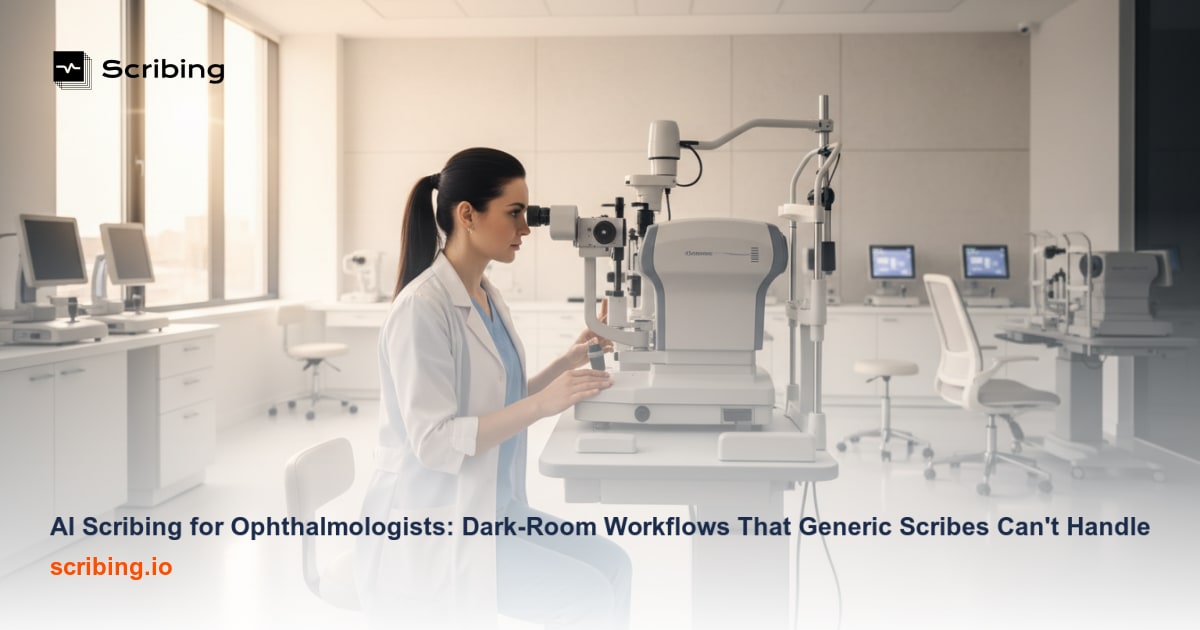
AI Scribing for Ophthalmologists: Dark-Room Workflows
How Scribing.io Solves the Hands-on-Slit-Lamp, Lights-Off Documentation Gap That Generic Vision Clinic Scribes Ignore
TL;DR: Generic AI scribes treat ophthalmology like any other "vision clinic"—transcribing exam dialogue into free-text draft notes that a doctor must later read and approve on-screen. This model collapses inside a dark exam room where the surgeon's hands are on a slit lamp and eyes are fixed on the oculars. Scribing.io is purpose-built for that exact constraint: it extracts laterality (OD/OS), numeric IOP values, tonometry method, and unit (mmHg) from ambient speech; writes them to discrete EHR flowsheet fields via FHIR Observation; reads everything back aloud for verbal confirmation before committing; and fires clinical threshold alerts—all without the physician ever looking at a screen, touching a keyboard, or breaking sterility. This is the definitive clinical-library playbook for glaucoma specialists evaluating AI scribes.
Contents
Why "Vision Clinic AI Scribes" Fail Glaucoma Specialists
Clinical Logic: The Dimly Lit Glaucoma Follow-Up Where Conventional ASR Fails
The Audio-Confirmation Loop: Step-by-Step Engineering
FHIR Observation Architecture: Discrete Data, Not Free Text
EHR Module Quirks: Epic Kaleidoscope, NextGen, and IRIS Registry Export
Technical Reference: ICD-10 Documentation Standards
Cross-Specialty Pattern Recognition
Implementation Checklist for Glaucoma Practices
Live Demo: Dark-Room IOP Audio-Confirmation
Why "Vision Clinic AI Scribes" Fail Glaucoma Specialists: The Dark-Room, Hands-Busy Gap No Competitor Addresses
The generic ophthalmology AI scribe market frames the problem as "documentation efficiency for vision clinics." Their marketing mentions customizable templates, real-time transcription, and draft eye exam notes the provider reviews for accuracy after the visit. Every word of that workflow assumes two things:
The physician can see a screen to review the draft.
The physician has free hands to edit or approve it.
Neither assumption holds during the clinical encounter that matters most in glaucoma care: the slit-lamp examination. This is not a niche edge case. The American Academy of Ophthalmology's diagnostic guidelines position Goldmann applanation tonometry at the slit lamp as the reference-standard IOP measurement. Every glaucoma follow-up—every suspect evaluation, every post-operative pressure check—runs through this exact physical setup.
The audio-confirmation architecture that Scribing.io deploys for ophthalmology emerged from this constraint. Similar domain-specific logic drives our work in Cardiology, where auscultation demands hands-on-stethoscope documentation, and Family Medicine, where multi-problem visits require structured capture across problem lists. But ophthalmology's dark-room constraint is uniquely unforgiving: the surgeon literally cannot see the screen.
The Physical Reality Competitors Miss
During slit-lamp–based IOP measurement, Goldmann applanation tonometry, or gonioscopy:
The room is dark or dim—pupil dilation and biomicroscopic visualization require low ambient light, per standard clinical protocol outlined in the AAO Preferred Practice Pattern for Primary Open-Angle Glaucoma.
Both of the surgeon's hands are occupied—one controls the joystick and applanation prism; the other steadies the patient or adjusts illumination.
The surgeon's eyes are fixed on the oculars—they are viewing magnified anterior-segment anatomy through a biomicroscope, not a monitor.
A trained ophthalmic technician or assistant verbally reports IOP readings, visual acuities, pachymetry values, and other measurements.
In this environment, a "draft note for later review" is not just inefficient—it is clinically dangerous. If the AI mishears "twenty-six" as "sixteen," that transcription error sits silently in free text until the surgeon finishes the encounter, moves to a workstation, and manually reads the note. By then, the auditory memory of the original measurement has faded, and the surgeon may unknowingly sign off on a normal-tension reading that masks ocular hypertension. A PubMed-indexed analysis of documentation errors in ophthalmology has repeatedly identified laterality and numeric transposition as the most frequent and dangerous error categories.
The Competitive Gap, Quantified
Capability | Generic Vision Clinic AI Scribe | Scribing.io for Ophthalmology |
|---|---|---|
Dark-room verbal confirmation loop | ❌ Not offered | ✅ Audio read-back + verbal "confirm" gate |
Discrete IOP field posting (OD/OS) | ❌ Free-text draft note | ✅ FHIR Observation with |
Tonometry method capture | ❌ Not parsed | ✅ Goldmann / iCare / Tono-Pen normalized |
Laterality extraction (OD/OS/OU) | ❌ Not specified | ✅ Mapped to SNOMED body-site codes |
IOP threshold clinical alert | ❌ Not offered | ✅ Configurable per-patient target IOP |
CCD / IRIS Registry export safety | ❌ No discrete-data enforcement | ✅ Ensures IOP survives Epic Kaleidoscope and NextGen CCD exports |
Hands-free, eyes-free workflow | ❌ Requires post-visit screen review | ✅ Entire loop is auditory |
This is not a marginal UX improvement. It is the difference between a scribe that works around the ophthalmologist's exam and one that works inside it.
Clinical Logic: The Dimly Lit Glaucoma Follow-Up Where Conventional ASR Fails
The following scenario occurs dozens of times daily in any busy glaucoma practice. It exposes every failure mode of generic ambient AI scribing—and demonstrates why Scribing.io's architecture exists.
The Scenario
During a dimly lit glaucoma follow-up, the ophthalmic assistant reports, "Twenty-six OD, sixteen OS by Goldmann" while the surgeon's hands are on the slit lamp, performing gonioscopy on the fellow eye. The room lights are off. The surgeon's eyes are in the oculars.
What Goes Wrong with Conventional ASR
A generic ambient AI scribe, optimized for dictation-style speech and not ophthalmology-specific data structures, processes this audio and:
Mishears the asymmetry. In a dim, reverberant exam room with equipment fan noise, "twenty-six" and "sixteen" can acoustically collapse to "sixteen and sixteen"—especially when the AI lacks a laterality-aware language model that expects inter-eye IOP asymmetry as a glaucoma risk factor (JAMA Ophthalmology has documented that asymmetry >3 mmHg is clinically significant).
Writes free text. The draft note reads: "IOP 16/16 by Goldmann." This is embedded in a narrative paragraph, not a discrete field.
Waits for post-visit review. The surgeon, now three patients later, scans the note on a workstation. "16/16—looks normal." They sign the note.
The Clinical Consequences
Domain | Harm |
|---|---|
Clinical Safety | IOP of 26 mmHg OD is uncontrolled ocular hypertension. Documenting 16 mmHg masks disease progression. The surgeon does not escalate therapy—no medication change, no selective laser trabeculoplasty (SLT) referral, no surgical consultation. The optic nerve continues to degrade. |
Billing & Prior Authorization | When the practice submits prior authorization for SLT, the insurer pulls the most recent IOP from the medical record: 16 mmHg. SLT is indicated for uncontrolled IOP, not normal IOP. Prior auth is denied. The CMS ICD-10 coding framework requires documented clinical evidence supporting the procedure—evidence this erroneous record actively contradicts. |
Registry & Quality Reporting | The AAO's IRIS Registry requires discrete IOP data for MIPS quality measures. Free-text IOP trapped in a narrative note may not export correctly, leading to missing quality data and potential payment adjustments under the CMS Quality Payment Program. |
Medicolegal Risk | If the patient progresses to advanced visual field loss, chart review reveals the "16/16" documentation. The surgeon's defense—"I heard twenty-six"—is unsupported by any auditable confirmation. |
The Audio-Confirmation Loop: Step-by-Step Engineering
The anchor truth of Scribing.io's ophthalmology module: in a dark room with hands on the slit lamp, surgeons cannot verify text. AI must use an Audio-Confirmation loop where it verbalizes the IOP back to the doctor. Here is the granular logic breakdown.
Step 1: Ambient Capture with Ophthalmology-Trained Acoustic Model
Scribing.io's microphone array captures the technician's utterance: "Twenty-six OD, sixteen OS by Goldmann." Unlike general-purpose ASR engines (trained on broadcast speech and office dictation), the acoustic model is fine-tuned on ophthalmology exam-room recordings that include:
Equipment noise profiles: slit-lamp fan, pachymeter beeps, visual field machine hum
Multi-speaker overlap: technician reporting while surgeon comments to the patient
Ophthalmology-specific numeric patterns: IOP ranges (6–60 mmHg), visual acuity notation (20/20–20/400), pachymetry values (450–650 μm)
Step 2: Structured Extraction (Not Transcription)
The NLP engine does not produce a sentence of text. It produces a structured observation with four discrete elements per eye:
Element | Extracted Value (OD) | Extracted Value (OS) | Source Standard |
|---|---|---|---|
Numeric IOP | 26 | 16 | Parsed from speech |
Unit | mmHg | mmHg | Normalized (default for IOP) |
Laterality | Right eye (OD) | Left eye (OS) | SNOMED CT: 18944008 / 8966001 |
Method | Goldmann applanation | Goldmann applanation | SNOMED CT: 252832004 |
The system expects inter-eye asymmetry in glaucoma patients. A 10 mmHg difference (26 vs. 16) does not trigger an extraction-confidence downgrade; it is flagged as clinically relevant, increasing the priority of the read-back.
Step 3: Audio Read-Back (The Critical Safety Mechanism)
Within two seconds of extraction, the system speaks aloud through the exam-room speaker:
"Confirm IOP: 26 millimeters of mercury, right eye. 16 millimeters of mercury, left eye. Method: Goldmann applanation."
Design decisions embedded in this read-back:
"Millimeters of mercury" not "mmHg"—eliminates abbreviation ambiguity in the auditory channel.
"Right eye" / "left eye" not "OD" / "OS"—follows the Joint Commission's "Do Not Use" abbreviation guidance for verbal communication, which cautions against OD/OS/OU due to confusion risk.
Higher IOP value stated first—draws the surgeon's attention to the clinically significant measurement.
Method stated last—confirms the tonometry type without interrupting the numeric data.
Step 4: Verbal Confirmation Gate
The system enters a confirmation-pending state. Data is not written to the EHR. The surgeon must respond with one of three commands:
"Confirm"—values accepted; system proceeds to FHIR commit.
"Correct [detail]"—e.g., "Correct right eye to twenty-four." The system re-extracts, re-reads the corrected value, and re-requests confirmation.
Silence or "Hold"—the system queues the pending values and re-surfaces them at the next interaction break (e.g., when the surgeon lifts off the slit lamp).
This gate replaces the post-visit screen-review paradigm with in-the-moment auditory verification that the surgeon performs without moving hands, shifting gaze, or breaking sterility. The AMA's framework for augmented intelligence in health care specifies that AI-assisted clinical tools must keep the physician as the decision authority—this verbal gate operationalizes that principle.
Step 5: Threshold Alert
The confirmed OD value of 26 mmHg exceeds the configurable threshold (default: 21 mmHg; adjustable to patient-specific target IOP per the AAO PPP recommendation for individualized target pressures). The system announces:
"Alert: right eye IOP 26 millimeters of mercury exceeds threshold of 21. Consider treatment plan update."
This prompt, delivered audibly while the surgeon is still with the patient, enables same-visit clinical decision-making—medication adjustment, SLT discussion, or surgical referral—rather than discovering the high IOP during retrospective chart review.
Step 6: Time-Stamped Audit Trail
Timestamp | Event | Actor |
|---|---|---|
14:32:07 | Ambient capture: "twenty-six OD, sixteen OS by Goldmann" | Technician |
14:32:09 | Extraction: OD 26 mmHg, OS 16 mmHg, Goldmann applanation | System |
14:32:11 | Audio read-back delivered | System |
14:32:14 | Verbal confirmation received: "confirm" | Surgeon |
14:32:15 | FHIR Observation posted to EHR (OD: 26 mmHg, right eye) | System |
14:32:15 | FHIR Observation posted to EHR (OS: 16 mmHg, left eye) | System |
14:32:16 | Threshold alert delivered (OD > 21 mmHg) | System |
This audit log provides medicolegal defense: the surgeon verified the exact values in real time, with a time-stamped audio record, not hours later from memory.
FHIR Observation Architecture: Discrete Data, Not Free Text
Posting IOP to free text is how data dies. Scribing.io generates a FHIR R4 Observation resource for each eye, structured as follows:
FHIR Element | Value (OD Example) | Why It Matters |
|---|---|---|
| LOINC 28630-2 (Intraocular pressure) | Universally recognized measurement code |
| 26 | Numeric, computable, trendable |
| mmHg | UCUM-standardized unit |
| SNOMED 18944008 (Structure of right eye) | OD/OS specificity for laterality safety |
| SNOMED 252832004 (Goldmann applanation) | Method specificity for clinical comparison |
| Reference to surgeon (confirmed) | Accountability chain |
| 2026-01-15T14:32:15Z | Timestamp alignment with audio trail |
This structure complies with the HL7 FHIR Observation specification and maps directly to the discrete flowsheet fields that ophthalmology EHR modules (Epic Kaleidoscope, NextGen Ophthalmology, Modernizing Medicine/EMA) use for IOP trending.
EHR Module Quirks: Epic Kaleidoscope, NextGen, and IRIS Registry Export
Discrete capture is necessary but not sufficient. Each major ophthalmology EHR module has idiosyncrasies that can strip structured IOP data during export if the data does not land in the correct fields.
EHR Module | Known Quirk | Scribing.io Mitigation |
|---|---|---|
Epic Kaleidoscope | IOP entered in the "Plan" or "Comments" section does not export to CCD or IRIS Registry data feeds. Only the dedicated IOP flowsheet row is recognized. | Scribing.io writes exclusively to the Kaleidoscope IOP flowsheet SmartData Element (SDE), never to free-text note sections. |
NextGen Ophthalmology | Laterality must be specified at the flowsheet-row level, not inferred from note context. Missing laterality = missing data in IRIS export. | Each FHIR Observation includes explicit |
Modernizing Medicine (EMA) | Tonometry method defaults to "unspecified" if not explicitly captured, degrading MIPS quality measure compliance. | Scribing.io always captures and posts the tonometry method (Goldmann, iCare, Tono-Pen), mapped to the EMA method field. |
These are not theoretical risks. The AAO's IRIS Registry data quality reports have documented that a significant fraction of submitted IOP values are missing laterality or method—directly traceable to free-text or improperly mapped structured data.
Technical Reference: ICD-10 Documentation Standards for Glaucoma and Ocular Hypertension
Accurate IOP documentation directly determines the ICD-10 codes that can be clinically and legally supported. When AI scribes capture IOP as free text—or worse, capture incorrect values—downstream coding collapses toward unspecified categories that increase denial rates and reduce reimbursement. The two codes most immediately affected by IOP transcription errors:
H40.059 - Ocular hypertension
This code requires documentation of elevated IOP in a specific eye. The "9" in the sixth character means "unspecified eye"—the lowest-specificity version of this code. With properly documented laterality (OD vs. OS), the coder can assign:
H40.051—Ocular hypertension, right eye
H40.052—Ocular hypertension, left eye
H40.053—Ocular hypertension, bilateral
When Scribing.io captures "26 mmHg, right eye" as a discrete, laterality-coded observation, the coding engine can confidently assign H40.051 rather than falling back to H40.059. This specificity is not academic—payers including CMS increasingly reject claims with unspecified laterality codes for conditions where laterality is clinically determinable, per the ICD-10-CM Official Guidelines for Coding and Reporting.
unspecified eye; H40.9 - Unspecified glaucoma
H40.9 is the "documentation gave us nothing to work with" code. It carries no type, no stage, no laterality. Practices relying on free-text IOP capture see disproportionate use of H40.9 because:
Free-text "IOP 16/16" does not reliably extract to discrete fields, so the coder has no structured IOP data to reference.
Without structured IOP trending, the distinction between suspect glaucoma (H40.0-), open-angle glaucoma (H40.1-), and ocular hypertension (H40.05-) depends on subjective note interpretation.
Without method documentation, the coder cannot confirm whether the IOP measurement meets the clinical standard required to justify a more specific diagnosis.
Scribing.io's discrete FHIR Observations—with numeric value, laterality, method, and unit—provide the coding team with the exact data elements needed to assign maximum-specificity codes. The system's threshold alerts also prompt the surgeon to document clinical decision-making (e.g., "initiating SLT referral for uncontrolled IOP OD"), which supports medical necessity documentation for the associated procedure codes.
Denial Prevention Through Specificity
Documentation Scenario | Likely ICD-10 Code | Prior Auth Risk |
|---|---|---|
Free-text "IOP 16/16" (erroneous) | H40.9 (Unspecified glaucoma) or no ocular hypertension code assigned | High—insurer sees normal IOP, denies SLT |
Free-text "IOP 26 OD, 16 OS" (correct but unstructured) | H40.059 (Ocular hypertension, unspecified eye)—coder may not reliably parse laterality from free text | Moderate—unspecified laterality may trigger request for additional documentation |
Scribing.io discrete: 26 mmHg, right eye, Goldmann | H40.051 (Ocular hypertension, right eye) | Low—maximum specificity, discrete data supports prior auth with structured IOP evidence |
Cross-Specialty Pattern Recognition
The dark-room audio-confirmation loop is ophthalmology's version of a pattern Scribing.io applies across procedural specialties where hands-busy, eyes-occupied constraints exist. In Cardiology, the parallel is the echocardiography suite, where the sonographer reports ejection fraction and wall-motion abnormalities while the cardiologist's hands manipulate the transducer. In Family Medicine, the complexity is different—multi-problem visits with 4–7 active diagnoses that must each map to discrete problem-list entries—but the principle is identical: the AI must produce structured, confirmed, discrete data, not free-text drafts.
What makes ophthalmology the hardest test case for this pattern is the combination of darkness (no visual verification channel at all), bilateral anatomy (OD/OS laterality errors are uniquely dangerous), and numeric precision (a 10 mmHg error changes the entire clinical trajectory). If an AI scribe works in the glaucoma exam lane, it works anywhere.
Implementation Checklist for Glaucoma Practices
For practices evaluating or onboarding Scribing.io's ophthalmology module, the following checklist covers the technical, clinical, and workflow prerequisites:
Pre-Installation
☐ Confirm EHR system and ophthalmology module version (Epic Kaleidoscope build, NextGen Ophthalmology version, or EMA version)
☐ Identify discrete IOP flowsheet fields and their SmartData Element (SDE) or equivalent identifiers
☐ Verify FHIR R4 API access is enabled for the EHR instance (Epic: FHIR App Orchard registration; NextGen: FHIR endpoint configuration)
☐ Map exam-room speaker/microphone placement—microphone should be positioned 1–2 meters from the slit lamp, away from fan exhaust
☐ Define practice-specific IOP threshold defaults (standard: 21 mmHg; per-patient target IOP if individualized)
Clinical Configuration
☐ Configure tonometry method vocabulary: Goldmann applanation, iCare rebound, Tono-Pen, pneumotonometry
☐ Set laterality confirmation rules: always require OD/OS/OU specification; reject "both eyes" without explicit bilateral notation
☐ Enable pachymetry capture module if central corneal thickness (CCT) is routinely measured (affects IOP interpretation per the Ocular Hypertension Treatment Study)
☐ Configure visual acuity capture (Snellen, logMAR, or Jaeger) if the practice wants full exam data in the audio loop
Workflow Training
☐ Train technicians on clear verbal reporting format: "[Value] [Eye] by [Method]"—e.g., "Twenty-six right eye by Goldmann"
☐ Train surgeons on confirmation vocabulary: "confirm," "correct [detail]," "hold"
☐ Run five supervised encounters per surgeon with Scribing.io clinical support observing the audio loop in real time
☐ Verify FHIR-posted values appear in the correct discrete flowsheet fields (spot-check first 20 encounters)
Post-Go-Live Monitoring
☐ Weekly audit: extraction accuracy rate (target: >99% for numeric IOP, >99.5% for laterality)
☐ Monthly audit: ICD-10 specificity distribution—track reduction in H40.9 and H40.059 relative to laterality-specific codes
☐ Quarterly audit: IRIS Registry export completeness—confirm IOP, method, and laterality fields populate in CCD exports
☐ Ongoing: prior-auth denial rate for IOP-dependent procedures (SLT, MIGS, tube shunt)—track as a direct ROI metric
Live Demo: Dark-Room IOP Audio-Confirmation
See the full dark-room IOP Audio-Confirmation loop running in real time against a simulated glaucoma follow-up. The demo covers:
Real-time OD/OS + method parsing with mmHg normalization—watch the system extract laterality, numeric value, unit, and tonometry method from natural technician speech
Spoken read-back + required verbal confirm—hear the system verbalize the structured data and wait for surgeon confirmation before any EHR write
Direct posting to Epic/NextGen discrete flowsheets via FHIR—see the FHIR Observation resource post to the correct Kaleidoscope or NextGen IOP field in under one second
IRIS/CCD-ready and audit-traceable—verify that the posted data exports correctly to CCD and IRIS Registry feeds with full laterality, method, and value integrity
Request your live dark-room demo at Scribing.io →
This playbook was authored by the Scribing.io Clinical Operations team. Clinical references current as of January 2026. ICD-10-CM codes referenced per FY2026 code set. FHIR specifications referenced per HL7 FHIR R4. For clinical implementation questions, contact Scribing.io directly.


