Posted on
Mar 15, 2026
Why Private Practice Owners Are Still Losing Hours to Solo Practitioner Documentation Burden Without Support Staff in 2026 (And How to Stop)
The Problem No One Talks About
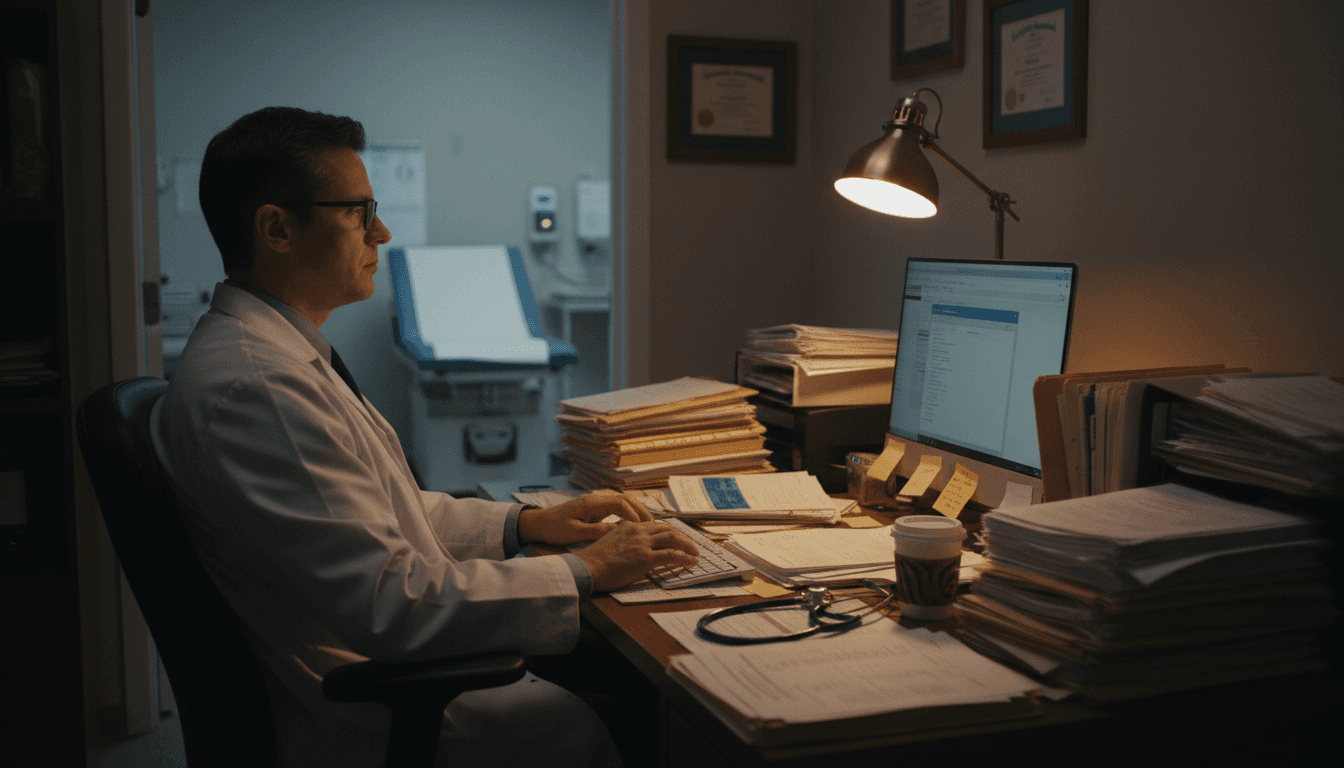
You finished your last patient at 5:30. It's now 9:47 PM, and you're still sitting in your office — or worse, at your kitchen table — typing notes from encounters you can barely reconstruct from memory. Your dinner is cold. Your kids stopped asking when you'd be done an hour ago. Tomorrow, you'll do it all again.
This is the reality of running a solo private practice without support staff in 2026, and the loneliness of it is staggering. There's no scribe waiting to hand you polished notes. No medical assistant who captured the history while you examined the patient. No office manager triaging your inbox. It's just you — the clinician, the documentarian, the biller, the administrator — and the charting never, ever ends.
You didn't go through years of training to become a data entry specialist. But somewhere between the dream of independent practice and the reality of running one alone, documentation became the thing that consumes most of your non-clinical hours. And it's quietly destroying the parts of medicine you actually love.
If you feel like you're drowning in notes while simultaneously trying to provide exceptional patient care, you are not failing. The system around you is failing. And you deserve to hear that clearly before we talk about anything else.
Why This Keeps Happening
The documentation burden on solo practitioners isn't an accident — it's the compounding result of several forces that have been building for years and show no signs of reversing.
EHR systems were designed for billing, not for clinicians. The interfaces you wrestle with every evening were built to satisfy compliance requirements and maximize reimbursement capture. They were never optimized for a single provider working without support. Every click, every dropdown, every redundant field was designed with the assumption that someone else would handle part of the data entry.
Payer requirements keep expanding. The documentation thresholds for medical necessity, prior authorizations, and audit protection have only grown more complex. What used to require a concise SOAP note now demands extensive detail that takes three to four times longer to produce — especially when you're the only person producing it.
Hiring support staff has become prohibitively expensive or impossible. The economics of solo practice in 2026 make hiring a dedicated medical scribe or even a part-time assistant a genuinely difficult financial decision. Competitive wages, benefits, training time, turnover risk — for many solo practitioners, the math simply doesn't work. So you absorb the work yourself and call it "just part of the job."
You've normalized the suffering. This might be the hardest truth. When every solo practitioner you know is also charting until 10 PM, it starts to feel inevitable. It's not. But the normalization of this burden keeps providers from seeking solutions aggressively enough, early enough.
The Real Cost of Solo Practitioner Documentation Burden Without Support Staff
The cost isn't just time, though the time cost alone is devastating. When you're spending two to three hours every evening on documentation, that's ten to fifteen hours per week of unpaid labor that doesn't generate revenue, doesn't improve outcomes, and doesn't sustain you.
Clinical quality suffers. When you're rushing through an encounter because you're mentally dreading the documentation that follows, you listen less carefully. You ask fewer open-ended questions. You truncate your assessments. The irony is painful: the documentation meant to capture quality care actually degrades the care itself.
Revenue leaks are invisible but constant. Exhausted providers under-code. They choose simpler billing levels because they don't have the energy to document the complexity that would justify higher reimbursement. Over the course of a year, this under-coding can represent tens of thousands of dollars in lost revenue — money that could have funded the very support you can't afford.
Burnout isn't a buzzword for you — it's Tuesday. The emotional exhaustion of solo documentation burden is a primary driver of practice closure. You didn't open your own practice to feel trapped by it. But when charting becomes the dominant activity of your professional life, the sense of purpose that drove you into independent practice erodes day by day.
Your personal life bears the real weight. Missed bedtimes. Cancelled plans. The ever-present laptop open on the couch. Your family sees it. You feel it. And the guilt of choosing between finishing charts and being present with the people you love is a burden no clinician should carry as a default condition of practice.
What Leading Private Practice Owners Are Doing Differently in 2026
The solo practitioners who have broken free from this cycle share a common insight: they stopped trying to become faster documenters and started eliminating the documentation task altogether.
They recognized that the bottleneck was never their clinical skill or even their typing speed. The bottleneck was the fundamental absurdity of asking one human to simultaneously provide care and produce a detailed written record of that care in real time, without help.
In 2026, the most sustainable solo practices are leveraging AI-powered ambient medical scribing — technology that listens to the natural patient-provider conversation and generates complete, accurate clinical documentation automatically. No templates to fill. No voice dictation to correct. No after-hours charting marathons.
This isn't futuristic speculation. It's happening right now in solo practices across every specialty, and the providers who've adopted it consistently report the same thing: they feel like they got their practice — and their life — back.
The shift isn't about replacing clinical judgment. It's about removing the mechanical labor that has nothing to do with clinical judgment. You should be thinking about your patient's differential diagnosis, not about whether you checked the right box in your EHR.
How Scribing.io Solves Solo Practitioner Documentation Burden Without Support Staff
Scribing.io was built specifically for the problem you're living with right now. It's an AI medical scribe that works the way a human scribe would — listening to your patient encounters and producing structured, specialty-specific clinical notes — but without the salary, the scheduling complexity, or the training period.
It listens while you practice medicine. Scribing.io captures the natural conversation between you and your patient during the encounter. You don't change how you practice. You don't dictate into a device. You simply talk to your patient the way you always have, and the documentation happens in the background.
Notes are generated in your preferred format. Whether you work in SOAP notes, H&P format, or a specialty-specific template, Scribing.io produces documentation that matches your clinical style and meets payer requirements. The notes are thorough enough to support accurate coding and protect you in an audit.
Your after-hours charting disappears. This is the transformation that solo practitioners describe as life-changing. When your notes are drafted by the time the patient walks out, there's nothing waiting for you at 9 PM. You review, you approve, and you go home. The evening documentation marathon is over.
It costs a fraction of a human scribe. For solo practitioners who can't justify a full-time hire, Scribing.io provides scribe-level documentation support at a price point that makes financial sense from day one. You're not taking on payroll. You're not managing another person. You're simply getting the documentation help you've needed but couldn't access.
Your coding accuracy improves. Because Scribing.io captures the full clinical conversation, details that you might have forgotten to document manually — the social history nuance, the additional review of systems elements, the counseling time — are preserved in the note. This supports appropriate coding levels and helps recover revenue you've been leaving on the table.
Getting Started Takes Less Than 10 Minutes
You've spent years adapting to broken workflows. Changing course shouldn't require another painful adaptation.
Scribing.io is designed for immediate use. There's no complex onboarding process, no multi-week implementation timeline, and no IT department required — which is fortunate, because you are your IT department.
You sign up, configure your note preferences, and start your next patient encounter. The AI scribe does the rest. Most solo practitioners report that they see the impact on their first day — not their first month, their first day.
If you've read this far, you already know the documentation burden isn't sustainable. You've known it for a while. The question isn't whether you need help — it's whether you'll let yourself accept it.
Tonight doesn't have to end with you hunched over a laptop finishing charts. Tomorrow's patients deserve a provider who isn't already exhausted before the first appointment. And you deserve to remember why you chose this work in the first place.
Try Scribing.io Free — and find out what your practice looks like when documentation is no longer your problem to solve alone.


