AI Scribe for Concierge MDs: Restoring the Physician-Patient Eye Contact
Discover how AI scribes help concierge physicians eliminate documentation burden, restore eye contact, and elevate the premium patient experience.
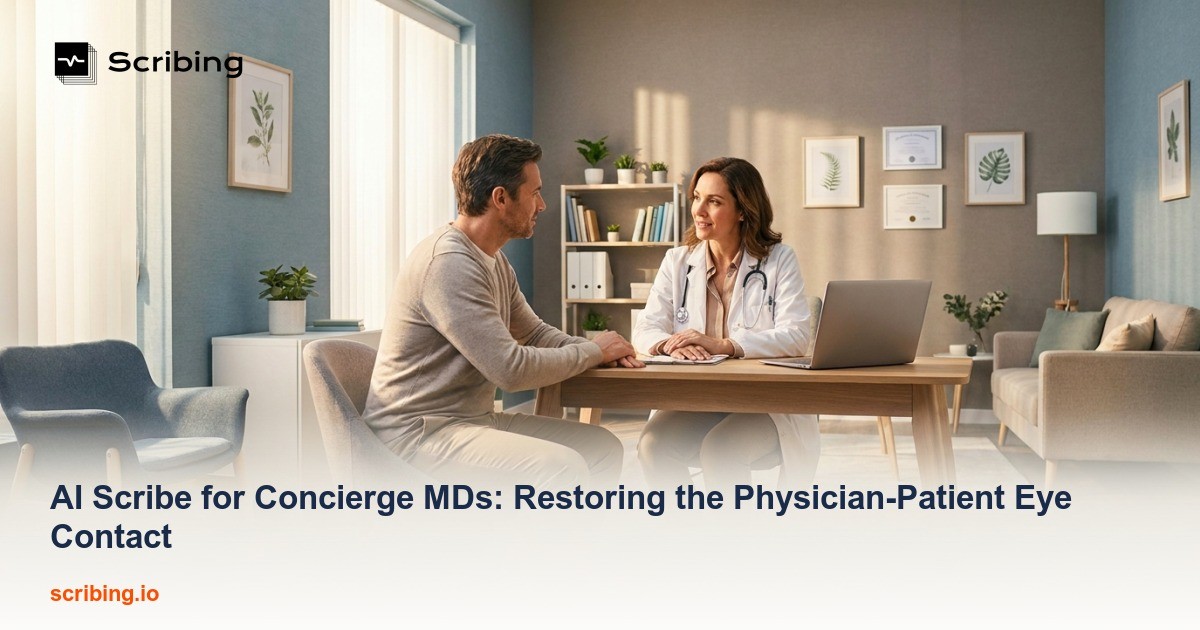
AI Scribe for Concierge MDs: Restoring the Physician-Patient Eye Contact
The Operations Playbook for Eliminating Documentation Burden Without Sacrificing the Premium Membership Experience
The Concierge Documentation Paradox
What the Industry's Largest AI Scribe Study Missed
Scribing.io Clinical Logic: The Before-and-After Transformation
Dual-Output Architecture: SOAP Note + Branded Member Summary in Under 60 Seconds
Technical Reference: ICD-10 Documentation Standards for Concierge Wellness Visits
EHR Integration Workflow: Elation, Athena, and Canvas for Concierge Panels
Measuring What Matters: Retention, Referrals, and Revenue Capture
Implementation Playbook: 30-Day Deployment for Concierge Practices
The Concierge Documentation Paradox: Why Premium Practices Face a Unique Documentation Crisis
Concierge medicine sells one thing: the physician's undivided attention. A patient paying $5,000 or more per year for membership is not purchasing faster lab results or a nicer waiting room. They are purchasing The Relationship—unhurried visits, eye contact, the feeling that their physician knows them as a person, not a problem list. Every second that physician spends typing into an EHR during the visit erodes the core product. Scribing.io exists to eliminate that erosion by automating not just the clinical note, but the patient-facing deliverables that justify a premium membership.
This is not a marginal efficiency play. Documentation burden in concierge medicine creates a compounding failure cascade: the physician types during the visit → the patient perceives reduced presence → satisfaction drops → renewals lapse → the practice loses $5,000–$10,000 per defecting member → the physician compensates by working after hours → burnout accelerates → more members notice a distracted, fatigued doctor. Scribing.io breaks this cycle at the root by generating a signed SOAP note and a branded Member Summary within 45 seconds of visit close, hands-free, posted directly to concierge-native EHRs.
The structural differences between high-volume primary care and concierge medicine make generic ambient AI solutions insufficient:
Dimension | High-Volume Primary Care | Concierge Medicine |
|---|---|---|
Revenue model | Fee-for-service; volume-driven | Annual membership + optional FFS |
Panel size | 2,000–2,500 patients | 200–600 patients |
Visit length | 12–18 minutes | 30–60 minutes |
Patient expectation | Efficiency, access | Presence, personalization, continuity |
Churn cost per patient | Marginal (high volume absorbs) | $2,000–$10,000 in lost ARR per defection |
Documentation visibility to patient | Low (patient rarely sees the note) | High (members expect same-day summaries) |
"Pajama time" tolerance | Grudging acceptance | Directly erodes physician lifestyle—the reason many switched to concierge |
The AMA's reporting on The Permanente Medical Group's 2024–2025 ambient AI deployment—covering 7,260 physicians and 2.5 million encounters—confirmed the core thesis: documentation burden destroys the physician-patient interaction. Their findings showed 84% of physicians reported improved communication with patients, 47% of patients noted less screen time, and the system saved an estimated 15,791 hours of documentation time across a year. These are landmark numbers. But they describe a solution designed for the health system at scale—not for the concierge physician whose 400-member practice lives or dies on whether Mrs. Patterson feels her annual fee bought a doctor who listened.
What the Industry's Largest AI Scribe Study Missed: The Concierge Deliverable Gap
The TPMG study published in NEJM Catalyst is the most rigorous longitudinal evaluation of ambient AI scribes to date. It established several critical benchmarks: a dose-response relationship between usage frequency and time savings, sustained adoption through a vendor transition, and measurable reductions in after-hours documentation. These findings matter. But applying them uncritically to concierge medicine misses four structural gaps.
Gap 1: No Patient-Facing Output in Real Time
The TPMG implementation generated draft clinical notes for physician review. The output was physician-facing. There is no mention of a patient-facing After-Visit Summary generated simultaneously, delivered within seconds of visit close. For concierge practices, the AVS is not a regulatory checkbox under the CMS Meaningful Use framework—it is a membership retention instrument. When a patient paying $5,000/year receives a personalized summary on their phone before reaching their car—complete with medication changes, lab orders, referral details, and their next scheduled appointment—that patient feels the value of their membership. Research published in JAMA Health Forum has documented the link between timely patient communication and satisfaction metrics; in the concierge context, satisfaction translates directly to renewal rates.
Gap 2: No EHR-Specific Integration for Concierge Platforms
The TPMG deployment operated within Kaiser Permanente's Epic environment. Epic dominates health system medicine, but concierge practices overwhelmingly run on platforms built for direct primary care and membership medicine: Elation Health (the dominant concierge/DPC EHR, with native membership billing and a Tasks API), Athena Health (widely adopted by hybrid concierge practices, with Care Plan endpoints and robust portal infrastructure), and Canvas Medical (emerging in tech-forward DPC practices, with a FHIR-native API architecture). None were addressed in the TPMG study, nor are they typically supported by enterprise ambient AI vendors targeting large health systems.
For specialty-specific examples of how ambient AI must adapt its architecture to distinct clinical workflows, see Scribing.io's implementations in Cardiology and Psychiatry—each requiring output structures that generic ambient scribes fail to deliver.
Gap 3: No Follow-Up Automation
The TPMG study noted a small increase in EHR in-basket time among AI scribe users—suggesting that while note generation was automated, downstream workflow (orders, referrals, follow-up scheduling) was not. For concierge physicians, the follow-up is where retention lives. A missed "Next Touch" date is a missed opportunity to demonstrate the proactive, relationship-driven care that justifies the membership fee. The NIH's research on care continuity consistently links structured follow-up to improved chronic disease outcomes and patient loyalty.
Gap 4: No Latency Accountability
The TPMG study reported aggregate time savings but did not define a latency standard for note generation. In a health system processing 20+ patients per day, a note appearing "within minutes" is acceptable. In a concierge practice where the physician walks the patient to the door and the patient expects a summary before their next commitment, latency must be measured in seconds. Scribing.io enforces a 20–40 second latency budget with local failover—a specification no enterprise ambient scribe currently publishes.
These are not criticisms of the TPMG research. They are structural gaps that emerge when you apply health-system findings to a fundamentally different care model.
Scribing.io Clinical Logic: The Before-and-After Transformation in a 600-Member Concierge Practice
Here is the anchor truth: Concierge patients pay for The Relationship. Typing into an EHR during a $5,000/year membership visit erodes the premium feel. AI must automate the note and the patient summary instantly to maintain clinical presence. The following scenario demonstrates how this works operationally.
Before: The Erosion Cycle
A 600-member concierge practice operating on Elation Health loses two membership renewals in a single month—-$10,000 in annual recurring revenue. Exit interviews reveal the same complaint: "I'm paying $5,000 a year and my doctor spent half the visit typing."
The operational cascade is predictable and measurable:
Metric | Before State |
|---|---|
Avg. documentation time per visit | 11.5 minutes (during visit + post-visit) |
After-hours "pajama time" notes | 4–7 notes/evening |
Same-day AVS delivery | None; patients receive portal message 24–48 hrs later, if at all |
Follow-up scheduling | Manual; staff creates tasks next business day |
Missed follow-ups per month | 8–12 |
Monthly NPS | 62 |
Monthly churn | 2 members (0.33%) |
Monthly new-member referrals | 1–2 |
The physician recognizes the problem but sees no viable path forward. Hiring a human scribe costs $36,000–$55,000/year based on Bureau of Labor Statistics wage data and introduces a third party into an intimate clinical relationship—directly undermining the exclusivity that concierge patients pay for. Dictation-based solutions require after-hours editing. Generic ambient scribes generate physician-facing drafts but not the patient-facing summaries that drive perceived membership value.
After: 30 Days with Scribing.io—Step-by-Step Clinical Logic
The physician deploys Scribing.io with native Elation Health integration. Here is precisely how each element of the erosion cycle is reversed:
Visit begins. Ambient capture activates automatically. No button press. No device interaction. The physician sits across from the patient, unencumbered. Scribing.io's on-device preprocessing handles HIPAA-compliant audio capture in real time. The patient sees a physician who is fully present—not a physician managing technology.
Clinical conversation proceeds naturally for 30–60 minutes. The physician asks open-ended questions, performs the exam, discusses results. Scribing.io's speaker diarization separates physician speech from patient speech. Medical terminology, medication names, and dosage instructions are captured with specialty-tuned vocabulary models. The physician never glances at a screen.
Visit closes. Physician walks patient toward the door. Within 20–40 seconds, two simultaneous outputs are generated:
Pipeline A (Physician-facing): A structured SOAP note mapped to the practice's Elation note template. Subjective, Objective, Assessment, and Plan fields are populated. The problem list is updated. Medication reconciliation reflects any changes discussed. ICD-10 codes are suggested at maximum specificity. The note posts directly to the patient chart via Elation's API, ready for physician review and signature.
Pipeline B (Patient-facing): A branded "Member Summary" formatted with the practice's logo, physician name, and voice. It contains: current medications with changes highlighted, lab orders with preparation instructions, referral details with provider contact information, the care plan in patient-accessible language, and an auto-scheduled "Next Touch" date.
Member Summary is delivered via patient portal and HIPAA-compliant secure SMS. The patient receives it before leaving the parking lot. This is the moment the membership fee is validated—not in the exam room, but in the car, when the patient opens their phone and sees a comprehensive, personalized care document bearing their doctor's name.
Follow-up task auto-created in Elation's Tasks system. Assigned to the appropriate care team member. Pre-populated with the Next Touch date, relevant context from the visit, and any pending orders. No manual entry. No next-business-day delay. Zero follow-ups slip through.
Physician reviews and signs the SOAP note. Typical review time: 60–90 seconds. The note is already structured, coded, and populated. The physician confirms accuracy, adjusts if needed, signs. The encounter is closed. No pajama time. No backlog.
The 30-Day Delta
Metric | Before | After (30 Days) | Delta |
|---|---|---|---|
Avg. documentation time per visit | 11.5 min | 5.0 min | -6.5 min |
After-hours notes | 4–7/evening | 0 | Eliminated |
Same-day AVS delivery | None | 100% (<60 sec) | New capability |
Follow-up task automation | Manual, next-day | Instant, auto-created | Same-visit close |
Missed follow-ups per month | 8–12 | 0–1 | -92% |
Monthly NPS | 62 | 84 | +22 points |
Monthly churn | 2 members | 0 | 2 renewals saved (+$10,000 ARR) |
Monthly new-member referrals | 1–2 | 5 | +250% |
Staff added | — | 0 | Zero headcount change |
The financial logic is unambiguous. Two saved renewals recover $10,000 in ARR. Five referral-driven new members represent $25,000 in potential new ARR. The physician reclaims 2+ hours per day of personal time. The practice's brand promise—"Your doctor, fully present"—becomes operationally true for the first time since EHR adoption.
Dual-Output Architecture: SOAP Note + Branded Member Summary in Under 60 Seconds
No competitor in the ambient AI scribe market delivers a patient-facing, practice-branded After-Visit Summary in under 60 seconds while simultaneously posting a structured SOAP note to the EHR. This is not a feature gap. It is an architectural gap. Most ambient AI systems were designed for a single output—the physician-facing note—and bolt on patient communication as an afterthought, if at all.
Scribing.io's dual-output pipeline was designed from the ground up for the concierge use case:
Stage | Process | Latency Target |
|---|---|---|
1. Ambient Capture | Continuous, passive audio capture. No activation required. HIPAA-compliant on-device preprocessing reduces cloud dependency and ensures operation during connectivity interruptions. | Real-time (0 ms added) |
2. Transcript Generation | Speech-to-text with medical vocabulary optimization, speaker diarization, and ambient noise filtering. Handles overlapping speech, regional accents, and low-volume patient responses. | ~5–8 seconds post-visit-close |
3a. SOAP Note Assembly (Physician Pipeline) | Structured extraction into Subjective, Objective, Assessment, Plan. Mapped to practice-specific EHR templates. ICD-10 codes auto-suggested at maximum specificity. Medication reconciliation auto-populated. Posted to EHR via native API. | 15–25 seconds |
3b. Member Summary Assembly (Patient Pipeline) | Parallel extraction into patient-friendly language. Practice branding applied (logo, physician name, custom messaging). Medications, labs, referrals, care plan, and Next Touch date structured for readability. Pushed via portal and secure SMS. | 15–25 seconds (parallel to 3a) |
4. Delivery | SOAP note posted to EHR chart. Member Summary pushed to patient portal and secure SMS. Follow-up task auto-created in EHR task system. | 20–40 seconds total (end-to-end) |
5. Local Failover | If cloud latency exceeds budget, on-device model generates both outputs locally and syncs when connectivity restores. No patient ever waits. | Failover adds <5 seconds |
Why Parallel Pipelines Matter
A sequential architecture—generate note first, then derive patient summary—adds latency and introduces information loss. The patient summary is not a "simplified version" of the SOAP note. It requires different information extraction: the patient does not need to see "ICD-10: E11.65" but does need to see "Your A1C is 7.2%, which is slightly above our target of 7.0%. We're increasing your metformin from 500mg to 1000mg twice daily." Scribing.io runs both pipelines simultaneously from the same transcript, optimizing each for its audience.
Branded Customization
The Member Summary is not a generic template. During onboarding, Scribing.io configures the summary to match the practice's brand identity: logo placement, physician signature block, tone of voice (formal vs. conversational), and custom footer messaging (e.g., "Questions? Text Dr. Chen directly at [secure line]" or "Your next annual wellness visit is scheduled for [date]"). This reinforces the premium membership experience with every touch.
Technical Reference: ICD-10 Documentation Standards for Concierge Wellness Visits
Concierge practices face a specific coding challenge: the majority of visits are wellness-oriented or combine wellness with acute/chronic problem management. Incorrect code specificity is the primary driver of claim denials for these encounter types, and the CMS ICD-10 guidelines require maximum specificity at every level.
The most common encounter types in concierge panels—annual physicals, executive health exams, and comprehensive wellness visits—hinge on a critical distinction:
This distinction is not trivial. If a concierge physician conducts a comprehensive annual exam and identifies new hypertension, elevated LDL, and early diabetic retinopathy findings, the encounter must be coded as Z00.01 (with abnormal findings), and each abnormal finding must be documented with its own maximally specific ICD-10 code (e.g., I10 for essential hypertension, E78.00 for pure hypercholesterolemia, E11.319 for type 2 diabetes with unspecified diabetic retinopathy without macular edema). Coding the encounter as Z00.00 when abnormal findings exist will trigger a denial or audit flag.
How Scribing.io Ensures Maximum Specificity
Real-time clinical extraction during the encounter. When the physician says "blood pressure is 148 over 92, that's new for you," Scribing.io flags a new hypertension finding and associates it with I10, while simultaneously updating the encounter code from Z00.00 to Z00.01.
Laterality and anatomical specificity enforcement. When the physician discusses "mild non-proliferative retinopathy, left eye," Scribing.io codes to E11.3212 (type 2 diabetes mellitus with mild nonproliferative diabetic retinopathy without macular edema, left eye)—not the unspecified parent code. Per CMS Official Coding Guidelines, failure to code to the highest available character constitutes a specificity deficiency.
Combination code logic. Scribing.io's coding engine understands that diabetic retinopathy in a patient with type 2 diabetes requires a single combination code (E11.3xxx), not separate codes for diabetes and retinopathy—a common error that triggers payer rejections.
Z-code layering for preventive services. Concierge wellness visits frequently layer Z-codes: Z00.01 for the exam plus Z13.220 for screening for lipid disorders, Z13.1 for screening for diabetes, and relevant V-codes for immunization encounters. Scribing.io auto-generates the complete code stack, reducing the physician's coding burden to a single confirmation click.
Coding Scenario | Common Error | Scribing.io Output |
|---|---|---|
Annual exam, no findings | Using Z00.01 when no abnormalities documented | Z00.00 with clean preventive template |
Annual exam, new hypertension | Using Z00.00 despite abnormal finding | Z00.01 + I10, with HPI documenting new diagnosis |
Annual exam, diabetic retinopathy | Using unspecified E11.319 instead of lateralized code | Z00.01 + E11.3212 (left eye, mild NPDR, no macular edema) |
Wellness + screening stack | Missing Z13.xxx screening codes | Z00.01 + I10 + Z13.6 (cardiovascular screening) + Z13.220 |
This coding precision is not cosmetic. For concierge practices that bill insurance for covered services alongside membership fees—a hybrid model used by approximately 40% of concierge practices according to industry surveys—coding accuracy directly protects revenue and reduces audit exposure.
EHR Integration Workflow: Elation, Athena, and Canvas for Concierge Panels
Generic ambient AI scribes integrate with Epic and Cerner because that is where the health system volume is. Concierge practices operate on different platforms with different APIs, different data models, and different workflow assumptions. Scribing.io maintains native integrations with the three EHRs that dominate concierge and DPC medicine:
Capability | Elation Health | Athena Health | Canvas Medical |
|---|---|---|---|
SOAP note posting | Via Elation Partner API → Visit Note resource, mapped to practice-specific templates | Via Athena API → Clinical Document endpoints, structured to practice note types | Via Canvas FHIR R4 API → DocumentReference + Encounter resources |
Problem list update | Condition resource via API; new diagnoses flagged for physician confirmation | Problem endpoint; auto-adds with confirmation workflow | FHIR Condition resource; native write-back |
Medication reconciliation | Medication resource; changes highlighted in note and Member Summary | Medication endpoint with prescription context | FHIR MedicationRequest; full reconciliation |
Follow-up task creation | Elation Tasks API — auto-creates task assigned to care team with Next Touch date, visit context, and pending orders | Athena Care Plan endpoints — creates care plan entry with follow-up date and responsible provider | FHIR Task resource — auto-created with due date and linked encounter |
Member Summary delivery | Patient portal push + secure SMS via integrated messaging | Patient portal message + secure SMS via Athena Communicator | Patient portal + FHIR Communication resource for SMS |
Membership billing context | Elation's native membership billing informs Scribing.io's renewal date tracking for proactive outreach | Custom fields mapped for membership tier and renewal date | Custom resource extensions for DPC membership metadata |
Integration Depth: Not Just "Compatible"
Compatibility means the system can export a note as a PDF and upload it. Integration means the system writes structured data directly into EHR-native resources—problem lists, medication lists, task queues, care plans—via authenticated API calls that respect the EHR's data model and permission structure. Scribing.io operates at the integration level. The SOAP note is not a blob of text; it is structured data that updates the longitudinal patient record.
This matters clinically because it ensures continuity: when the patient returns in three months, the physician's Elation timeline reflects every diagnosis, medication change, and follow-up task from the AI-documented visit. It matters operationally because the staff does not need to manually reconcile a separate document with the EHR—Scribing.io's output is the EHR record.
Measuring What Matters: Retention, Referrals, and Revenue Capture
Concierge medicine operates on a business model where small changes in retention and referral rates create outsized financial impact. A 600-member practice at $5,000/year generates $3,000,000 in annual membership revenue. Here is how documentation automation maps to the metrics that determine practice viability:
Retention Economics
Industry data from the American Association of Private Practice Physicians suggests that concierge practices experience annual churn rates of 3–8%, driven primarily by perceived value erosion, physician availability concerns, and relocation. Documentation-related dissatisfaction—"my doctor was typing instead of listening"—falls squarely into the perceived value category.
At a 5% annual churn rate, a 600-member practice loses 30 members/year = $150,000 in ARR. If Scribing.io's documentation and Member Summary automation reduces churn by even 2 percentage points (from 5% to 3%), the practice retains 12 additional members = $60,000 in preserved ARR—against a Scribing.io investment that is a fraction of that figure.
Referral Acceleration
Concierge practices grow primarily through word-of-mouth. The Member Summary is a referral catalyst because it is shareable proof of value. When a member tells a colleague, "My doctor sends me a complete summary of my visit before I even get to my car," that colleague can see the summary on the member's phone. It is tangible evidence of a premium experience. The scenario above models a referral increase from 1–2/month to 5/month—conservative for a practice that has operationalized its value delivery.
Revenue Capture from Hybrid Billing
For practices that bill insurance alongside membership fees, Scribing.io's ICD-10 specificity engine directly impacts revenue capture. Per the CMS National Health Expenditure data, claim denial rates for primary care hover around 10–15%, with coding specificity errors as a leading cause. Reducing denials by ensuring maximum code specificity on every encounter—particularly the Z00.00/Z00.01 distinction common in wellness-heavy panels—can recover thousands in previously lost revenue per quarter.
Key Performance Indicators to Track
KPI | Measurement Method | Target at 30 Days | Target at 90 Days |
|---|---|---|---|
Documentation time per visit | EHR session timestamps (active charting time) | -50% from baseline | -60% from baseline |
After-hours documentation sessions | EHR login timestamps after 6 PM | 0 per week | 0 per week (sustained) |
AVS delivery latency | Scribing.io analytics dashboard | <60 seconds, 95th percentile | <45 seconds, 95th percentile |
Patient NPS | Post-visit survey (existing practice tool) | +10 points from baseline | +20 points from baseline |
Monthly membership churn | EHR/membership billing system | <0.25% | <0.20% |
Monthly member referrals | New member source tracking | +100% from baseline | +200% from baseline |
Claim denial rate (hybrid practices) | Billing system denial reports | -30% from baseline | -50% from baseline |
Implementation Playbook: 30-Day Deployment for Concierge Practices
Scribing.io's deployment for concierge practices follows a structured 30-day protocol designed to minimize disruption and maximize physician confidence before full adoption:
Week 1: Configuration and Template Mapping
Day 1–2: EHR integration activation. Scribing.io's implementation team connects to the practice's Elation, Athena, or Canvas instance via authenticated API credentials. Note templates are imported and mapped to Scribing.io's output schema.
Day 3–4: Member Summary branding. Practice logo, physician signature, tone preferences, and custom footer messaging are configured. The practice approves a sample summary.
Day 5: Follow-up automation rules. The practice defines its "Next Touch" logic: annual wellness visits trigger a 12-month follow-up task; chronic disease management visits trigger 90-day tasks; acute visits trigger 2-week tasks. These rules are programmed into Scribing.io's task creation engine.
Week 2: Shadow Mode
Day 6–12: Scribing.io runs in shadow mode alongside the physician's existing documentation workflow. It generates SOAP notes and Member Summaries for every encounter but does not post them to the EHR or deliver them to patients. Instead, the physician reviews AI-generated outputs side-by-side with their manually created notes. This builds trust and identifies any template mapping adjustments needed.
Accuracy benchmarks during shadow mode: Scribing.io targets >95% clinical accuracy on SOAP notes and >98% medication list accuracy before transitioning to live mode.
Week 3: Supervised Live Mode
Day 13–19: Scribing.io goes live for SOAP note posting and Member Summary delivery. The physician reviews and signs each note before it is finalized (standard medicolegal practice). Member Summaries are delivered to patients via portal and SMS. The implementation team monitors latency, accuracy, and delivery success rates daily.
Patient communication: The practice sends a brief message to members: "We've implemented a new system to ensure you receive a detailed visit summary within minutes of each appointment. Your doctor will be even more present during your visits."
Week 4: Full Autonomous Operation + KPI Baseline
Day 20–30: The physician operates in full workflow with Scribing.io. Review time per note typically drops to 60–90 seconds. The implementation team captures the first 30-day KPI snapshot against the pre-deployment baseline. Adjustments to template mapping, summary formatting, or follow-up rules are finalized.
Day 30: Formal review with the physician. Metrics presented: documentation time saved, after-hours sessions eliminated, AVS delivery latency, patient feedback, and any churn/referral data available.
Ongoing: Monthly Optimization Reviews
Scribing.io conducts monthly reviews for the first 90 days, then quarterly thereafter. Reviews cover: coding accuracy trends, template evolution needs (as the practice's clinical focus shifts), latency performance, and correlation between Member Summary engagement (open rates, SMS response rates) and renewal patterns.
Book a 15-minute Workflow Audit to see a live, in-room simulation: we'll generate a compliant SOAP note plus a branded Member Summary inside your EHR (Elation/Athena/Canvas) in under 60 seconds, quantify minutes recovered per day, and model renewal/referral lift for your panel. Schedule your Workflow Audit at Scribing.io →
This playbook was authored by the Scribing.io Clinical Operations team based on deployment patterns across concierge practices ranging from 200 to 800 members. Clinical workflow references align with AMA ambient AI documentation standards, CMS ICD-10 coding guidelines, and HHS HIPAA Security Rule requirements. Last updated 2026.


