Neurosurgery
Everyday medical support built on trust, quality checkups, and personal attention to your overall wellness.
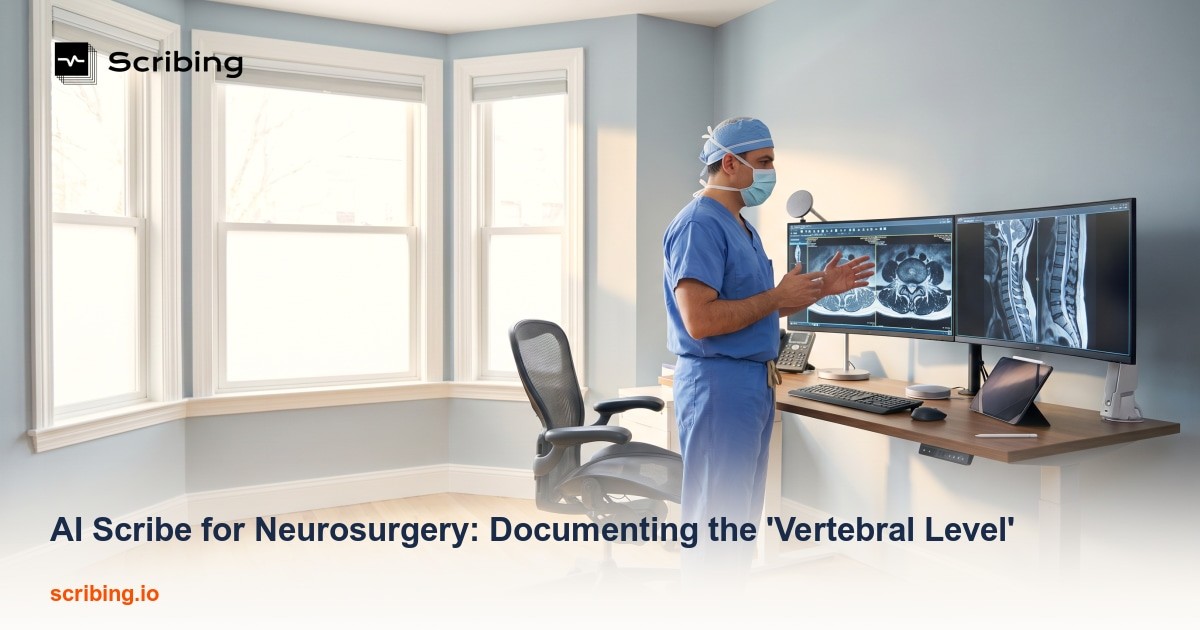
AI Scribe for Neurosurgery: Documenting the Vertebral Level with Radiographic Precision
TL;DR
Every spine neurosurgery note lives or dies on one detail: the vertebral level. If the documented operative level doesn't match intraoperative imaging, you face wrong-level liability exposure, CPT add-on denials (22552, 63048), and hours lost to addenda. Scribing.io's Imaging Cross-Check engine binds every dictated vertebral level to a PACS DICOM accession/SOP Instance UID, injects a timestamped "Radiographic Operative Level" attestation before sign-off, and auto-generates an NCCI-compliant level→CPT map. The result: first-pass payment, defensible documentation, and zero ambiguity about what was done and where. This is the definitive clinical operations playbook for spine neurosurgeons who refuse to leave level accuracy to chance.
What Competitor AI Scribes Miss: The Vertebral Level Gap
Scribing.io Clinical Logic: Radiographic Operative Level — Before and After
Imaging Cross-Check Architecture: Step-by-Step Logic Breakdown
Technical Reference: ICD-10 Documentation Standards
CPT Add-On Capture and NCCI Edit Compliance
Wrong-Level Liability: Programmatic Mitigation
Implementation: EHR/PACS Integration Workflow
Book a 15-Minute Workflow Audit
What Competitor AI Scribes Miss: The Vertebral Level Gap in Neurosurgical Documentation
Most ambient AI scribes were engineered for clinic encounters—the 15-minute office visit where a neurologist documents cranial nerve findings and medication titrations. The competitor landscape focuses on longitudinal disease tracking (MS, Parkinson's, epilepsy), E/M coding optimization, and pre-charting from prior visit data. These are legitimate capabilities for neurology. They are categorically insufficient for neurosurgery.
The gap is specific and measurable: multi-level spine CPT add-on codes (22552 for each additional interbody arthrodesis level, 63048 for each additional laminectomy level) are only reliably payable when each treated vertebral level is explicitly enumerated in the operative note and tied to contemporaneous intraoperative imaging. Scribing.io was built to close this gap. Payers don't deny these codes because the surgery wasn't performed. They deny them because the documentation doesn't prove, at the level of radiographic specificity, which vertebrae were instrumented. The AMA's CPT Editorial Panel guidelines are explicit: add-on codes require documentation that each additional level constitutes a distinct procedural service. Narrative shorthand like "levels addressed as planned" fails that standard.
What "Context-Aware" Actually Means in the OR
A competitor may claim "context-aware neurological notes." In practice, that means pulling forward a patient's medication history or prior MRI findings into a clinic note. It does not mean:
Ingesting a DICOM image from the intraoperative C-arm and extracting the vertebral level marker
Cross-referencing the dictated operative level against the radiographic operative level
Flagging a mismatch (e.g., the surgeon dictates "C3–4 discectomy" but the C-arm confirms C4–5) before the note is signed
Inserting a timestamped, UID-linked attestation that constitutes a medico-legal record of radiographic confirmation
Auto-mapping each confirmed level to the correct CPT code with NCCI-aware modifier logic (59/XS for distinct procedural services, modifier 62 for co-surgery, modifier 22 for increased complexity)
The Joint Commission has classified wrong-site spine surgery as a sentinel event since 2001. The AANS/CNS joint guidelines mandate intraoperative imaging confirmation of the operative level. Yet no ambient AI scribe—until Scribing.io—programmatically enforces this standard inside the documentation workflow. The operative note is not a narrative. It is a source of truth that must triangulate between three independent data streams: the surgeon's dictation, the intraoperative imaging, and the billing code set.
For a parallel example of how Scribing.io adapts clinical logic to specialty-specific documentation demands, see how our system handles Cardiology hemodynamic data capture and Psychiatry longitudinal mood and risk documentation—both built on the same principle of binding clinical data to its authoritative source before sign-off.
Ambient AI Scribe Capability Comparison: Neurology vs. Spine Neurosurgery | ||
Capability | Generic Neurology AI Scribe | Scribing.io Spine Neurosurgery Module |
|---|---|---|
Ambient clinical note generation | ✅ Office visits | ✅ Office visits + operative notes |
Longitudinal disease tracking | ✅ MS, Parkinson's, epilepsy | ✅ Plus post-op fusion status, hardware surveillance |
ICD-10 code suggestion | ✅ General neurology codes | ✅ Level-specific spine ICD-10 (M50.121–M50.123, M48.062, etc.) |
DICOM/PACS image ingestion | ❌ | ✅ Intraoperative C-arm, CT, fluoroscopy |
Radiographic Operative Level attestation | ❌ | ✅ Timestamped, UID-linked, witness-recorded |
Dictation ↔ imaging mismatch detection | ❌ | ✅ Pre-sign-off flag with correction workflow |
Multi-level CPT add-on mapping (22552, 63048) | ❌ | ✅ NCCI-aware with modifier logic (59/XS, 62, 22) |
Wrong-level liability mitigation | ❌ | ✅ Programmatic enforcement of AANS/CNS imaging guidelines |
Scribing.io Clinical Logic: Handling the Radiographic Operative Level — Before and After
This section illustrates the exact clinical scenario that costs spine neurosurgery practices thousands of dollars per case and exposes them to preventable liability. It is the operational justification for Scribing.io's Imaging Cross-Check engine.
BEFORE: The $4,200 Documentation Failure
A 57-year-old patient with C4–C6 myelopathy undergoes a two-level anterior cervical discectomy and fusion (ACDF). The surgeon completes the case uneventfully. During dictation, the operative note states:
"Levels addressed as planned. Instrumentation placed. Intraoperative imaging confirmed satisfactory positioning."
No explicit vertebral levels are enumerated. No radiographic attestation is linked. The note is signed.
What happens next:
CPT 22552 denied. Coding submits 22551 (primary ACDF) + 22552 (add-on for additional level). The 22552 is denied because the note does not explicitly state which two levels were fused, and the payer's utilization review cannot verify that two distinct levels were treated. Per CMS NCCI policy, add-on codes require documentation of the distinct procedural service at each level.
Risk management flags the note. The phrase "levels addressed as planned" introduces wrong-level ambiguity. If a complication arises, a plaintiff's attorney will argue the surgeon cannot prove which levels were operated on. Published data in JAMA Surgery confirms that ambiguous level documentation is a leading contributor to spine malpractice claims.
The surgeon is pulled from clinic to dictate an addendum. The addendum must reference the original intraoperative images, which requires a PACS lookup, radiology coordination, and a formal attestation. This consumes 40 minutes of surgeon time.
Total cost: $4,200+ per case. The 22552 denial represents approximately $3,200 in lost revenue. The 40 minutes of surgeon time adds approximately $1,000. Risk management remediation adds additional administrative overhead.
Scale this across a practice performing 8–12 multi-level cases per week, and the annual revenue leakage reaches six figures—before counting the liability exposure.
AFTER: Scribing.io's Imaging Cross-Check in Action
Same case. Same surgeon. Scribing.io is running.
Step 1 — Ambient Dictation Capture: The surgeon dictates the operative note. Scribing.io captures the narrative in real time, including "levels addressed as planned."
Step 2 — DICOM Ingestion: The Imaging Cross-Check engine connects to the facility's PACS and ingests the intraoperative C-arm images. It extracts DICOM metadata: accession number, SOP Instance UID, acquisition timestamp, and vertebral level markers visible in the images.
Step 3 — Mismatch Detection: The system detects that the dictated note references "levels addressed as planned" without enumerating specific vertebral levels. C-arm image analysis identifies level markers at C4–C5 and C5–C6. One image series shows a marker interpretable as C3–C4 depending on the counting method from the occiput. A pre-sign-off alert fires:
⚠️ Level Verification Required: Dictation references "levels addressed as planned" without explicit enumeration. DICOM analysis suggests C4–C5 and C5–C6, but image series [UID] shows potential C3–C4 marker. Please confirm operative levels before signing.
Step 4 — Surgeon Confirmation (Two Clicks): The surgeon reviews the flagged images on the Scribing.io interface, confirms operative levels are C4–C5 and C5–C6, and dismisses the C3–C4 flag. The counting ambiguity is resolved by reference to the preoperative MRI correlation.
Step 5 — Attestation Injection: Scribing.io automatically injects the following into the operative note:
"Radiographic Operative Level confirmed: C4–C5, C5–C6. Intraoperative fluoroscopic imaging (DICOM Accession: [ACC#], SOP Instance UID: [UID], Acquisition Time: [HH:MM:SS], Confirming Surgeon: [Name, NPI]). Levels correlated with preoperative MRI dated [DATE]."
Step 6 — CPT Level Table Generation: Scribing.io auto-builds the level→CPT map:
Auto-Generated Level→CPT Map for Two-Level ACDF | ||||
Operative Level | Procedure | CPT Code | Modifier | NCCI Validation |
|---|---|---|---|---|
C4–C5 | ACDF, primary | 22551 | — | ✅ Pass |
C5–C6 | ACDF, additional level | 22552 | — | ✅ Pass (add-on, no modifier required) |
C4–C5 | Structural allograft | 20931 | — | ✅ Pass, if applicable |
Result: The note is signed in under 90 seconds of active surgeon time. First-pass payment. Defensible documentation. Zero addenda. Zero ambiguity.
Imaging Cross-Check Architecture: Step-by-Step Logic Breakdown
The Anchor Truth of Scribing.io's spine module: surgeons face massive liability if the note doesn't perfectly match the Radiographic Operative Level. The Imaging Cross-Check engine is engineered to make that match programmatic rather than dependent on human recall during a high-cognitive-load dictation. Here is the granular logic architecture.
Layer 1: DICOM Metadata Extraction
When the intraoperative C-arm (or O-arm, CT, fluoroscopy) acquires images, those images are stored in PACS as DICOM objects. Each object carries structured metadata per the DICOM standard: Patient ID, Study Instance UID, Series Instance UID, SOP Instance UID, Acquisition DateTime, Modality (CR, XA, CT), Body Part Examined, and Institution Name. Scribing.io's PACS connector queries these fields in real time via DICOM QIDO-RS/WADO-RS or C-FIND/C-MOVE, depending on the facility's PACS architecture. No pixel data leaves the facility network during metadata extraction; image analysis occurs on-premise or within a BAA-covered environment.
Layer 2: Vertebral Level Marker Identification
Intraoperative spine images typically contain radiopaque markers (needles, K-wires, or the instrument itself) placed at the operative level under fluoroscopic guidance. Scribing.io's computer vision module identifies the marker position relative to vertebral body landmarks. The system uses a reference atlas trained on cervical, thoracic, and lumbar anatomy to determine the vertebral level. When ambiguity exists—as with transitional vertebrae or anomalous segmentation (present in approximately 10–12% of the population per NIH data)—the system flags the image for surgeon confirmation rather than making an autonomous determination.
Layer 3: Dictation-to-Image Reconciliation
Scribing.io's natural language processing engine parses the surgeon's dictation for vertebral level references. It recognizes explicit level callouts ("C4–C5 discectomy"), implicit references ("the level above the previously fused segment"), and—critically—the absence of level callouts entirely. The reconciliation engine then runs a three-way comparison:
Dictated levels (extracted from the operative narrative)
Radiographic levels (extracted from DICOM image analysis)
Pre-operative plan levels (extracted from the consent form and pre-op imaging orders, when available in the EHR)
Any discordance triggers a pre-sign-off alert. The alert hierarchy follows a severity model:
Red Alert: Dictated level ≠ radiographic level (potential wrong-level event)
Orange Alert: No dictated level present despite multi-level imaging (missing level attestation)
Yellow Alert: Radiographic image shows ambiguous anatomy (transitional vertebra, counting uncertainty)
Layer 4: Attestation Generation and Injection
Upon surgeon confirmation, Scribing.io generates the attestation block. This block is not a free-text addendum—it is a structured data element that includes:
Confirmed operative level(s)
DICOM Accession Number
SOP Instance UID for each confirming image
Acquisition DateTime (to the second)
Confirming surgeon's name and NPI
Correlation with preoperative imaging study (date, modality, accession)
This attestation block satisfies the documentation requirements outlined in the CMS Claims Processing Manual and aligns with the AANS/CNS position statement on intraoperative imaging for level verification. It is injected into the operative note at the "Operative Findings" or "Procedure Details" section, depending on the surgeon's template preference.
Layer 5: CPT and NCCI Mapping
Each confirmed level is mapped to the appropriate CPT code. Scribing.io's coding engine runs the proposed code set against the current CMS NCCI edit tables to identify bundling conflicts, modifier requirements, and medically unlikely edits (MUEs). For multi-level spine procedures, the system validates that:
Add-on codes (22552, 63048) are paired with their corresponding primary codes (22551, 63047)
Modifier 59 or XS is applied only when distinct procedural services at distinct anatomical sites are documented
Modifier 62 is applied for co-surgery scenarios where two surgeons operate at the same level
Modifier 22 is flagged as available (with a documentation prompt for the operative report) when complexity exceeds the typical procedure
Technical Reference: ICD-10 Documentation Standards for Spine Neurosurgery
Accurate ICD-10 coding in spine neurosurgery demands level-specific diagnosis codes. Generic codes (e.g., "cervical disc disorder, unspecified level") trigger payer edits, reduce reimbursement, and weaken the medico-legal defensibility of the record. Scribing.io's clinical logic maps each confirmed operative level to its corresponding ICD-10 code automatically, ensuring maximum specificity with every submission. The system cross-references the confirmed radiographic level, the documented clinical findings (radiculopathy distribution, myelopathic signs, claudication pattern), and the operative procedure to select the most specific code available.
Cervical Spine ICD-10 Codes
For cervical procedures, level-specific coding prevents the single most common reason for initial claim denial: lack of anatomical specificity. Scribing.io auto-populates these codes based on the confirmed operative level and the documented clinical syndrome:
ICD-10 Codes: Cervical and Lumbar Spine Neurosurgery Documentation Reference | |||
ICD-10 Code | Description | Clinical Context | Documentation Requirement |
|---|---|---|---|
M50.121 — Cervical disc disorder at C4–C5 with radiculopathy | C5 nerve root compression with radicular symptoms | ACDF or posterior foraminotomy at C4–C5 | Specify level, laterality of symptoms, correlating imaging study |
M50.122 — Cervical disc disorder at C5–C6 with radiculopathy | C6 nerve root compression with radicular symptoms | ACDF or posterior foraminotomy at C5–C6 | Specify level, laterality, dermatomal distribution, correlating imaging |
M50.123 — Cervical disc disorder at C6–C7 with radiculopathy | C7 nerve root compression with radicular symptoms | ACDF or posterior foraminotomy at C6–C7 | Specify level, laterality, dermatomal distribution, correlating imaging |
Central canal stenosis with or without myelopathy | Cervical laminectomy, laminoplasty, or posterior decompression | Specify stenosis location, presence of myelopathy, cord signal changes on MRI |
Lumbar Spine ICD-10 Codes
Lumbar coding follows the same specificity imperative. Scribing.io maps the clinical syndrome (neurogenic claudication, radiculopathy, spondylolisthesis) to the level confirmed by intraoperative imaging:
ICD-10 Codes: Lumbar Spine Documentation Reference | |||
ICD-10 Code | Description | Clinical Context | Documentation Requirement |
|---|---|---|---|
M48.061 + G95.89 — Lumbar spinal stenosis with neurogenic claudication | Central lumbar stenosis producing claudication symptoms | Lumbar laminectomy, interspinous process device | Specify stenosis level(s), walking distance, relief with flexion, correlating imaging |
Lumbar nerve root compression with radicular symptoms | Microdiscectomy, transforaminal decompression | Specify affected nerve root, dermatomal distribution, correlating imaging level | |
Vertebral translation (degenerative, isthmic, or iatrogenic) | TLIF, PLIF, ALIF with instrumented fusion | Specify grade (Meyerding), level, type (degenerative vs. isthmic), instability on dynamic imaging | |
Disc herniation or degeneration at specified lumbar level | Discectomy, interbody fusion | Specify level, herniation type (protrusion, extrusion, sequestration), laterality |
How Scribing.io prevents denials through maximum specificity: The system cross-references three data points before assigning an ICD-10 code: (1) the confirmed radiographic operative level from the Imaging Cross-Check, (2) the clinical syndrome documented in the history of present illness and physical examination (radiculopathy pattern, myelopathic signs, claudication distance), and (3) the preoperative imaging findings (MRI signal characteristics, CT bony detail). If the documentation lacks specificity for a level-specific code—for example, if the surgeon documents "lumbar radiculopathy" without specifying L4 vs. L5 vs. S1 distribution—Scribing.io prompts the surgeon to clarify before sign-off, preventing a downcode to an unspecified code that will trigger a payer edit.
CPT Add-On Capture and NCCI Edit Compliance
The financial impact of missed add-on codes in multi-level spine surgery is substantial. Each 22552 add-on for an additional ACDF level represents approximately $3,200 in commercial payer reimbursement. Each 63048 add-on for an additional laminectomy level represents approximately $1,800. When documentation fails to enumerate each level explicitly, these codes are either not submitted or denied on first pass.
Scribing.io's CPT engine operates on a rules matrix derived from the AMA CPT codebook and the CMS NCCI edit tables, updated quarterly. The logic flow:
Level Count: How many operative levels were confirmed by the Imaging Cross-Check?
Primary Code Assignment: The first level maps to the primary procedure code (22551, 63047, 22612, etc.).
Add-On Code Assignment: Each additional level maps to the corresponding add-on code (22552, 63048, 22614, etc.).
NCCI Edit Screening: The proposed code set is screened against Column 1/Column 2 edits. If a code pair triggers an NCCI edit, the system evaluates whether modifier 59/XS is appropriate (distinct anatomical site) or whether the codes are truly bundled.
MUE Validation: Medically unlikely edit thresholds are checked. For example, reporting 22552 four times for a five-level ACDF is within MUE limits; reporting it seven times would trigger a flag.
Output: A clean, NCCI-compliant code set with modifiers attached, ready for the coder to verify and submit.
This eliminates the back-and-forth between surgeon, coder, and billing department that consumes days and delays claim submission.
Wrong-Level Liability: Programmatic Mitigation
Wrong-level spine surgery is among the most litigated events in all of surgery. The Joint Commission's Sentinel Event database tracks wrong-site procedures as a top category, and spine surgery is consistently overrepresented due to the anatomical challenge of identifying vertebral levels through limited surgical exposures. A 2015 analysis published in Spine (Lippincott) estimated the incidence of wrong-level cervical spine surgery at 1 in 3,110 cases—a number that may appear small until you consider the severity of the resulting claims.
Scribing.io's Imaging Cross-Check provides a programmatic safety net that operates independently of the Universal Protocol (time-out, site marking). It does not replace the Universal Protocol—it documents it and adds a second, imaging-bound verification layer. Specifically:
Pre-sign-off mismatch detection catches cases where the surgeon's cognitive load during a complex, multi-level decompression leads to a dictation error (e.g., saying "C3–C4" when the operative level was C4–C5).
DICOM UID binding creates an immutable link between the operative note and the confirming image. In litigation, this link is discoverable and serves as objective evidence that the correct level was verified radiographically.
Timestamped attestation establishes the chronology: the image was acquired at [time], the level was confirmed at [time], the note was signed at [time]. This timeline is critical for defending against claims that the verification was performed after an adverse event.
The medico-legal value is not theoretical. Risk management teams at major academic spine centers have identified the absence of explicit radiographic level attestation as the single most common documentation deficiency in cases that proceed to litigation. Scribing.io eliminates this deficiency by design.
Implementation: EHR/PACS Integration Workflow
Deploying Scribing.io's spine neurosurgery module requires integration with two systems: the facility's EHR (for operative note generation and sign-off) and the facility's PACS (for DICOM image ingestion). The implementation pathway:
Scribing.io Spine Module Implementation Timeline | |||
Phase | Duration | Activities | Responsible Party |
|---|---|---|---|
Discovery | 1–2 days | EHR/PACS architecture review, operative note template audit, DICOM connectivity test | Scribing.io Engineering + Facility IT |
Configuration | 2–3 days | Operative note template mapping, CPT rules matrix customization (payer mix-specific), surgeon preference configuration | Scribing.io Clinical Team |
PACS Integration | 1–2 days | DICOM QIDO-RS/WADO-RS or C-FIND/C-MOVE connection, test image ingestion, BAA execution | Scribing.io Engineering + Facility PACS Admin |
Validation | 2–3 days | Retrospective analysis of 10 recent multi-level spine cases, mismatch detection accuracy verification, CPT mapping validation against actual billed codes | Scribing.io Clinical Team + Surgeon Champion |
Go-Live | 1 day | Live case documentation with Imaging Cross-Check active, real-time surgeon feedback | Full team |
Total implementation: under one week from contract execution to live documentation. No EHR downtime. No PACS reconfiguration. The DICOM connector operates as a read-only listener—it queries and retrieves; it never writes to or modifies the PACS archive.
Book a 15-Minute Workflow Audit
Here is what we do in 15 minutes: We run an Imaging Cross-Check simulation on your last 10 spine operative notes (no PHI required—we work from de-identified note structure and DICOM metadata patterns). We quantify:
Missing level attestations: How many notes lack explicit radiographic level confirmation?
NCCI edit exposure: How many add-on codes (22552, 63048) were submitted without level-specific documentation support?
CPT add-on capture rate: How many billable add-on codes were missed entirely due to documentation gaps?
Dollars at risk: Exact revenue leakage from denied or unsubmitted add-on codes, calculated against your payer mix.
Liability exposure score: How many notes would survive a medico-legal review for level attestation?
Then we preview how the Imaging Cross-Check engine runs inside your specific EHR and PACS environment—with a deployment timeline of under one week.
Book your 15-minute Workflow Audit at Scribing.io →
Stop losing $4,200 per case to documentation gaps that a machine should have caught before you signed the note.


