Posted on
May 7, 2026
Posted on
Jul 16, 2026
Medicaid Documentation Standards for Group Therapy 2026: The Clinical Director's Operations Playbook
This playbook exists to protect your program's Medicaid revenue and licensure. Group therapy documentation is the single most audited artifact in outpatient SUD care. We wrote this for Clinical Directors running IOP and PHP tracks under 2026 CMS scrutiny.
Every claim you submit depends on individualized medical necessity, not boilerplate cloning. Medicaid auditors now use pattern-detection to identify duplicated group notes. This document shows you how Scribing.io produces defensible, semantically unique records at scale.
Table of Contents
Section one covers the 2026 Medicaid Documentation Standards
Section two details the Forensic Logic of Individualized Notes
Section three demonstrates the Clinical Logic Masterclass: The Evening IOP
Section four explains our Interactive Speaker Review Dashboard
Section five provides the Part 2 Inference Isolation Architecture
Section six delivers the Technical Configuration and DOM Selectors
Section seven closes with Audit Defense and ROI
The 2026 Medicaid Documentation Standards
CLINICAL UPDATE JUNE 2026: Revised for new CMS standards and Group Diarization accuracy.
Medicaid group therapy reimbursement hinges on five discrete data points per member. Attendance, duration in minutes, modality, individualized medical necessity, and plan. Missing any field triggers a clawback risk during retrospective review.
The 2026 standards eliminate identical group note narratives across attendees. CMS contractors flag charts where every patient's response to intervention reads verbatim. Each note must reflect that specific patient's participation and clinical response.
Attendance and duration must reconcile across the master group record and every individual note in the cohort.
Modality must be explicitly named using recognized frameworks such as CBT, MI, DBT, or Relapse Prevention.
Medical necessity requires diagnosis-linked justification tying the group content to that member's active treatment goals.
Risk and status changes must be documented at the individual level, not aggregated into the group summary.
Forensic Logic of Individualized Notes
Auditors reconstruct clinical events from timestamps, speaker attribution, and semantic uniqueness. A defensible note demonstrates the clinician heard and responded to that individual. Diarization is the technical foundation that makes this provable.
Scribing.io ingests session audio and performs speaker diarization to segment who spoke when. Low-confidence speaker segments are flagged rather than guessed. This preserves the integrity of the attribution chain.
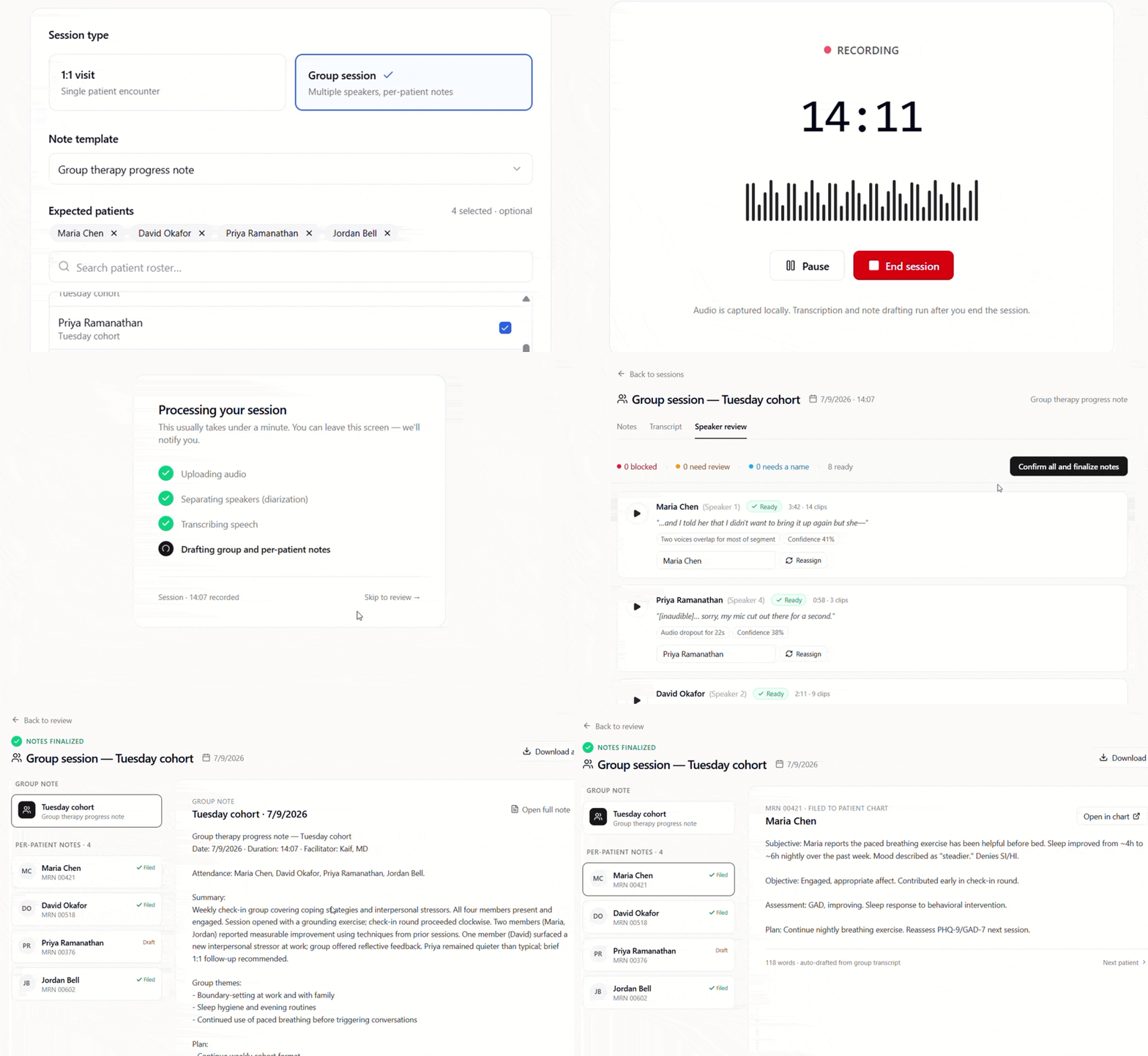
Each individualized note is tied to that member's diarized speaker segments. When an auditor asks how you know Patient B engaged, the answer is a timestamped segment. This is forensic documentation, not narrative fiction.
Review Scribing.io plans and request a quick 15 mins demo with our Solutions Expert.
Clinical Logic Masterclass: The Evening IOP
Picture an evening IOP group of eight members convened for relapse prevention. Mid-session, Patient C (F11.20) discloses a slip. Patient F (F33.1) reports increased anhedonia during the same hour.
The clinician runs the session while delivering two brief side interventions. Scribing.io ingests the audio, performs diarization, and flags low-confidence speakers for review. The clinician confirms attribution in seconds, not minutes.
On finalize the system produces a Master Group Summary containing goals, modality, duration, and safety checks. This single artifact anchors the session-level facts. It satisfies the program-level documentation requirement.
Simultaneously the system generates eight individualized notes. Each details attendance, participation level, goals addressed, response to interventions, risk or status changes, and plan. Every note is semantically unique and bound to that speaker's segments.
One-click write-back maps attendance minutes, modality, individualized medical necessity, and plan into discrete EHR fields. No copy-paste. No manual re-entry across eight charts.
Critically, Part 2 inference isolation ensures Patient C's slip and identity never surface in Patient F's chart. The group artifact stores only a non-PHI cohort hash for provenance. Cross-chart inference is blocked at the architectural level.
Dual-Output mapping for the eight-member IOP session | ||
Output Type | Contents | Medicaid Field Mapping |
|---|---|---|
Master Group Summary anchors the session | Goals, modality (CBT/MI), duration, safety checks | Group session header, service duration |
Per-Patient Note documents individual necessity | Attendance, participation, goals, response, risk, plan | Discrete individualized progress note fields |
Cohort Hash preserves provenance without PHI | Non-PHI cohort identifier for linkage | Internal provenance, excluded from patient chart |
The Interactive Speaker Review Dashboard
Behavioral health and rehab documentation demands human verification of every speaker. Our Interactive Speaker Review Dashboard surfaces each diarized segment for rapid confirmation. Clinicians correct attribution with a single click before finalizing.
The Dual-Output View is the operational heart of group documentation. On the left sits the Master Summary; on the right, the eight Per-Patient Notes. Both regenerate as you reassign speaker segments.
Low-confidence segments are visually flagged in amber so the clinician reviews only ambiguous attributions, not the entire transcript.
Reassigning a segment instantly updates the relevant patient note while leaving all other charts untouched.
The Master Summary remains PHI-safe at the cohort level, referencing members by internal seat rather than name.
This workflow pairs directly with your existing EMR pipeline. See our Kipu AI Workflow guide for the deepest Kipu integration path.
Part 2 Inference Isolation Architecture
The 2026 gap most programs miss is 42 CFR Part 2 inference isolation for group sessions. Standard scribes clone a shared narrative into every chart. That practice leaks co-attendee SUD participation and creates inference liability.
Cohort-safe write-back partitions content per patient before it ever touches the EHR. Patient F's chart contains only Patient F's participation, response, and plan. Patient C's slip lives exclusively in Patient C's record.
Co-attendee identifiers are redacted at the write-back boundary. No name, initial, or diagnosis of another member appears in any individual chart. This prevents inference that a given patient attended a SUD group.
A non-PHI cohort hash provides provenance without exposing membership. Auditors can confirm the notes derive from one session. They cannot reverse-engineer the roster from any single chart.
Per-patient partitioning blocks cross-chart cloning so identical narratives never propagate across the cohort.
Identifier redaction removes co-attendee names, initials, and diagnoses from every individual note automatically.
Cohort hashing enables provenance linkage during data exchange while carrying zero PHI downstream.
Technical Configuration and DOM Selectors
Restrictive EMRs like Behave Health block conventional automated write-back. Scribing.io injects field mappings through configured Chrome DOM selectors. This bypasses the interface lock without violating data integrity.
The configuration below targets discrete group note fields and enforces per-patient isolation. Deploy it via the Scribing.io Chrome extension configuration panel. Test against your sandbox environment first.
For the full bypass methodology including session persistence and iframe handling, review our Behave Health Integration deep dive. It documents every selector edge case.
Audit Defense and ROI
Your strongest audit defense is semantic uniqueness backed by diarized provenance. When a Medicaid contractor requests records, each note demonstrates individual necessity. The cohort hash proves session origin without exposing peers.
Manual group documentation costs clinicians forty-plus minutes per eight-member session. Scribing.io reduces that to under five minutes of review. The recovered clinical hours compound across every group, every day.
Quantify your program's specific return using our AI Scribe ROI Calculator. Enter your session volume and clinician cost. The model outputs recovered hours and clawback risk avoided.
Adopt this playbook as your standard operating procedure for all 2026 group documentation. Defensible notes, cohort-safe write-back, and inference isolation are no longer optional. They are the baseline for Medicaid survival.

