Posted on
Feb 9, 2025
Posted on
Jul 8, 2026

Learn how IOP/PHP & MAT clinical directors bypass Behave Health EMR integration blocks with a proven DOM selector and documentation strategy.
Bypassing Behave Health EMR Integration Blocks: The V6 Group Documentation Playbook
Operational Table of Contents
Section 1: Forensic Logic — Why Behave Health blocks scribes
Section 2: Technical Configuration — DOM selector bypass strategy
Section 3: Clinical Masterclass — The 9-attendee IOP walkthrough
Section 4: Part 2 Isolation — Inference Isolation architecture
Section 5: Audit Defense — Payer and supervision integrity
Section 6: ROI Justification — Financial case for operations
Forensic Logic: The Integration Block
CLINICAL UPDATE JUNE 2026: Revised for new CMS standards and Group Diarization accuracy.
Behave Health deliberately restricts DOM access to prevent unauthorized third-party write-back. This is a security posture, not a technical impossibility. Your scribe must respect the auth layer while writing to sanctioned fields.
Most competing scribe tools fail because they attempt clipboard injection into read-only React components. Behave Health's virtualized DOM re-renders and discards those writes silently. This produces phantom documentation that never persists.
Scribing.io resolves this cleanly by mapping stable field selectors and injecting through the sanctioned input event pipeline. Read our full Behave Health Integration teardown for the complete selector logic.
Book a Quick 15 mins Scribing.io x Behave Health Workflow Demo →
Technical Configuration: DOM Selector Bypass
The Chrome extension binds selectors to persistent attribute anchors rather than volatile class hashes. This survives Behave Health's virtual DOM re-renders. Configure the mapping before your first group session.
The native input event dispatch forces Behave Health's controlled components to register the value as user-typed. This makes the write-back indistinguishable from manual entry. Persistence is guaranteed on save.
Clinical Logic Masterclass: The 9-Attendee IOP
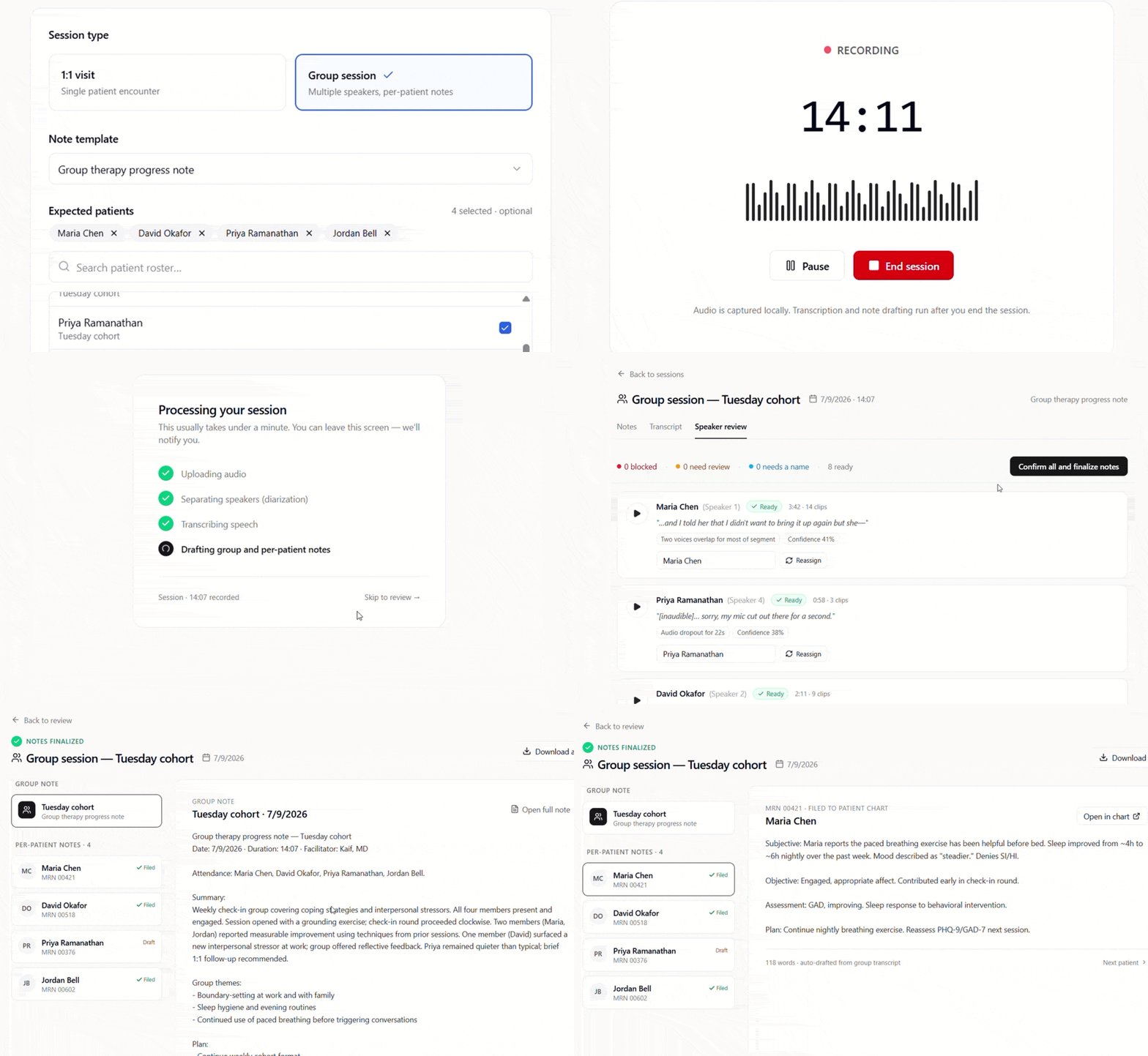
Consider a 60-minute IOP SUD group with nine attendees, three of them telehealth. Pre-session, the clinician selects the roster directly through the Chrome extension. This binds each speaker slot to a patient identity before capture begins.
During capture diarization separates speakers in real time. One attendee joins late and another leaves early. The system timestamps each attendance window independently for billing accuracy.
The Interactive Speaker Review Dashboard surfaces any low-confidence voice assignment. The clinician corrects the flagged attribution in seconds with a single click. No transcript rewriting is required.
The Dual-Output View then drafts two synchronized artifacts from one capture. This is the core of our group architecture.
Master Group Summary captures topic, interventions delivered, and collective group outcomes.
Per-Patient Progress Notes render individual attendance windows, responses, and discrete clinical fields.
The rules engine auto-attributes minutes to each patient from their diarized attendance window. One patient falls below the 45-minute payer threshold. The engine removes 90853 for that patient and inserts a reschedule note automatically.
Attendee Type | Modifier | POS | Billing Result |
|---|---|---|---|
Two remote telehealth patients | 95 | 10 | 90853 billable |
Facility-based telehealth patient | 95 | 02 | 90853 billable |
Below-threshold in-person patient | — | 11 | 90853 removed + reschedule |
Interpreter-required patient | — | 11 | 90785 added to that line only |
The interpreter patient triggers interactive complexity, adding 90785 to that patient's line exclusively. This code never appears on any other attendee's claim. Per-line isolation is enforced at the billing layer.
One-click EHR injection then writes the group summary and each patient's discrete fields into Behave Health or Kipu. See our Kipu AI Workflow guide for the parallel Kipu field mapping.
Part 2 Inference Isolation: The 2026 Standard
42 CFR Part 2 governs SUD records with the strictest confidentiality tier in healthcare. Group documentation creates a hidden leakage vector. A Master Summary can accidentally reveal who disclosed cravings, safety planning, or interpreter need.
Competitor group tools co-mingle context across all patients in a single generation pass. This lets a group narrative be reverse-inferred to identify a specific patient's disclosures. That is a Part 2 violation waiting to happen.
Scribing.io isolates context by design across drafting and write-back. Our Inference Isolation layer enforces three simultaneous guarantees.
Token-level segregation prevents statistical bleed between the Master Summary and any individual note.
Per-patient context windows ensure each Progress Note is drafted in isolation from every other patient's disclosures.
DOM-field isolation scopes write-back so craving scores and safety plans land only in the owning patient's chart.
In our masterclass scenario this means the Master Group Summary cannot leak who had cravings, who required safety planning, or who used an interpreter. Those details live only in the respective patient notes. The group narrative becomes non-reversible to any individual identity.
Audit Defense: Supervision and Payer Integrity
The audit log preserves every decision made across the session lifecycle. This is your defense artifact when a payer or surveyor challenges group billing. Nothing is inferred or reconstructed after the fact.
Diarization edits are timestamped and attributed to the reviewing clinician.
Billing decisions log the rationale, including the 90853 removal and 90785 addition.
Write-back mappings record which field received which value in Behave Health or Kipu.
This traceability satisfies both supervision and payer audit simultaneously. Your Director of Clinical Operations can reconstruct any session in full. The log is immutable and exportable.
ROI Logic: The Operations Business Case
Manual group documentation costs clinicians 15 to 20 minutes per attendee post-session. For a nine-person group that is over two hours of unbillable labor. Diarization and dual-output collapse this to minutes.
Recovered clinical time converts directly into additional billable group cycles per week. The threshold-flagging alone prevents denied 90853 claims that would otherwise clawback. Model your specific numbers with the AI Scribe ROI Calculator.
Deploy this playbook across your IOP and PHP programs as the operational standard. The combination of DOM bypass, dual-output drafting, and Part 2 Inference Isolation is the 2026 compliance baseline. Anything less exposes your program to preventable audit and privacy risk.

