Posted on
Feb 9, 2025
Posted on
Jul 9, 2026

Demo the best group therapy AI scribe for Behave Health now. A complete operations playbook for rehab managers on speaker tracking and EHR sync.
The Complete Playbook: Best Group Therapy AI Scribe for Behave Health
Playbook Navigation Map
Forensic Logic of Group Notes
Dual-Output View Architecture
Interactive Speaker Review Dashboard
Technical Configuration for Behave Health
Clinical Logic Masterclass: IOP SUD Evening Group
2026 Part 2 Inference Isolation
Claims Mapping and Billing Defense
ROI and Audit Defense
Forensic Logic of Group Notes
CLINICAL UPDATE JUNE 2026: Revised for new CMS standards and Group Diarization accuracy.
Group documentation carries hidden liability that individual notes never expose. Eight voices collapse into one shared transcript by default. This creates cross-patient contamination that fails 42 CFR Part 2 on export.
Scribing.io solves the core problem by tying every diarized utterance to a single verified speaker. Nothing bleeds across patient boundaries. This is the foundation of every defensible group workflow for SUD IOP and PHP settings.
Book a Quick 15 mins Scribing.io x Behave Health Workflow Demo →
The forensic standard demands attribution at the utterance level, not the session level. Auditors now expect per-patient minutes, participation, and individualized MSE. A shared summary alone will not survive a 2026 payer review.
Dual-Output View Architecture
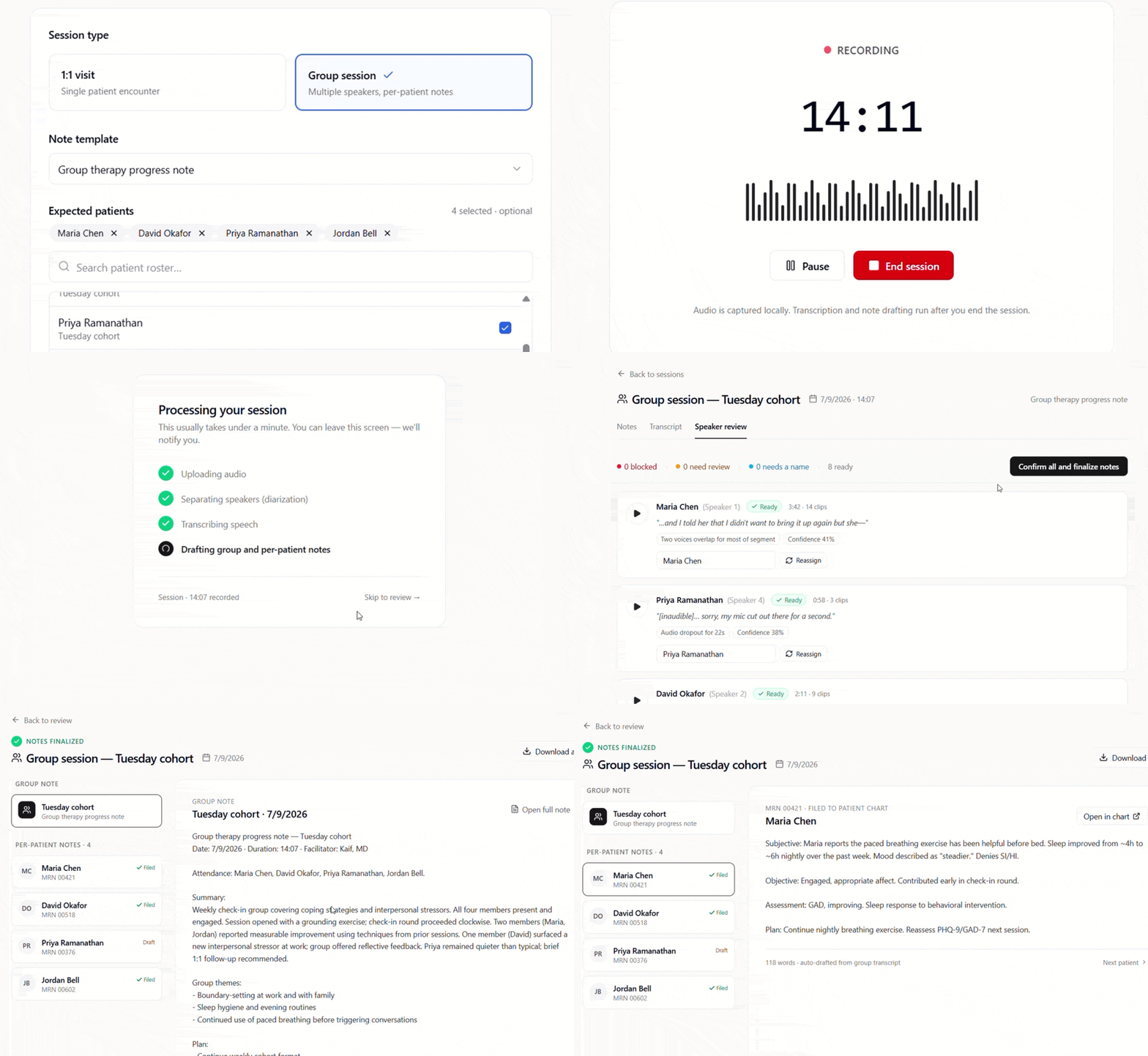
Every group session produces two artifacts from a single recording. The Master Group Summary captures the collective clinical narrative. The Per-Patient Notes isolate each individual's contribution and outcomes.
The Master Summary documents themes such as relapse prevention and craving management. It records the interventions delivered, the group modality, and the safety check performed. This satisfies the program-level documentation requirement.
The Per-Patient Notes carry individualization that billing and compliance require. Each note contains minutes attended, participation level, goals addressed, and an MSE snippet. Homework assignments are written back to the specific patient chart.
Master Summary output includes: group theme, interventions, modality, and the documented safety check for the cohort.
Per-Patient output includes: join/leave timestamps, engagement level, individualized goals, MSE fragments, and homework.
Risk escalation fields activate only on the affected patient's note, never on the shared summary visible to the program.
Interactive Speaker Review Dashboard
Diarization is never blindly trusted in a clinical-grade system. The Interactive Speaker Review Dashboard renders each labeled speaker segment for clinician verification. You confirm or reassign identities before any note is generated.
Pre-selecting the roster anchors accuracy at the start of every session. The clinician loads the expected eight participants from Behave Health. Diarized voices are then mapped against that known roster in the UI.
Late arrivals are handled gracefully through timeline-aware verification. When two members join late, the dashboard flags unassigned early segments as facilitator-only. This preserves accurate minutes-attended for each patient. See our Kipu AI Workflow for a parallel EMR pattern.
Technical Configuration for Behave Health
Behave Health restricts direct write-back through hardened DOM containers and shadow roots. Standard scribes fail silently against these blocks. Scribing.io uses targeted Chrome DOM selectors to inject per-patient fields correctly.
The configuration logic below resolves the group-note container and isolates each patient tab. This bypasses the shared-summary lock that Behave Health enforces on group sessions.
The bypass never overrides consent or data segmentation rules. It only restores field-level write access the EMR obscures. Full technique details live in our Behave Health Integration guide.
Clinical Logic Masterclass: IOP SUD Evening Group
Consider an evening IOP SUD group with eight participants in a hybrid format. The clinician pre-selects the roster before the session opens. Audio is diarized and speaker identities are verified in the dashboard UI.
Two members join the group late and the timeline captures their true entry points. One member, J.D., discloses new suicidal ideation without a plan. The system detects the disclosure tied to J.D.'s verified voice segment.
Dual-output resolves the complexity instantly. The Master Group Summary documents relapse prevention themes, CBT and craving-management interventions, and the group safety check. No patient-specific SI content appears in that shared artifact.
J.D.'s per-patient note escalates properly. It raises a risk flag, documents a brief safety check, and prompts the clinician to schedule a separate individual crisis visit. This routing prevents improper double-billing against the 90853 group code.
Minutes attended are captured from exact join and leave timestamps for late arrivals and full-session members alike.
Participation level is graded per patient based on attributed utterance volume and engagement markers.
Individualized MSE snippets isolate each patient's presentation without merging observations across the cohort.
Homework is assigned per patient and written back to the correct Behave Health chart field.
2026 Part 2 Inference Isolation
Shared group summaries create a compliance gap that 2026 Part 2 rules explicitly target. A per-patient export must never allow identification of other group members. This applies to direct content, contextual clues, and metadata alike.
Inference Isolation closes that gap through utterance-level attribution and automated redaction. Scribing.io ties every diarized statement to a single patient. Cross-patient references are auto-redacted before the note is finalized.
FHIR Consent and segmented sharing enforce the boundary at the interoperability layer. The system writes back only patient-specific fields. J.D.'s exported note contains no content that could reveal any other attendee.
Diarized utterance binding ensures one voice maps to exactly one patient record with verified identity.
Automatic cross-patient redaction removes names, references, and identifying context from every export.
FHIR Consent segmentation applies so shared summaries and individual notes obey separate disclosure rules.
Metadata scrubbing prevents inference via timestamps, session IDs, or co-attendee counts leaking into exports.
Claims Mapping and Billing Defense
Per-patient billing differences resolve automatically based on each attendee's setting. Telehealth and on-site members in the same group require distinct place-of-service coding. Scribing.io maps each one from the verified attendance record.
Attendee Type | CPT/HCPCS | Place of Service | Modifier |
|---|---|---|---|
Telehealth attendee | 90853 | POS 10 | 95 |
On-site attendee | 90853 | POS 11 | — |
Medicaid-configured site | H0005 + HQ | Per payer rules | HQ |
The J.D. crisis visit stays separate from the 90853 group claim. The system prompts an individual visit rather than folding SI management into group billing. This prevents the double-billing flag that triggers payer clawbacks.
ROI and Audit Defense
Audit defense rests on attribution that survives external review. Every per-patient note carries verifiable minutes, participation, and individualized clinical content. Reviewers see individualization, not a copied group template.
The financial return compounds quickly across a full IOP and PHP census. Fewer clawbacks, faster documentation, and clean coding drive measurable margin recovery. Model your specific numbers with the AI Scribe ROI Calculator.
Clinical Directors adopt this playbook to standardize group documentation across every clinician. The Dual-Output View and Inference Isolation become the default, not the exception. This is how you make Scribing.io the operational standard on Behave Health.
Return to the top of the playbook

