Posted on
May 7, 2026
Posted on
Jul 16, 2026

TJC Compliance: Preventing Cloned Group Therapy Notes in Behavioral Health
Playbook Navigation
The Cloning Crisis Explained
Forensic Logic of Cloned Notes
Inference Isolation Under Part 2
Interactive Speaker Review Dashboard
Clinical Logic Masterclass: The IOP Group
Technical Configuration for Restrictive EMRs
Audit Defense and Claim Support
ROI and Operational Payoff
The Cloning Crisis Explained
CLINICAL UPDATE JUNE 2026: Revised for new CMS standards and Group Diarization accuracy.
The Joint Commission flags identical group notes as the single most common trigger for documentation integrity citations. Cloned notes suggest fabricated individualization. They also expose your facility to clawbacks.
Cloning happens when clinicians duplicate one group narrative across ten patient charts. The engagement, response, and plan fields become carbon copies. Auditors read this as care that never happened.
Behavioral health directors carry unique exposure because group modalities like IOP and PHP dominate billing. Each 90853 claim demands proof of individualized participation. Sameness is the enemy of survey readiness.
Forensic Logic of Cloned Notes
Surveyors run pattern-matching diffs across your progress notes during tracer methodology. When five notes share identical phrasing, the tracer expands. A single cloned note can unravel an entire program review.
The forensic tell is repeated verbatim language in the "patient response" and "clinical assessment" sections. Genuine group work produces variance. Ten patients cannot respond identically to the same intervention.
Identical intervention descriptions across charts signal a copy-paste workflow rather than facilitated therapy.
Missing per-patient engagement language reveals that no individual observation was documented at all.
Uniform start and stop times that ignore late arrivals undermine the entire attendance record.
Recycled treatment plan objectives suggest stale goals disconnected from the actual session content.
Inference Isolation Under Part 2
Competitors solve direct identifier leakage but ignore the harder problem. The 2026-ready standard is 42 CFR Part 2 "Inference Isolation." It prevents indirect exposure of another attendee's SUD identity.
Inference leakage occurs when Patient A's note references "another member discussed weekend relapse." Even without a name, a small group makes the source identifiable. That is a reportable Part 2 breach.
Scribing.io binds every utterance to a patient object at the diarization layer. Cross-patient content is suppressed during per-patient note generation. Segmentation survives all the way through EHR write-back.
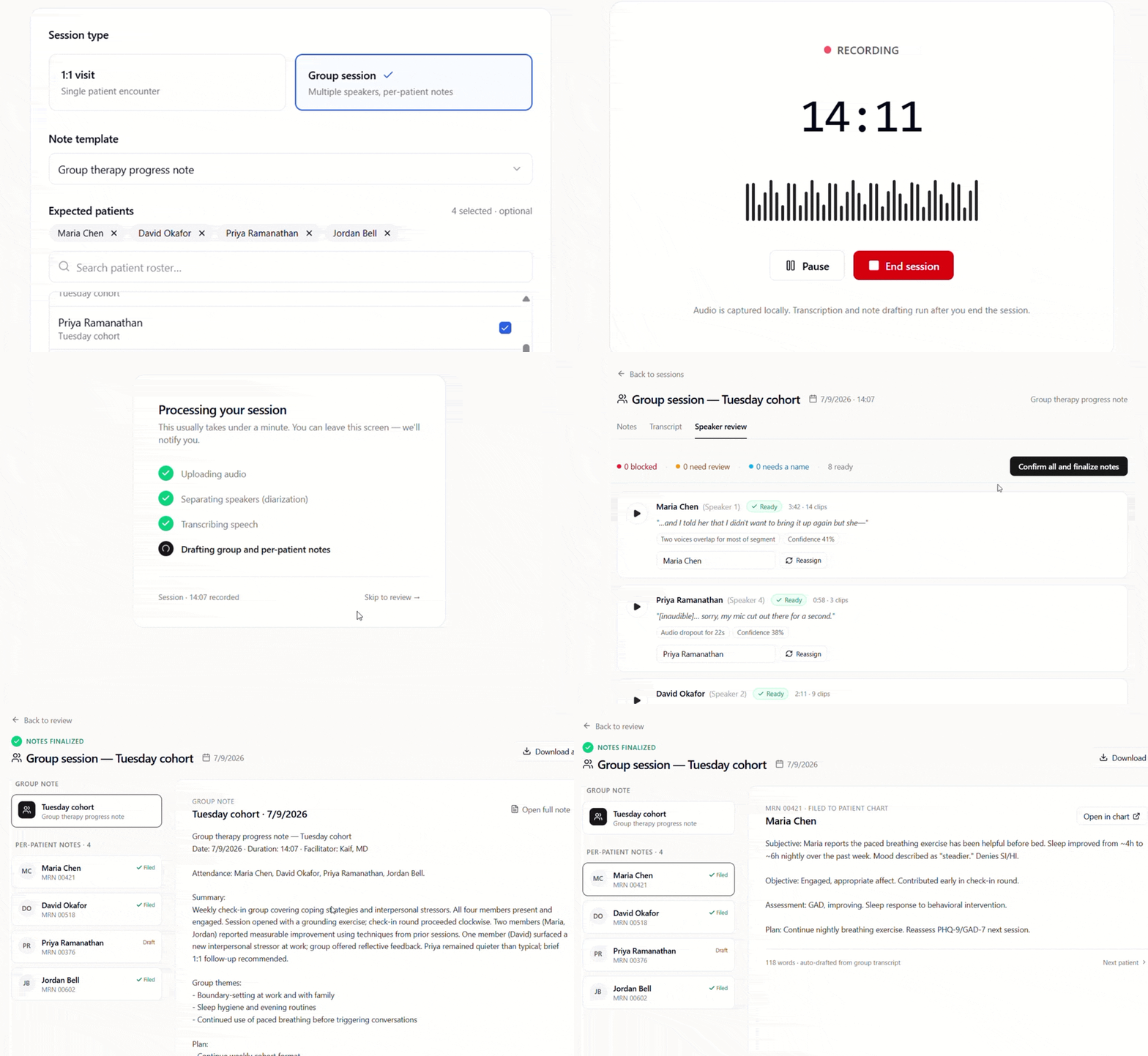
This eliminates cross-patient PHI leakage in both notes and exports. No competitor preserves speaker binding through the DOM mapping step. That gap is where audit failures live.
Book a quick 15 minutes Scribing.io Pro demo with our Solutions Expert →
Interactive Speaker Review Dashboard
Our diarization engine captures and labels each speaker with a confidence score. The Interactive Speaker Review Dashboard lets facilitators correct misattributions before any note generates. Accuracy is locked before output.
The Dual-Output View is the core differentiator for group modalities. It produces one Master Group Summary and separate Per-Patient Progress Notes simultaneously. Both derive from a single recording.
The Master Summary captures shared themes, facilitated interventions, and skills taught to the whole group.
Each Per-Patient Note isolates individual attendance, engagement level, diagnosis linkage, and personalized plan.
Confidence review flags low-certainty utterances so the clinician confirms attribution before sensitive content routes anywhere.
Clinical Logic Masterclass: The IOP Group
Consider a high-stakes IOP group running sixty minutes in hybrid telehealth and in-person format. Ten attendees present with co-occurring SUD and MDD. The roster loads pre-session via the Chrome extension.
Audio is captured and diarized with confidence review active throughout. During session Patient R discloses a weekend alcohol relapse. Patient J reports passive suicidal ideation with no plan.
Other members discuss coping skills and distress tolerance techniques. After speaker review, Scribing.io generates the Master Group Summary. It then produces ten individualized Per-Patient Progress Notes.
Patient R's relapse appears only within R's own note. Patient J's note auto-triggers the risk pathway with Columbia-Suicide Severity prompts and safety plan fields. Every other note excludes R and J content entirely.
This exclusion satisfies Part 2 inference isolation at the note level. No attendee can be identified from another's chart. The outcome is zero cross-patient PHI leakage from one recording.
Per-Patient Note Structure
Field | Source | Isolation Rule |
|---|---|---|
Attendance and start/stop | Rostered check-in | Individual timestamp preserved |
Engagement level | Diarized speaker turns | Own utterances only |
Diagnosis linkage | Chart problem list | Patient-specific |
Individualized goals and response | Treatment plan match | No cross-patient inference |
Risk actions | Auto-triggered pathway | Only in affected patient note |
Technical Configuration for Restrictive EMRs
Restrictive platforms like Behave Health block standard automation on their charting DOM. Our Chrome extension maps discrete fields using configured selectors. This bypasses write-back friction cleanly.
Review our full walkthrough for the Behave Health Integration before deployment. For Kipu programs, follow the Kipu AI Workflow. Both preserve speaker segmentation into discrete fields.
The configuration logic below shows the DOM selectors used to route each discrete field. Segmentation binding travels with every mapped value. No content crosses patient boundaries during write-back.
The suppressCrossPatient flag enforces isolation at the moment of injection. Even if a transcript segment references another member, it never renders. Segmentation is preserved end to end.
Audit Defense and Claim Support
One-click write-back maps attendance, start and stop times, interventions, risk actions, and plan into discrete Behave Health or Kipu fields. Discrete data beats free-text narrative for surveys. Auditors can trace every element.
Claim support generates payer-ready 90853 codes for eligible facilitators. Telehealth visits append modifier 95 and correct the place of service where required. Clean claims flow from a single group recording.
Individualized language proves each patient's unique participation, defeating the cloned-note citation entirely.
Discrete timestamp fields verify session duration against the billed group therapy unit.
Auto-triggered risk documentation demonstrates that safety protocols followed disclosure in real time.
ROI and Operational Payoff
Preventing a single cloned-note clawback often exceeds a year of platform cost. Add reclaimed clinician hours and the math compounds fast. Model your own numbers precisely.
Use our transparent tool to quantify the return with the AI Scribe ROI Calculator. Enter group volume and clinician count. The output reflects both compliance risk and time savings.
The strategic outcome is compliant documentation, zero cross-patient PHI leakage, and clean claims at scale. Cloned notes become structurally impossible. Your program survives any tracer.

