Posted on
Apr 2, 2026
Can Patients Refuse AI Scribing? A Provider's Guide to Consent & Compliance
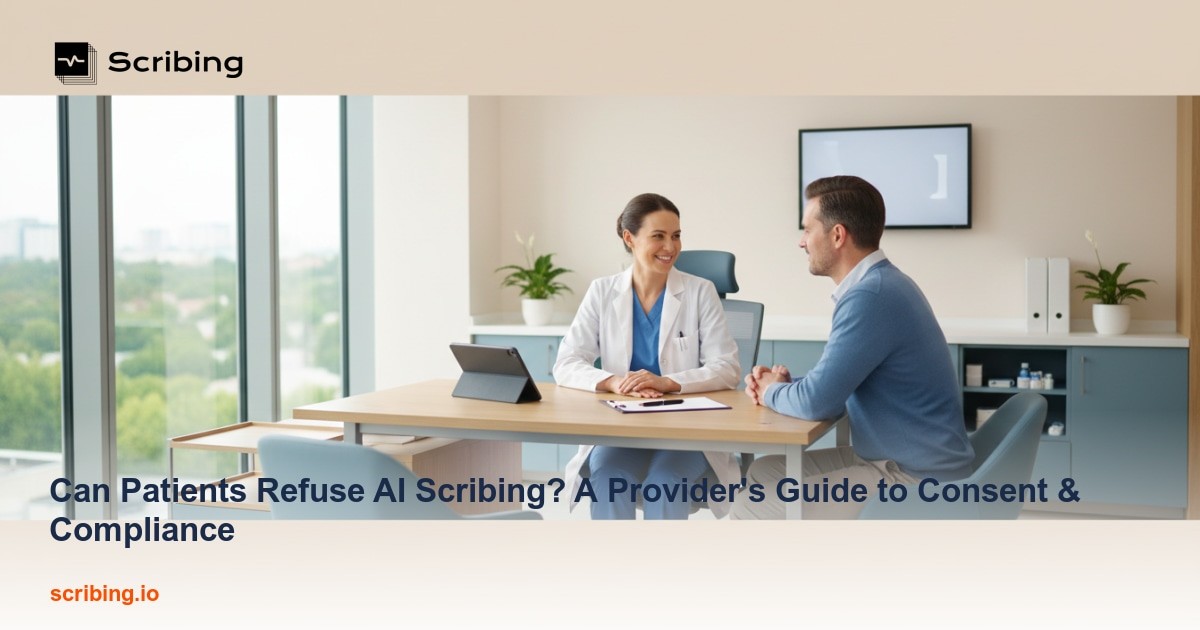
Can Patients Refuse AI Scribing? A Provider's Guide to Consent, Objections, and Workflow
As AI-powered clinical documentation becomes standard across specialties, one question surfaces in nearly every practice meeting: what happens when a patient says no? Platforms like Scribing.io are designed with patient consent workflows built in, but the broader legal, ethical, and operational landscape around patient refusal deserves careful attention from every clinician using ambient AI tools.
The short answer is unambiguous: yes, patients can refuse AI scribing, and they have every right to do so. What matters is how you handle that refusal — because your response shapes trust, affects compliance, and determines whether AI documentation remains a sustainable part of your practice. This guide, built for providers using tools like Scribing.io, covers the legal framework, the psychology behind objections, word-for-word consent scripts, and a practical workflow for when patients decline.
Yes, patients can refuse AI scribing — and they have every right to. Understanding the legal, ethical, and practical dimensions of patient refusal is critical to maintaining trust, staying compliant, and keeping your workflow efficient. This guide breaks down the consent landscape state by state, gives you word-for-word scripts for handling objections, explains what to do when a patient says "no," and shows how choosing a privacy-first AI scribe platform minimizes objections in the first place.
Yes, Patients Can Refuse AI Scribing — Here's What Providers Need to Know
The Legal Landscape — Consent Requirements by State
Why Patients Object — The 5 Most Common Concerns
Your Consent Script Playbook — What to Say (And What Never to Say)
What Happens When a Patient Says No — Your Workflow Contingency Plan
How Privacy-First AI Scribes Minimize Refusals
Get Started Today
Yes, Patients Can Refuse AI Scribing — Here's What Providers Need to Know
No federal law currently mandates AI scribe use. Consent is not just a regulatory box to check — it is a foundational ethical requirement in clinical documentation. A patient can refuse AI-assisted documentation at any point during a visit: before it starts, mid-conversation, or retroactively by asking that it not be used in future encounters.
The distinction between legal requirements and ethical best practices matters here. Legal requirements vary significantly by state, as we'll detail below. Ethical best practices, however, are universal: the American Medical Association's principles on AI in medicine emphasize transparency, patient autonomy, and physician oversight as non-negotiable standards regardless of jurisdiction.
Reporting from KFF Health News confirmed that verbal consent remains the prevailing standard for AI scribe use in clinical settings, though state recording laws add meaningful complexity — particularly in states requiring all-party consent. Meanwhile, a qualitative study published in JAMA Network Open (Shah et al., 2025) documented rare but real instances of patient discomfort, including patients who initially consented but later asked that AI scribing not be used in subsequent visits.
Here's the reframe that matters: patient refusal is not a failure of your technology adoption. It's a trust-building opportunity. Providers who handle refusal gracefully — without defensiveness, delay, or inconvenience — consistently strengthen the patient-clinician relationship. The goal is never 100% adoption. The goal is 100% informed consent.
State-level rules matter significantly here. See our deep dive on California's specific AI scribe consent and recording requirements for one of the most complex regulatory environments.
The Legal Landscape — Consent Requirements by State
The legal framework governing AI scribing consent hinges on a concept most providers already know from other contexts: recording consent laws. Because ambient AI scribes record and process the audio of clinical conversations, they fall squarely within state wiretapping and eavesdropping statutes.
One-Party vs. Two-Party Consent
One-party consent states allow recording of a conversation as long as one participant (in this case, you, the clinician) consents. Legally, you could activate an ambient AI scribe without explicitly informing the patient. But "legally permissible" and "clinically appropriate" are not the same thing. Institutional policies, malpractice risk, and ethical standards almost always require patient notification and agreement even in one-party states.
Two-party (all-party) consent states require every participant in a conversation to agree to recording. In these jurisdictions — including California, Florida, Illinois, Pennsylvania, Washington, and several others — recording without explicit consent can carry civil liability and, in some states, criminal penalties. This is not hypothetical risk; it is enforceable law.
One-Party vs. Two-Party Consent: Quick Reference for AI Scribe Use | |||
Consent Type | Notable States | Legal Requirement for AI Scribing | Best Practice |
|---|---|---|---|
One-Party Consent | Texas, New York, Ohio, Georgia, North Carolina, and most other states | Clinician's own consent to record may suffice legally | Still obtain explicit verbal patient consent and document it |
Two-Party (All-Party) Consent | California, Florida, Illinois, Pennsylvania, Washington, Connecticut, Maryland, Massachusetts, Michigan, Montana, New Hampshire, Oregon | Explicit patient consent required before any recording begins | Obtain consent, document it, offer opt-out at any time |
It's worth noting that institutional policies often layer additional consent requirements on top of state law. Large hospital systems and health networks frequently require signed consent forms, specific EHR documentation of consent, or standardized disclosure language — even in one-party consent states.
Federal HIPAA regulations govern how recorded data is stored, transmitted, and used, but HIPAA itself does not specifically address the act of ambient recording. That regulatory gap is filled by state law. This is precisely why understanding your state's specific requirements is non-negotiable. California is one of the strictest two-party consent states — here's exactly what that means for your practice.
Recommended best practice regardless of state: always obtain explicit verbal consent, document it in the chart, and offer to pause or disable the tool at any time. This approach protects you legally in every jurisdiction and demonstrates the kind of patient-centered practice that builds long-term trust.
Why Patients Object — The 5 Most Common Concerns (And the Psychology Behind Them)
Understanding why patients refuse is just as important as knowing how to handle it. Most competitor resources on this topic are written for patients. This section is written for you — the provider who needs to anticipate objections and respond with empathy, not defensiveness.
1. Privacy and Surveillance Fears
Patients worry about who hears the recording and where it goes. This concern is rooted in broader societal distrust of technology companies and data harvesting — not in distrust of you personally. When a patient says "I don't want to be recorded," they're often expressing anxiety about a system, not rejecting your clinical judgment.
2. Data Misuse and De-Identification Skepticism
As KFF Health News has reported, some AI scribe companies can use de-identified data to improve their software — and patients frequently don't receive a clear answer about how their data is used downstream. This ambiguity fuels distrust, particularly among patients who have experienced data breaches in other contexts.
3. AI Accuracy and "Hallucination" Concerns
Patients who have read about AI errors — or experienced inaccuracies in their own records — may fear that fabricated or distorted information could enter their permanent medical record. This concern is not irrational. It's a legitimate clinical safety question, and acknowledging it directly builds credibility.
4. Sensitive Visit Content
Mental health discussions, reproductive health, substance use, sexual health, domestic violence — patients may accept AI scribing for a routine blood pressure follow-up but object strenuously during a sensitive encounter. This is not inconsistency; it's context-appropriate decision-making. Specialties like psychiatry require particular care — see how AI scribing works in psychiatric settings where patient trust is paramount.
5. Generational and Cultural Factors
Older patients, patients with limited English proficiency, and patients from communities with historical medical mistrust may have heightened resistance. The JAMA Network Open study documented that limited functionality with non-English speaking patients was a real barrier, and that some patients who initially consented later requested the tool not be used after reviewing their notes. Meeting patients where they are — culturally and linguistically — is part of informed consent.
Your Consent Script Playbook — What to Say (And What Never to Say)
Scripted language reduces variability, protects you legally, and makes the consent process feel natural rather than bureaucratic. These scripts are designed to be adapted to your communication style while preserving the essential elements of informed consent.
Recommended Introduction Script
"Before we get started, I want to let you know that I use an AI-assisted tool to help me take notes during our conversation. It listens to our discussion and creates a draft summary that I personally review and edit before anything goes into your chart. You're in complete control — I can turn it off at any time, or we can skip it entirely today. Your care won't change either way. Do you have any questions, or would you like to proceed?"
When a Patient Hesitates (Soft Objection)
"I completely understand. A lot of patients have questions about this. The tool doesn't store any audio — it generates a text draft that I review. Nothing goes into your record without my approval. Would you like to try it today, knowing you can ask me to stop at any point?"
When a Patient Declines (Firm Refusal)
"Absolutely — no problem at all. I'll take notes the way I always have. This doesn't affect your care in any way. If you ever change your mind in the future, just let me know."
Mid-Visit Pause Script (for Sensitive Topics)
"We're about to discuss something more personal. Would you like me to pause the AI scribe for this part of our conversation?"
What You Should Never Say
Never imply the visit will be shorter, faster, or "better" with AI. This can feel coercive — as if refusing creates an inconvenience.
Never present AI scribing as a default that requires opting out. Consent must be opt-in, not opt-out.
Never express frustration or inconvenience at a refusal. Even subtle sighing or schedule commentary undermines patient autonomy.
Document consent or refusal with a simple EHR notation: "Patient consented to AI-assisted documentation" or "Patient declined AI scribe; manual documentation used." This takes seconds and creates a clear medicolegal record.
What Happens When a Patient Says No — Your Workflow Contingency Plan
The question competitors ignore: what do you actually do when a patient refuses? Your AI scribe just went from active to off. The visit still needs documentation. You need a seamless fallback that doesn't add 15 minutes to your day or compromise note quality.
Step 1: Disable the Scribe Immediately and Visibly
Don't just minimize a window. Turn the tool off in a way the patient can see. With platforms like Scribing.io, this is a single tap — the session ends, no audio is retained, and the patient sees confirmation that the tool is off.
Step 2: Shift to Your Fallback Documentation Method
Every provider using an AI scribe needs a documented fallback plan. Options include:
Real-time typing: If you're comfortable with keyboard documentation during the visit.
Post-visit dictation: Use traditional voice dictation to complete notes after the encounter.
Abbreviated encounter notes completed immediately after: Jot key findings during the visit and flesh out the note within minutes of the patient leaving.
Template-based smart phrases: Pre-built EHR templates for common visit types can bridge the gap efficiently. Providers already using AI scribe integration with Epic or athenahealth often have templates ready as backups.
Step 3: Don't Extend the Visit Unnecessarily
One of the fastest ways to create implicit pressure is to let the visit run noticeably longer because you're documenting manually. Patients notice. If documentation takes longer without the AI scribe, complete the note after the visit rather than during it.
Step 4: Flag the Preference for Future Visits
Use a discrete EHR flag or patient preference note so that front-desk staff or rooming nurses can preemptively address AI scribe preferences at the next visit. This prevents the patient from having to refuse repeatedly — which itself can erode trust.
Step 5: Revisit the Conversation When Appropriate
Patients' preferences change. A patient who refuses during a sensitive mental health visit may welcome AI scribing during a routine follow-up six months later. Don't assume a single refusal is permanent — but equally, don't bring it up every visit. A reasonable cadence is re-offering once every few visits, briefly and without pressure.
How Privacy-First AI Scribes Minimize Refusals
The best way to handle patient objections is to prevent them. Not through persuasion — through platform design. The AI scribe you choose directly affects your refusal rate, because patients are responding to the tool's privacy architecture as much as they're responding to you.
Zero Audio Storage
Platforms that retain audio recordings create a fundamentally different risk profile than platforms that process audio in real time and discard it. Clinicians report that when they can truthfully tell patients "no audio is ever stored," objection rates drop significantly. Scribing.io's architecture processes the clinical conversation and generates a text note — audio is not retained after processing.
Physician-in-the-Loop Review
Patients who worry about AI "hallucinations" entering their record are reassured when you explain that every note is reviewed and edited by you before it touches the chart. This is not just a talking point — it's a clinical safety standard aligned with AMA guidance on augmented intelligence requiring physician oversight of AI-generated clinical content.
One-Tap Pause and Disable
If pausing the scribe requires navigating menus or closing applications, the moment of patient hesitation becomes an awkward operational disruption. Instant pause functionality means you can respond to a mid-visit objection in under a second — preserving conversational flow and patient dignity.
Transparent Data Practices
Can you answer clearly when a patient asks, "What happens to my data?" If your AI scribe vendor's data practices are ambiguous — especially regarding de-identified data use for model training — you inherit that ambiguity. Choose a platform with a clear, patient-facing privacy policy that you can reference with confidence.
Specialty-Specific Sensitivity
A platform designed for family medicine needs different consent workflows than one built for psychiatry or pediatrics. The ability to configure consent prompts, auto-pause triggers for sensitive topics, and specialty-specific documentation templates all reduce friction at the point of patient interaction.
Putting It Together
When your AI scribe platform is built with privacy-first architecture, informed consent becomes a 15-second conversation instead of a negotiation. Users report that objection rates are lowest when the technology itself eliminates the most common sources of patient anxiety before the conversation even begins.
Get Started Today
Patient consent around AI scribing isn't a problem to solve once — it's a practice to build into your clinical workflow permanently. The right approach combines legal awareness, empathetic communication, a reliable fallback plan, and a documentation platform engineered to make consent the easy path for both you and your patients. Scribing.io was designed for exactly this reality: privacy-first architecture, one-tap controls, zero audio retention, and built-in consent workflow support across every specialty and every plan.


