Individualizing DBT Skills Training Notes for Large Groups: The Complete Operations Playbook
Struggling to personalize DBT skills group notes at scale? Discover a proven system for individualizing DBT skills training notes for large groups efficiently.

The Complete Playbook: Individualizing DBT Skills Training Notes for Large Groups
Playbook Navigation Map
Jump directly to The DBT Documentation Reality
Explore in detail The Dual-Output Architecture
Review the walkthrough Clinical Logic Masterclass
Understand the technical DOM Configuration & EMR Bypass
Prepare for the future Part 2 Inference Isolation
Defend against the auditor Audit Defense & Billing Logic
The DBT Documentation Reality
CLINICAL UPDATE JUNE 2026: Revised for new CMS standards and Group Diarization accuracy.
Your clinicians run structured groups teaching Distress Tolerance, Emotion Regulation, and Interpersonal Effectiveness. Yet each patient's chart demands an individualized narrative. This tension defines the SUD IOP documentation crisis.
Most scribes collapse everything into a single group blob copied across eight charts. Auditors reject this as cloned documentation. CMS medical necessity reviewers flag identical narratives instantly.
Scribing.io was engineered specifically to resolve this at the sentence level. We separate the shared curriculum from each patient's unique response. This is the foundation of defensible group billing.
The Dual-Output Architecture
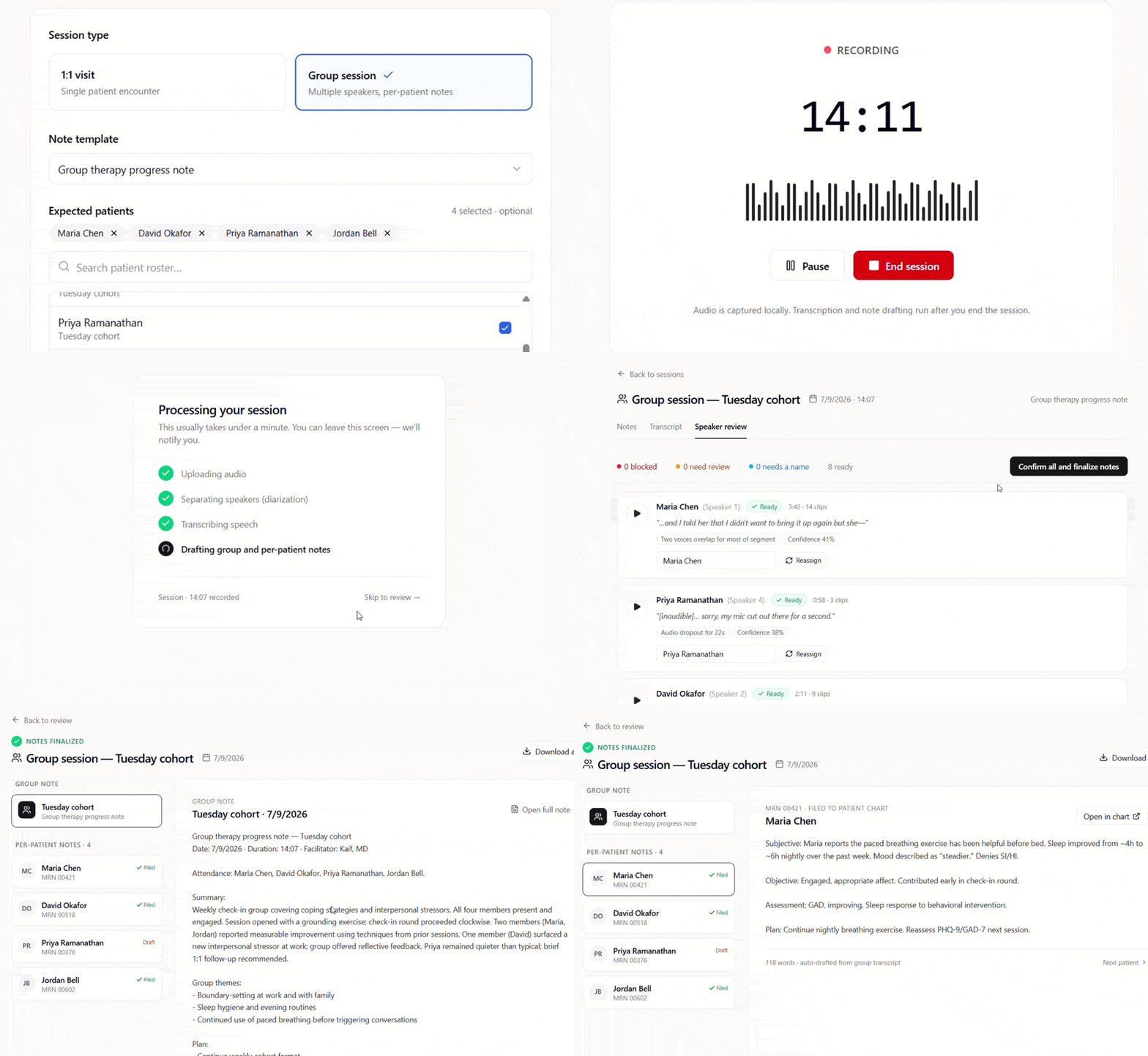
Every group session generates two artifacts from one recording. The first is a Master Group Summary. The second is a set of individualized per-patient SOAP notes.
Book a Quick 15 mins Scribing.io x Behavioral Health Workflow Demo →
The Interactive Speaker Review Dashboard
Before drafting begins, our diarization engine separates each voice in the room. The Interactive Speaker Review Dashboard displays every speaker segment for confirmation. Your clinician edits and confirms voice-to-patient mapping in seconds.
Visual timeline of speakers shows exactly who contributed and when across the 60-minute block.
One-click voice reassignment corrects any diarization ambiguity before a single note is written.
Confidence scoring per segment flags low-certainty attributions for mandatory human review.
The Dual-Output View Explained
The Master Summary captures group-level content: DBT modules taught, interventions delivered, safety screen results, and roster attendance. It intentionally excludes any Part 2–segmented detail.
The per-patient notes render individual engagement: skill acquisition, goal progress, clinical response, risk assessment, treatment plan, and precise start/stop times. Early-departure flags attach automatically to the affected patient only.
Clinical Logic Masterclass
Consider a live production scenario: an LCSW runs a 60-minute telehealth IOP DBT skills group with eight adults. This walkthrough shows exactly how the engine behaves end to end.
Pre-Session and Capture
Before the session the clinician selects the roster inside the Chrome extension. Audio uploads, diarization separates all eight speakers, and the UI confirms voice mapping. No manual name-tagging is required mid-session.
Real-Time Segmentation Logic
During drafting one patient discloses MOUD-related content within the group. That patient's disclosure is marked Part 2–segmented at the sentence level. The engine binds that segment away from the shared Master Summary.
Dual-Output Generation
The Master Group Summary compiles DBT topics, interventions, the safety screen, and attendance—while excluding all segmented MOUD detail.
Each individualized SOAP note captures personal goals, clinical response, risk, plan, start/stop times, and early-departure status.
Billing logic recommends 90853 only for attendees who meet duration and participation thresholds, mapping telehealth POS and modality attestations per payer policy.
One click then writes discrete fields into Behave Health or Kipu across the group encounter and each patient's chart. Per-patient provenance and consent artifacts are preserved automatically. Review our full Kipu AI Workflow for field-level detail.
DOM Configuration & EMR Bypass
Restrictive EMRs like Behave Health block standard paste and injection behaviors. Our Chrome extension bypasses these through validated DOM selector mapping. This preserves discrete-field entry rather than free-text dumps.
The configuration logic below demonstrates how group and per-patient fields target distinct DOM nodes. Each patient's note routes to their own MRN chart element.
Full technical bypass procedures live in our Behave Health Integration guide. It documents selector fallbacks for locked iframes and shadow DOM containers.
Part 2 Inference Isolation and FHIR Provenance
Competitors treat a group note as one indivisible artifact. When a single patient discusses MOUD, that content contaminates all eight charts. This is the industry's most dangerous compliance gap.
Scribing.io segments sentence-level PHI by attendee. Each segment binds to a patient-scoped Provenance and Consent record. Only permissible slices export to each MRN.
Per-patient FHIR Provenance resources record who authored, who consented, and which segment routed where.
42 CFR Part 2 segregation holds because MOUD disclosures never enter the shared Master Summary artifact.
TEFCA and QHIN exchange readiness is preserved by exporting only consented, provenance-bound slices for 2026 interoperability.
Capability | Legacy Group Scribes | Scribing.io V6 |
|---|---|---|
PHI segmentation granularity level | Whole-note | Sentence-level per attendee |
Part 2 MOUD isolation method | Manual redaction | Automated inference isolation |
Provenance binding per patient | None | FHIR Provenance + Consent |
TEFCA / QHIN exchange readiness | Not supported | 2026-ready slice export |
Audit Defense & Billing Logic
The forensic logic behind 90853 demands proof each attendee met duration and participation thresholds. Our engine attaches per-patient start/stop times and engagement evidence. Cloned narratives are structurally impossible.
When a payer requests records, each chart tells a distinct clinical story bound to verifiable provenance. Early-departure flags automatically adjust billing recommendations downward. This protects you from clawbacks and recoupment audits.
Quantify the financial impact directly using our AI Scribe ROI Calculator. Recovered clinician hours and reduced audit exposure compound rapidly across a full IOP census.
This playbook establishes the operational standard for individualizing DBT skills training notes at scale. Deploy the roster selection, confirm diarization, and let dual-output do the rest. Your documentation becomes defensible, individualized, and 2026-ready.


