Posted on
Feb 9, 2025
Posted on
Jul 10, 2026

Discover the best Kipu EMR AI scribe for group progress notes, dual-output architecture, speaker review, and audit-proof logic for directors.
The Complete Playbook: Best Kipu EMR AI Scribe for Group Progress Notes
Table of Contents
Forensic Logic: Why Group Notes Fail Audit
The Dual-Output View Architecture
Interactive Speaker Review Dashboard
Clinical Logic Masterclass: The 8-Person IOP
Per-Patient 90785 Complexity Gating
Technical Configuration: Bypassing Behave Health
Audit Defense and Provenance
ROI Logic for Operations Directors
Forensic Logic: Why Group Notes Fail Audit
Most group progress notes collapse under 2026 CMS scrutiny because they are cloned. Reviewers see eight identical narratives with one name swapped. This pattern triggers immediate clawback flags across IOP and PHP programs.
CLINICAL UPDATE JUNE 2026: Revised for new CMS standards and Group Diarization accuracy.
The core failure is attribution. A single undifferentiated group note cannot prove that Patient A experienced interactive complexity while Patient F did not. Payers now demand participant-level evidence, not blanket assertions.
Diarization solves the attribution gap. Scribing.io separates every speaker into timestamped segments before any note is drafted. This creates a forensic chain linking clinical events to specific participants.
Book a Quick 15 mins Scribing.io x Kipu EMR Workflow Demo →
The Dual-Output View Architecture
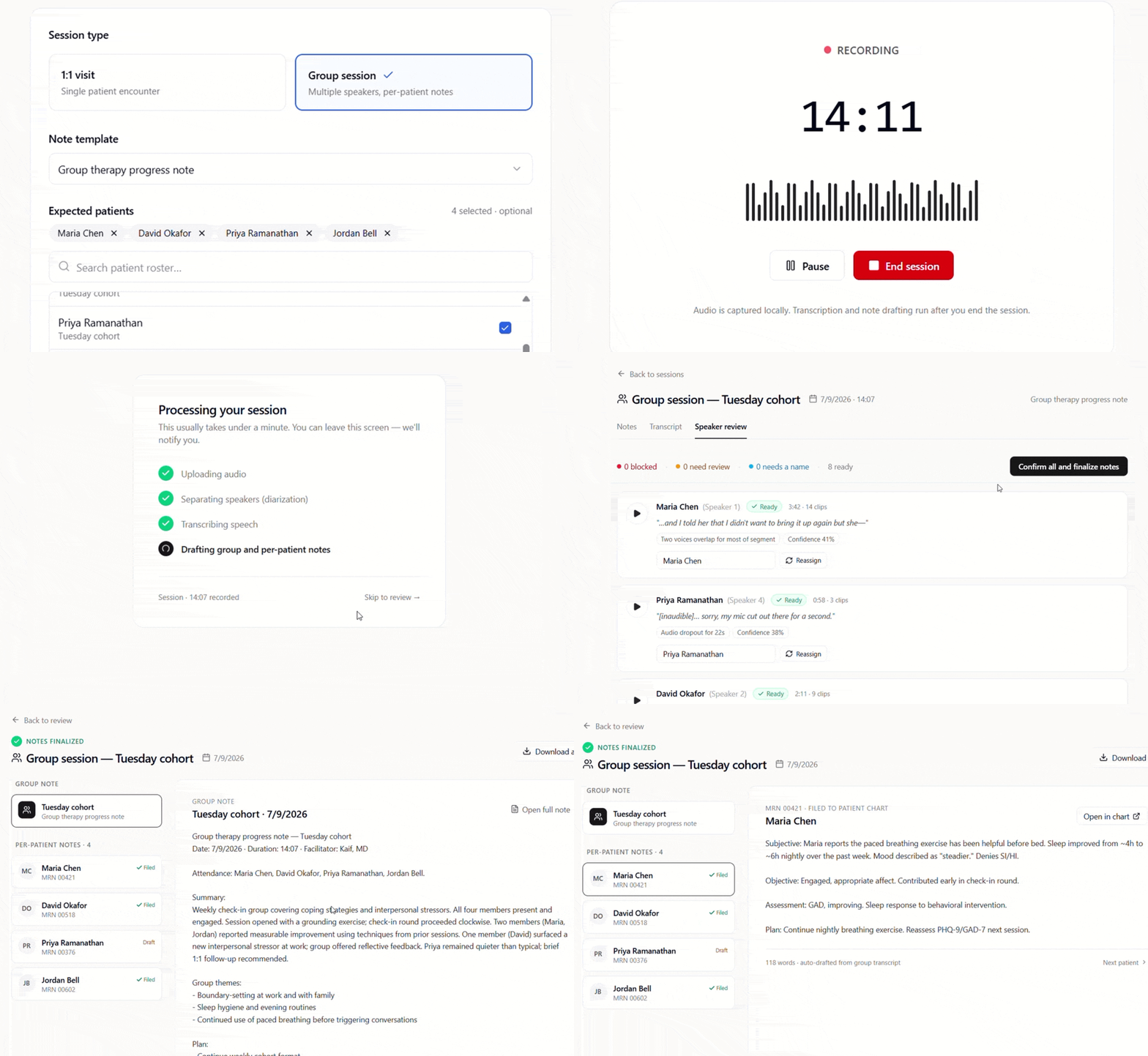
Every group session generates two artifacts from a single recording. The Master Group Summary captures shared themes, group dynamics, and the 90853 justification. The Per-Patient Notes render individualized progress documentation for each attendee.
The Master Summary never leaks PHI across participants inappropriately. It documents group-level therapeutic process while each individual note stays sealed to its owner. This dual structure satisfies both billing and privacy requirements simultaneously.
Eight patients produce nine documents. One Master Summary plus eight discrete progress notes, each carrying its own CPT logic and provenance metadata. See our Kipu AI Workflow for field-level mapping.
Interactive Speaker Review Dashboard
Diarization is powerful but imperfect. The Interactive Speaker Review Dashboard gives clinicians a visual timeline of every detected voice. Clinicians confirm or correct speaker identity in seconds, not minutes.
Color-coded speaker lanes display each participant's contribution across the full session timeline.
Drag-to-reassign segment correction lets clinicians fix misattributed statements with a single gesture.
Guardian and interpreter tagging isolates non-patient voices so they never contaminate a patient note.
Real-time confidence scoring highlights low-certainty segments that require clinician attention.
The dashboard enforces clinician oversight. No note finalizes until speaker assignments are attested. This human-in-the-loop step is what converts raw transcription into defensible documentation.
Clinical Logic Masterclass: The 8-Person IOP
Consider a hybrid telehealth IOP group of eight patients treating co-occurring depression and substance use disorder. Mid-session, Patient A's guardian joins briefly to coordinate care. Simultaneously, Patient B exhibits disruptive behavior requiring active de-escalation.
Step One: Full-Session Diarization
Scribing.io diarizes all speakers including the remote guardian and every in-room voice. Each utterance receives a timestamp and speaker label. The guardian's contribution is tagged as non-patient coordination.
Step Two: Clinician Reassignment
The clinician opens the dashboard and spots two crosstalk segments misattributed during the de-escalation moment. Two clicks reassign them to Patient B. The correction propagates instantly through the pipeline.
Step Three: Dual-Output Generation
The pipeline generates one Master Summary plus eight individualized notes. Each note references only that patient's participation. No patient's note exposes another participant's disclosures.
Step Four: Complexity Detection and Attestation
The system flags Patient A and Patient B for CPT 90785. Patient A qualifies via minor/guardian care coordination; Patient B qualifies via high-conflict disruptive behavior requiring de-escalation. Per-patient justifications insert automatically without cross-exposure.
Step Five: One-Click Write-Back
The clinician approves and writes back to Behave Health and Kipu discrete fields in one action. The result is a clean 90853 for all eight patients. The 90785 add-on applies only to A and B, backed by timestamped provenance ready for audit.
Per-Patient 90785 Complexity Gating
Interactive Complexity is the fault line where competitors fail entirely. CPT 90785 is an add-on that must be justified per participant, never per group. Our diarization-backed engine gates it at the individual level.
The system auto-detects qualifying triggers from the diarized transcript itself. It does not guess from a summary. It reads the evidence.
High-conflict verbal exchanges signal potential de-escalation complexity for the involved participant.
Interpreter presence in a segment flags communication barrier complexity for that specific patient.
Minor or guardian coordination events trigger family-management complexity for the affected patient only.
Disruptive behavior interventions detected in a speaker lane prompt attestation for that patient.
Each detection prompts clinician attestation before any code is written. The clinician confirms the criterion applies. This attestation, plus the timestamp, becomes the audit artifact.
Capability | Scribing.io | Generic Group Scribes |
|---|---|---|
Participant-level 90785 gating | Yes, diarization-backed | No, group-level only |
Per-patient justification isolation | Yes, no cross-exposure | No, single shared note |
Timestamped provenance chain | Yes, segment-linked | No |
Discrete EHR field write-back | Yes, Kipu and Behave | Rarely, free-text only |
Technical Configuration: Bypassing Behave Health
Restrictive EMRs block programmatic writes and hide discrete fields behind dynamic DOM nodes. Behave Health is notoriously restrictive on write-back paths. Our Chrome DOM selector layer maps fields reliably.
The configuration logic targets stable attributes rather than volatile class hashes. This survives EMR UI updates. Full detail lives in our Behave Health Integration guide.
The batchWrite flag commits all patients in a single authorized transaction. This eliminates repetitive per-note logins on locked EMRs. Provenance stamps attach automatically to each discrete field.
Audit Defense and Provenance
Every code carries a defensible chain. When an auditor asks why Patient A received 90785, you produce the exact diarized segment, timestamp, and clinician attestation. The evidence lives inside the record, not in a clinician's memory.
Cross-exposure is architecturally impossible. Patient A's note contains only Patient A's evidence and the guardian coordination event. No other participant's disclosures appear. This protects both compliance and confidentiality.
Timestamped provenance withstands 2026 scrutiny. Reviewers accept segment-linked evidence far more readily than narrative assertion. Your denial rate on Interactive Complexity add-ons drops sharply.
ROI Logic for Operations Directors
Clean 90785 capture recovers revenue that undifferentiated notes leave on the table. Every legitimately gated add-on is defensible income, not audit risk. Model the impact with our AI Scribe ROI Calculator.
Clinician time drops dramatically per group. Nine documents generate from one recording in minutes, not the hours of post-session charting your staff currently absorbs. That reclaimed time expands census capacity.
The compliance dividend compounds silently. Every clean, provenance-backed note reduces future clawback exposure across your entire IOP and PHP census. That protection is the strongest ROI line no spreadsheet fully captures.

