Posted on
Feb 9, 2025
Posted on
Jul 11, 2026

Discover the best NetSmart myAvatar AI scribe for group therapy—solving overlapping speech, IOP/PHP documentation, and 42 CFR Part 2 audit risk.
The Complete Playbook: Best NetSmart myAvatar AI Scribe for Group Therapy
Built for Behavioral health directors, this playbook solves the single hardest documentation problem in IOP/PHP settings. Group therapy generates overlapping speech, shared narratives, and 42 CFR Part 2 liability. Scribing.io was engineered specifically to neutralize all three.
Every clinical director running SUD knows the audit exposure hidden inside group notes. This document shows you the exact configuration, logic, and defensibility framework we deploy. Read it as an operational standard, not marketing.
Table of Contents
Jump to the core — Forensic Logic of Group Diarization
Jump to the demo — Clinical Logic Masterclass
Jump to the tech — Technical Configuration & DOM Selectors
Jump to the gap — Why Naive Note-Splitting Fails
Jump to defense — Audit Defense & Provenance
Jump to the dashboard — Interactive Speaker Review Dashboard
Jump to the math — ROI & Deployment Metrics
Forensic Logic of Group Diarization
CLINICAL UPDATE JUNE 2026: Revised for new CMS standards and Group Diarization accuracy.
Group therapy documentation is fundamentally different from a 1:1 encounter. One recording contains ten legally distinct medical records. Any tool that treats it as a single transcript is generating latent compliance debt.
The forensic requirement is speaker attribution with provenance you can defend in a post-payment audit. Each utterance must map to a verified attendee before a note ever exists. This is the architectural foundation of Scribing.io.
Scribing.io's diarization engine timestamps every speaker and links each segment to a pre-selected roster identity. When confidence drops below threshold, the system flags rather than guesses. Guessing is how PHI gets redisclosed into the wrong chart.
Book a Quick 15 mins Scribing.io x NetSmart myAvatar Workflow Demo →
Clinical Logic Masterclass
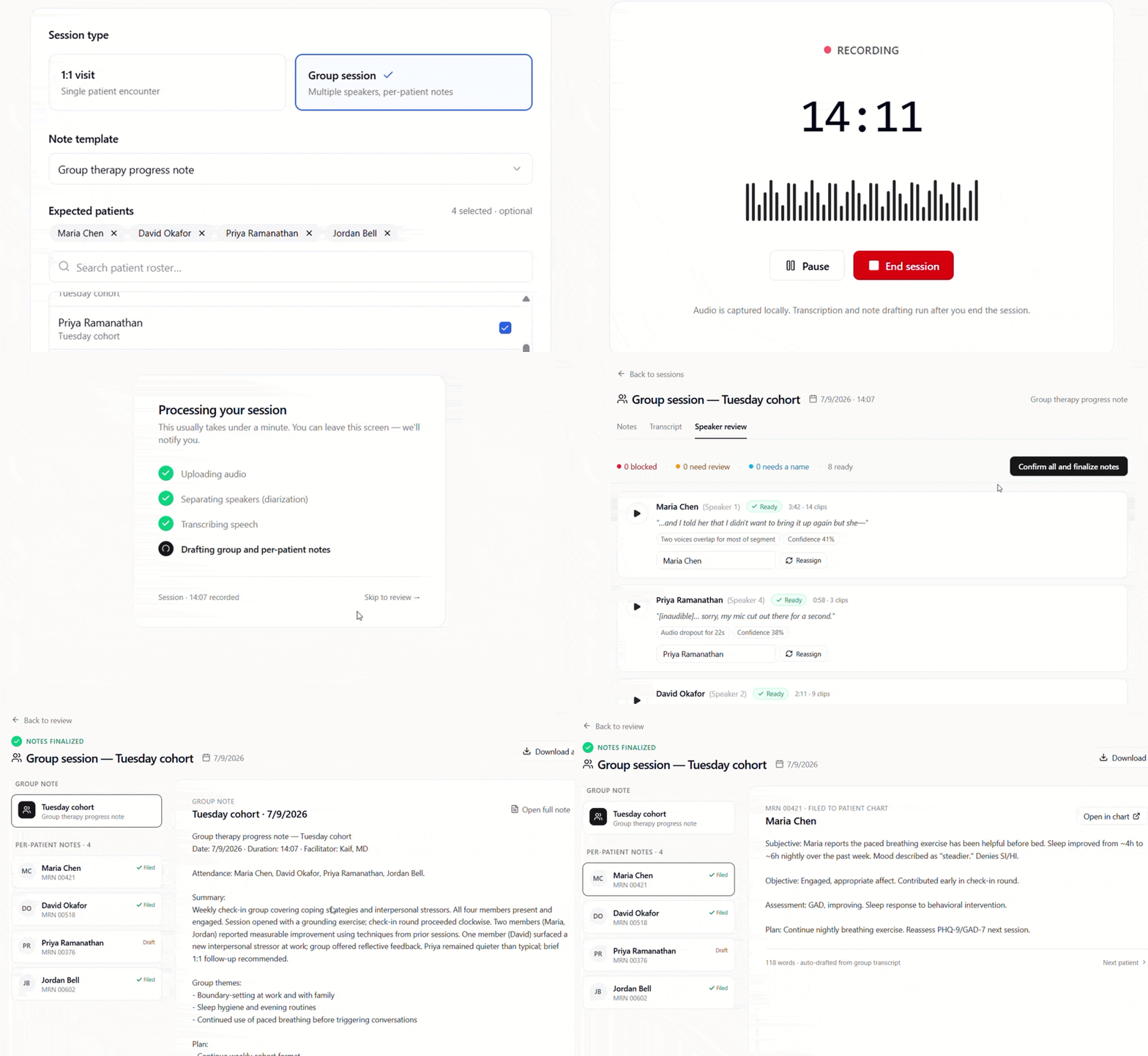
Consider a real IOP scenario unfolding exactly as your clinicians experience it. An IOP runs a 60-minute hybrid group with 10 attendees, two of whom carry SUD diagnoses protected under 42 CFR Part 2. The clinician launches Group Session directly from the Chrome extension.
Pre-selection of attendees happens first, binding the roster to the recording before audio begins. The clinician hits record and runs the group normally. No workflow disruption, no manual timestamping.
After capture, auto-diarization processes the session and flags two low-confidence speakers in the UI. The clinician reassigns them in under fifteen seconds via the review dashboard. Attribution is now locked and provenance-stamped.
Scribing.io then generates the Dual-Output View: one Master Group Summary plus ten individualized progress notes. In Patient A's note, the system documents their specific relapse trigger and safety plan. This is their record, and only their record.
Here is the critical isolation behavior: in the other nine notes, every reference to Patient A is automatically removed through inference isolation. Yet each note still captures that patient's own participation, goals, clinician interventions, and time-in/time-out for CPT 90853. No cross-contamination, full billing fidelity.
One click injects discrete fields into Kipu or Behave Health with immutable provenance attached. When the insurer's post-payment audit arrives, each chart stands alone. No cross-chart contamination, no redisclosure, no clawback.
Technical Configuration & DOM Selectors
Restrictive EMRs like Behave Health and myAvatar frequently sandbox their form fields or block third-party write-back. Our extension uses DOM-scoped selectors to inject discrete data cleanly. This bypasses restrictive containers without breaking EMR integrity.
The configuration logic below shows how we target group note fields while respecting per-patient isolation boundaries. Deploy this per-EMR profile during onboarding.
The shadowDOMPierce flag is essential for EMRs nesting note fields inside protected iframes. See our full Behave Health Integration guide for edge-case selectors. The same profile pattern extends to our Kipu AI Workflow.
Why Naive Note-Splitting Fails
Competitors take a shortcut that fails audits. They generate one multi-subject note and split it naively across attendees. This leaves fragments of every patient's disclosures inside every other patient's chart.
That approach is a Part 2 redisclosure event waiting to be discovered. If Patient B's chart references Patient A's SUD history, you have violated federal statute. Naive splitting cannot detect or remove those references.
Scribing.io enforces true inference isolation at three layers, described below.
Layer | Competitor (Naive Split) | Scribing.io (Isolation) |
|---|---|---|
Speaker attribution linkage | Best-guess, no provenance | Diarization-linked provenance per segment |
Narrative segmentation timing | Post-hoc string split | Per-patient segmentation at export |
EHR write-back scope | Bulk paste, cross-visible | DOM-scoped, chart-isolated |
Billing capture | Shared time block | Per-patient time-in/out for 90853 |
The result is a defensible record where no attendee's PHI or SUD detail is redisclosed. Each note still maps objective attainment and participation to 90853 audit fields. This is the information gain competitors structurally cannot replicate.
Audit Defense & Provenance
Post-payment audits target group billing because it is the easiest place to find documentation gaps. Insurers demand proof each attendee actively participated and received distinct clinical intervention. Generic split notes cannot supply this.
Our immutable provenance hash chains every documented statement back to a verified speaker segment. When challenged, you produce lineage, not a rewritten summary. This transforms audit from threat to formality.
Per-patient time-in and time-out fields satisfy the CMS unit requirements for 90853 automatically. Each note stands as an independently defensible artifact. The audit passes without any cross-chart exposure.
Interactive Speaker Review Dashboard
The dashboard is the clinician control point between raw capture and locked documentation. It displays the diarized timeline with confidence scores per speaker. Low-confidence segments surface at the top for immediate correction.
Reassigning a mislabeled speaker takes one drag, and the change propagates through all downstream notes instantly. This is where accuracy is enforced by the human, not assumed by the machine. Thirty seconds of review protects ten charts.
The Dual-Output View lives here too, letting the director toggle between Master Summary and any individual patient note. You verify isolation visually before export. Confirm no cross-references, then commit.
Master Summary tab shows group theme, clinician interventions, and collective dynamics.
Per-Patient tab shows individual participation, goals, safety planning, and 90853 time fields.
Confidence flags highlight speakers needing reassignment before any note locks.
ROI & Deployment Metrics
A single reclaimed clinician hour per group session compounds fast across a full IOP schedule. Ten-patient groups previously cost 40+ minutes of post-session charting. Scribing.io compresses that into a two-minute review.
Reduced clawback exposure adds hidden value that most directors underestimate. One failed Part 2 audit can exceed a year of software cost. Model your real numbers with our AI Scribe ROI Calculator.
Deploy the myAvatar profile first, validate isolation on a live group, then scale. Your clinicians document faster and your charts survive audit. That is the entire mandate of this playbook.
Return to the top of the V6 Operations Playbook.

