Posted on
Feb 9, 2025
Posted on
Jul 13, 2026

Best Qualifacts Credible AI scribe for IOP clinics. A definitive ops playbook covering 42 CFR Part 2 compliance, group notes, and workflows.
The Definitive Operations Playbook: Best Qualifacts Credible AI Scribe for IOP Clinics
Playbook Navigation Map
Forensic Logic: Why IOP Documentation Breaks
42 CFR Part 2 Inference Isolation
Interactive Speaker Review Dashboard
Clinical Logic Masterclass
Technical Configuration Layer
Audit Defense for 90853
ROI and Operational Rollout
Forensic Logic: Why IOP Documentation Breaks
CLINICAL UPDATE JUNE 2026: Revised for new CMS standards and Group Diarization accuracy.
Group psychotherapy documentation is fundamentally a diarization problem disguised as a compliance problem. Qualifacts Credible captures the encounter, but the intelligence layer must separate ten voices cleanly. Without that separation, your notes collapse into a single blended narrative.
Most vendors produce one note for the entire group session. This creates an immediate 42 CFR Part 2 exposure because Patient A's lapse bleeds into Patient B's chart. Auditors treat this as an unauthorized PHI disclosure, not a clerical error.
Your clinical operations exposure compounds when talk-time attribution and attendance are missing. CMS reviewers reviewing 90853 want per-participant evidence of active clinical work. A blended summary cannot survive that scrutiny.
The 2026 Inference Isolation Standard
The defining technical gap remains 42 CFR Part 2–aligned segmentation for group sessions. Scribing.io closes this with Inference Isolation, which auto-segments, redacts, and exports per-patient outputs. No cross-participant PHI is ever disclosed in any single chart.
Inference Isolation preserves the audit chain that most vendors destroy. It captures per-participant attendance and speaker attribution while stripping foreign clinical references. You retain defensibility without creating disclosure liability.
This is the operational difference between a blended note and an audit-ready record. Where competitors output one document, Scribing.io outputs ten isolated notes plus a governance-grade master. That architecture is purpose-built for IOP and PHP.
The Interactive Speaker Review Dashboard
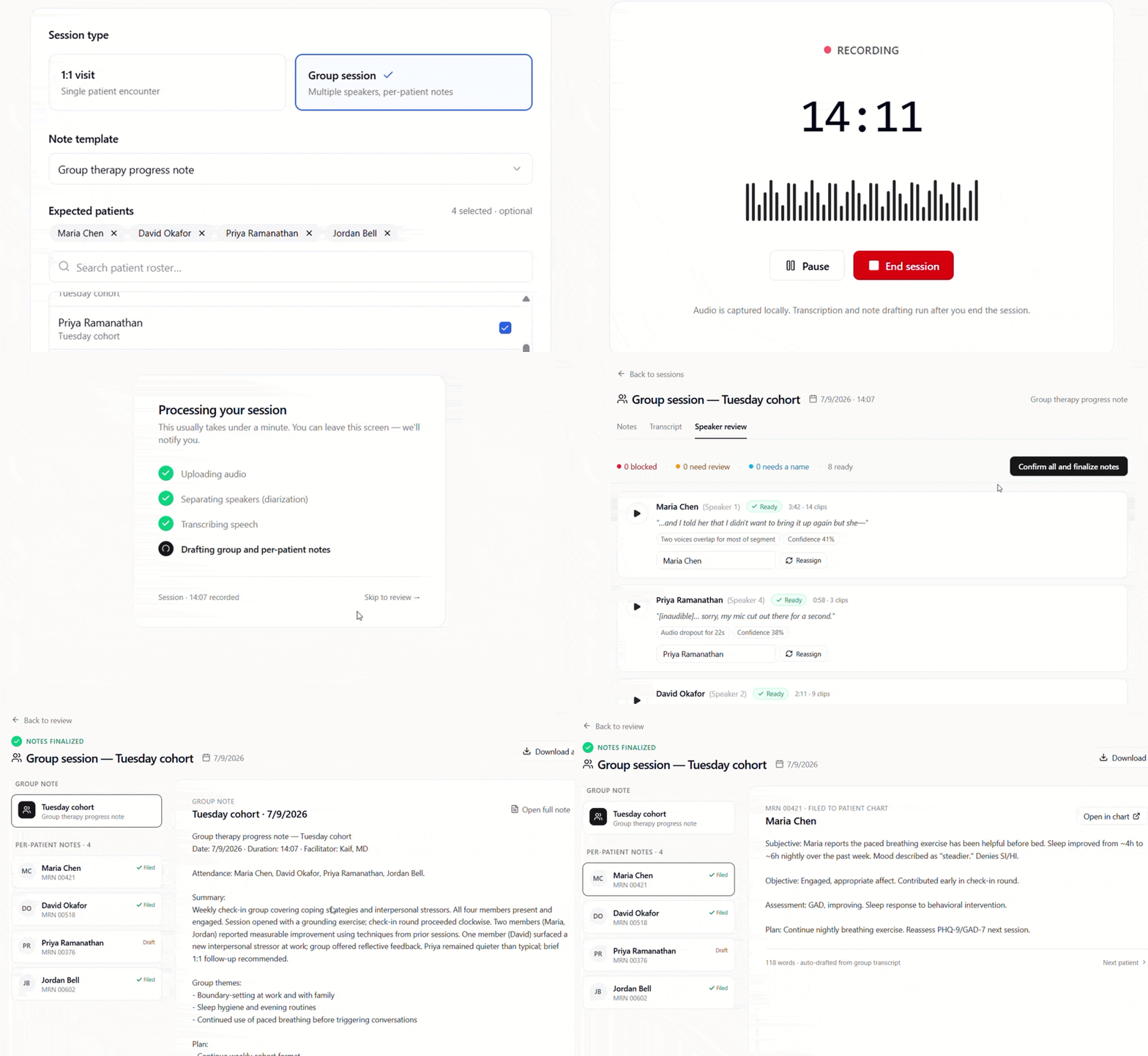
Behavioral Health rehab groups demand human verification before anything reaches the chart. The Interactive Speaker Review Dashboard displays every diarized contribution mapped to a participant. Your clinician confirms or reassigns speakers in seconds.
The Dual-Output View is central to this workflow. It generates two synchronized artifacts from one verified transcript. Nothing is duplicated or re-entered.
Master Group Summary for QA: a governance-level overview capturing group theme, interventions delivered, and session-wide dynamics for utilization review.
Per-Patient Individualized Notes: discrete goals, interventions, responses, and risk actions isolated to each participant with zero cross-PHI leakage.
This dual architecture eliminates the single blended note problem entirely. Your QA team reviews the master; your compliance chart holds only the isolated individual notes. One session, two audit-appropriate outputs.
Clinical Logic Masterclass: The Evening IOP SUD Group
Consider a live IOP SUD evening group with ten patients. During session, Patient A reports an opioid lapse alongside passive suicidal ideation. Patient B, meanwhile, shows minimal engagement throughout.
Scribing.io diarizes every contribution first, attributing statements to specific speakers. The clinician opens the Speaker Review Dashboard and verifies each assignment. This human-in-the-loop step is non-negotiable for defensibility.
Book a Quick 15 mins Scribing.io x Qualifacts Credible Workflow Demo →
Dual-Output then generates both artifacts automatically from that verified transcript. The Master Group Summary flows to QA for utilization tracking. The per-patient notes populate individually with goals, interventions, responses, and documented risk actions.
Inference Isolation strips every reference to Patient A's lapse and SI from all other participants' notes and exports. Patient B's minimal engagement is documented in Patient B's note only. No foreign clinical content contaminates any chart.
The attendance ledger and talk-time attribution are captured per participant simultaneously. This gives you objective evidence of active clinical involvement for each member. That evidence is precisely what 90853 audits require.
One-click EHR Injection then writes each patient's discrete problems, goals, plan, and attendance fields directly into Behave Health Integration or the Kipu AI Workflow. Documentation lands audit-ready with no cross-PHI leakage. Ten defensible notes ship from one verified session.
Technical Configuration Layer: Bypassing Restrictive EMRs
Restrictive EMRs like Behave Health often block programmatic field injection with hardened DOM structures. Scribing.io resolves this with a Chrome DOM selector map that targets discrete note fields reliably. This configuration bypasses the injection blocks without hacking the underlying EMR.
The isolation flag enforces PHI boundaries at the injection layer, not just the transcript. Even if the EMR renders a shared group screen, each write targets only the active patient container. Cross-contamination becomes structurally impossible.
Set the audit_chain to preserve speaker attribution and attendance metadata during every write. This ensures the per-participant evidence survives into the permanent record. Your audit defense is baked into the injection itself.
Audit Defense for 90853 Group Psychotherapy
CMS reviewers auditing 90853 want proof of individualized clinical work inside a group format. The per-patient note plus talk-time ledger delivers exactly that evidence. Each chart stands alone under review.
Audit Requirement | Blended-Note Vendors | Scribing.io V6 |
|---|---|---|
Per-patient individualized note | No — single narrative | Yes — isolated per participant |
42 CFR Part 2 PHI isolation | No — cross-PHI leakage | Yes — Inference Isolation |
Attendance ledger per member | Manual entry | Auto-captured |
Talk-time attribution evidence | Absent | Diarized and logged |
Risk action documentation | Buried in group note | Isolated to affected patient |
Patient A's SI documentation must show a specific risk action in Patient A's chart only. Scribing.io logs the passive SI, the clinical response, and the safety plan discretely. That record satisfies both the payer and the licensing board.
ROI and Operational Rollout
Your clinicians reclaim the evening hours lost to writing ten notes from a single group. One verified session produces ten compliant charts in minutes. That time recovery directly reduces documentation attrition and burnout.
Quantify the financial impact directly using the AI Scribe ROI Calculator. Most IOP programs recover the platform cost within the first billing cycle. The clean 90853 documentation also reduces clawback risk materially.
Roll out in three disciplined phases to protect data integrity from day one. Begin with dashboard verification training, then enable Dual-Output, then activate EHR Injection. This sequence builds clinician trust before automation scales.
Phase one covers speaker verification: clinicians practice confirming diarization on the Interactive Speaker Review Dashboard before any injection.
Phase two enables Dual-Output review: QA validates Master Summaries against per-patient notes to confirm Inference Isolation performance.
Phase three activates EHR Injection: configuration writes isolated fields into Qualifacts Credible, Behave Health, or Kipu at full scale.
Scribing.io was engineered specifically for the IOP and PHP documentation reality. Group diarization, Inference Isolation, and Dual-Output are not add-ons here. They are the core architecture your compliance posture depends on.

